Live data from Hacker News

On generative algorithms

inconvergent.net

11–20 of 43 posts

Re: On generative algorithms

#11
post #2

Davinci pointed out that a tree’s thickness is constant if you slice it in a semi circle. https://fractalfoundation.org/OFC/leonardotree1.jpg That is, if you face a tree and draw a circle with your arm, and add up all the thicknesses your fingers intersect, the total will always be the same. https://www.insidescience.org/news/uncovering-da-vincis-rule...

In forestry, they teach that as "pipe model". I am unable to track down how long that observation has been known in forestry, but I found this 1964 paper that attempts to build on the observation (already known in 1964) and build a theory.

https://www.ncbi.nlm.nih.gov/pubmed/29370362

The modern understanding is that the pipe model holds only approximately.
Re: On generative algorithms

#12
post #2

Davinci pointed out that a tree’s thickness is constant if you slice it in a semi circle. https://fractalfoundation.org/OFC/leonardotree1.jpg That is, if you face a tree and draw a circle with your arm, and add up all the thicknesses your fingers intersect, the total will always be the same. https://www.insidescience.org/news/uncovering-da-vincis-rule...

That second link you gave puts it very well:

> In other words, if a tree’s branches were folded upward and squeezed together, the tree would look like one big trunk with the same thickness from top to bottom.

Absolutely fascinating!

Re: On generative algorithms

#13
post #3

Warning, this series of fantastically written articles on generative art might make you feel very small and sad compared to those who are capable of not only creating but communicating beauty like this. In other words, I highly recommend you try some generative art yourself and see that at its core, it is not that hard and YOU can do it too!

Do you have any recommendations of where to start?

Re: On generative algorithms

#14
post #10
post #6

Everyone who liked this should like to read on Generative Adversarial (Neural) Networks, generative models where a pair of neural networks are trained one against the other to learn to generate new images. This has been put to many great purposes, including artistic ones: https://towardsdatascience.com/gangogh-creating-art-with-gan...

No it's a completely different interest and skillet. Not everything can be boiled down to "datascience can fix it!". Especially when all those NNs will just generate art that's a mashup of the training data and won't have any real inspiration. Unexpected results is not inspiration.

[deleted]

Re: On generative algorithms

#15
post #3

Warning, this series of fantastically written articles on generative art might make you feel very small and sad compared to those who are capable of not only creating but communicating beauty like this. In other words, I highly recommend you try some generative art yourself and see that at its core, it is not that hard and YOU can do it too!

Do you have any recommendations of where to start?

Processing is very popular and easy to pick up for generative art. This youtube channel has some great tutorials and walkthroughs on creating various things with it: https://www.youtube.com/channel/UCvjgXvBlbQiydffZU7m1_aw

Beyond the basics, it's also quite useful to pick out a piece of art or an effect you like and attempt to recreate it. You'll learn a lot of tricks very quickly that way.

Re: On generative algorithms

#16
post #10
post #6

Everyone who liked this should like to read on Generative Adversarial (Neural) Networks, generative models where a pair of neural networks are trained one against the other to learn to generate new images. This has been put to many great purposes, including artistic ones: https://towardsdatascience.com/gangogh-creating-art-with-gan...

No it's a completely different interest and skillet. Not everything can be boiled down to "datascience can fix it!". Especially when all those NNs will just generate art that's a mashup of the training data and won't have any real inspiration. Unexpected results is not inspiration.

Using GANs for art is not necessarily limited to training on a collection of famous artists to replicate their style.

Some artists use them as another tool to process and transform their artwork https://thegradient.pub/playing-a-game-of-ganstruction/

I'm pretty sure that the invention of photography was also greeted with complaints that it lacked "real inspiration" because a photographer "just" had to choose what to take a picture of. But the real inspiration is always in what you choose your art to be, and not whether you create it by applying paint to a canvas.

Re: On generative algorithms

#17
post #11
post #2

Davinci pointed out that a tree’s thickness is constant if you slice it in a semi circle. https://fractalfoundation.org/OFC/leonardotree1.jpg That is, if you face a tree and draw a circle with your arm, and add up all the thicknesses your fingers intersect, the total will always be the same. https://www.insidescience.org/news/uncovering-da-vincis-rule...

In forestry, they teach that as "pipe model". I am unable to track down how long that observation has been known in forestry, but I found this 1964 paper that attempts to build on the observation (already known in 1964) and build a theory. https://www.ncbi.nlm.nih.gov/pubmed/29370362 The modern understanding is that the pipe model holds only approximately.

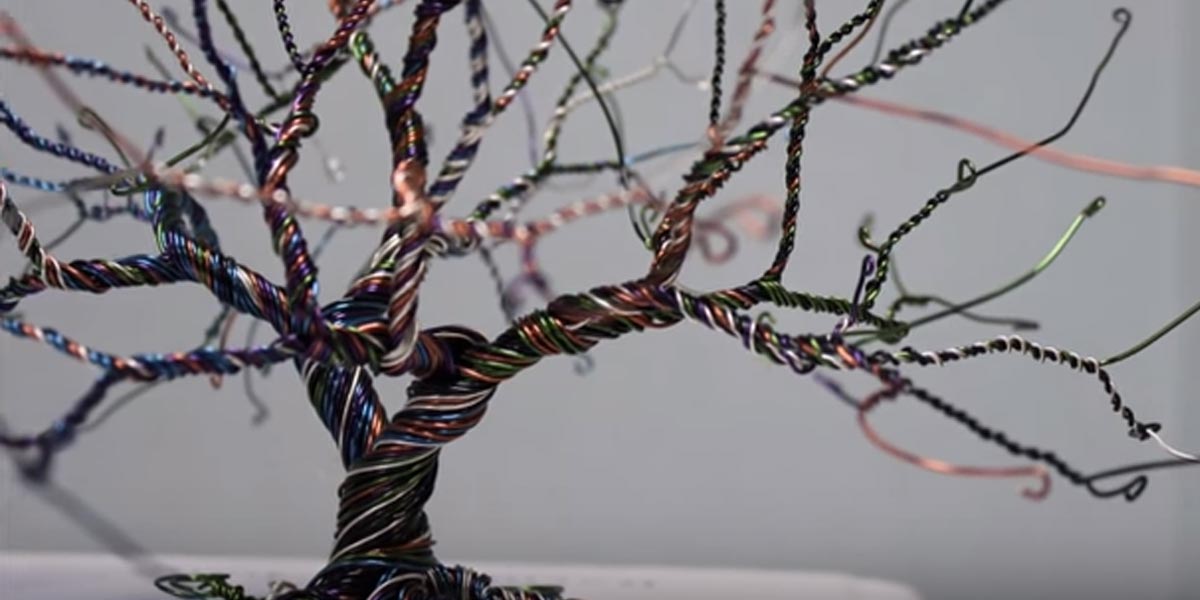
It's kinda nice, how you can take a bunch of metal wires to make a tree trunk, and start separating them and folding them into branches, and separating and folding into smaller branches, and this can give pretty realistic looking trees.

https://diyjoy.com/wp-content/uploads/2016/06/WireTree.jpg

https://www.thisiscolossal.com/2014/10/dense-wire-tree-sculp...

https://www.youtube.com/watch?v=g0tj_ZLpv80

Re: On generative algorithms

#18

There's but a fine line between generative algorithms used for the purposes of arts and entertainment and those used for programming itself. Formerly referred to as meta-programming generative programming is the art of writing programs that help generate programs sort of a way of extending the idea of the tool as in programming tool beyond its current rather static avatar that consists merely of a rather lifeless IDE

Honestly, given the unreasonable effectiveness of (de-)compression algorithms, and the plethora of "I built a CPU in [insert PCG game here]" articles, I think it's a line of negative width.

Re: On generative algorithms

#19
The Hyphae image (and the trees) have a result that's very similar to Diffusion Limited Aggregation, but the method of generation is very different.

IMO the Hyphae way is actually less cool than plain DLA. The algorithm had a lot of degrees of freedom that were selected randomly, while DLA has very few degrees of freedom and gives a cooler shape

I guess the point is that sometimes a simpler algorithm can give more interesting results for this kind of thing

Re: On generative algorithms

#20

Earlier quoted context omitted.

Do you have any recommendations of where to start?

Processing is very popular and easy to pick up for generative art. This youtube channel has some great tutorials and walkthroughs on creating various things with it: https://www.youtube.com/channel/UCvjgXvBlbQiydffZU7m1_aw Beyond the basics, it's also quite useful to pick out a piece of art or an effect you like and attempt to recreate it. You'll learn a lot of tricks very quickly that way.

Some amazing stuff here - https://www.contextfreeart.org/

There is also p5.js - https://p5js.org/

Kadenze has some courses that might be of interest - https://www.kadenze.com/, for example this one : https://www.kadenze.com/courses/generative-art-and-computati...

Post reply on HN