Live data from Hacker News

Texas Is Too Windy and Sunny for Old Energy Companies to Make Money

bloomberg.com

11–20 of 278 posts

Re: Texas Is Too Windy and Sunny for Old Energy Companies to Make Money

#11
post #8

It's surprising that this is allowed to happen by the Texas GOP lege. I would have expected them to either outlaw outright or severely hamper wind farms and other renewable energy business in favor of their big oil benefactors. The resulting screwing of the energy consumers is, as always, an extra benefit.

The idea of energy independence is a thing, or can be. Texas has its own grid and prefers to be an energy independent state. People don't have to be motivated to save the planet to contribute to the overall sustainability.

[deleted]
Re: Texas Is Too Windy and Sunny for Old Energy Companies to Make Money

#13

I wonder what the economics would be without the federal tax incentives for wind and solar. Does anyone know? EDIT: Someone above provided a link that provides the figure I was looking for: "Between 2010 and 2016, subsidies for solar were between 10¢ and 88¢ per kWh and subsidies for wind were between 1.3¢ and 5.7¢ per kWh. Subsidies for coal, natural gas and nuclear are all between 0.05¢ and 0.2¢ per kWh over all ye…

In short: 5 years ago - bad. Currently - pretty good. In 5 years - wonderful.

Tax incentives and their predictable phase-out gave enough momentum to the market that it can currently continue on its own.

Re: Texas Is Too Windy and Sunny for Old Energy Companies to Make Money

#14

I wonder what the economics would be without the federal tax incentives for wind and solar. Does anyone know? EDIT: Someone above provided a link that provides the figure I was looking for: "Between 2010 and 2016, subsidies for solar were between 10¢ and 88¢ per kWh and subsidies for wind were between 1.3¢ and 5.7¢ per kWh. Subsidies for coal, natural gas and nuclear are all between 0.05¢ and 0.2¢ per kWh over all ye…

I don't know the economics specifically but coal, gas, oil are all subsidized too.

Re: Texas Is Too Windy and Sunny for Old Energy Companies to Make Money

#15
post #3

Earlier quoted context omitted.

Natural gas energy can be transported much more easily than solar or wind. As more export capacity comes online in the US I would expect natural gas projects in the US to continue apace even if domestic consumption stays flat or declines.

There are multiple transmission line projects in progress in the US to drag wind energy to major load centers. Solar can be produced anywhere of course. Natgas exports may increase, but it appears everyone is getting off of fossil asap. You cannot compete against an energy source with no fuel cost.

> You cannot compete against an energy source with no fuel cost

Of course you can. The technology to turn photons into useful energy is heavy, complex and reliant on rare elements. In any case, one could flip the analogy by branding coal as photons freely stockpiled by dead trees and algae.

Re: Texas Is Too Windy and Sunny for Old Energy Companies to Make Money

#16
post #5

Earlier quoted context omitted.

There are multiple transmission line projects in progress in the US to drag wind energy to major load centers. Solar can be produced anywhere of course. Natgas exports may increase, but it appears everyone is getting off of fossil asap. You cannot compete against an energy source with no fuel cost.

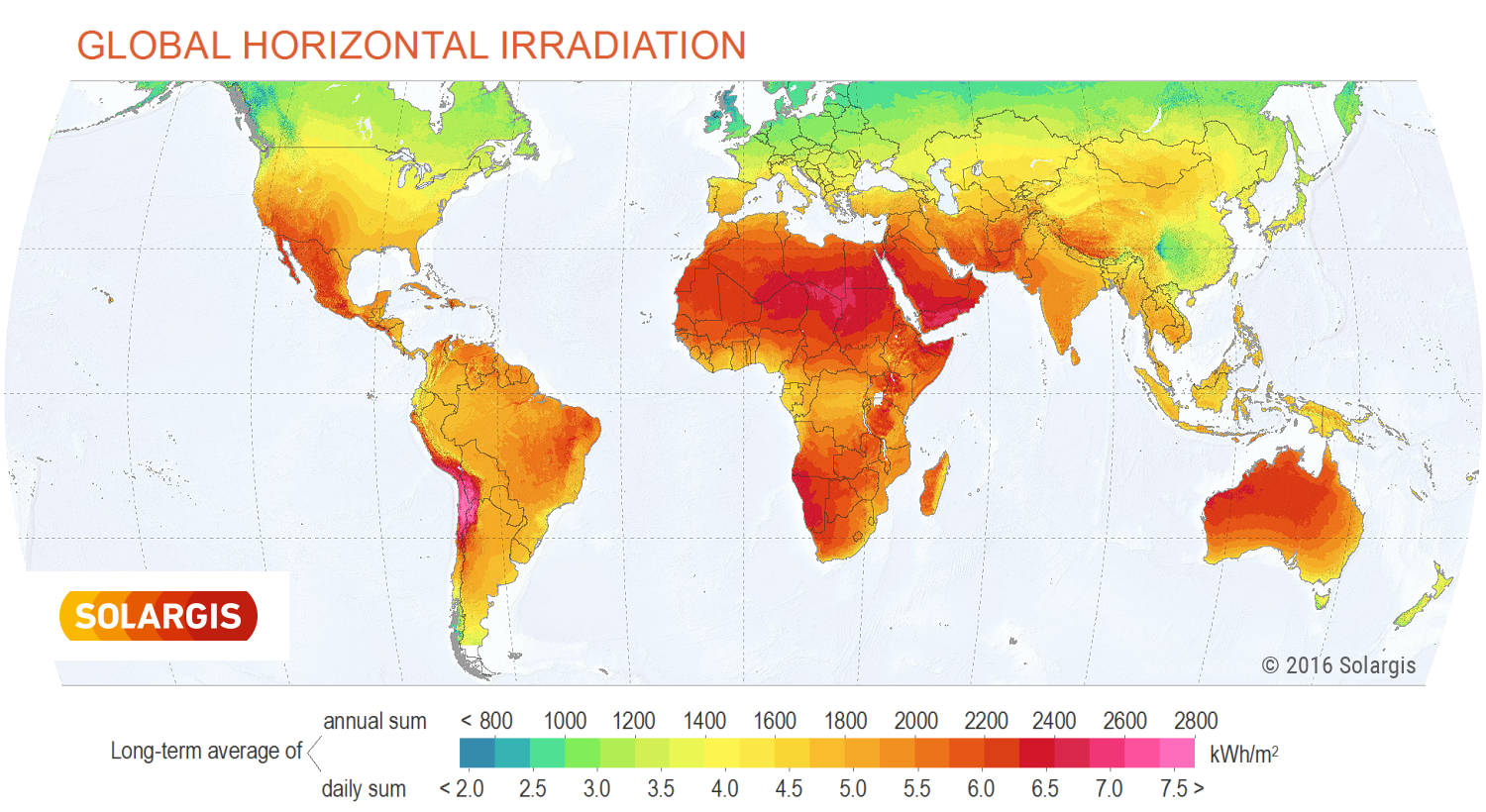
> Solar can be produced anywhere of course. I take issue with "of course". It will be always be wildly more economic to produce solar power in places with a lot of sun. And without checking, my ballpark guess would be that you get at least 10 times more solar energy out of a panel in Texas than a panel in, say, Canada. Our eyes are just so good at adapting to different light levels that we don't notice the different…

>And without checking, my ballpark guess would be that you get at least 10 times more solar energy out of a panel in Texas than a panel in, say, Canada. Our eyes are just so good at adapting to different light levels that we don't notice the different energy densities that much.

Should have checked. "Canada" is pretty vague, but if you mean the southern part where people live you're waaay off. It's only a factor of 2.

http://solargis.com/assets/graphic/free-map/GHI/Solargis-Wor...

Re: Texas Is Too Windy and Sunny for Old Energy Companies to Make Money

#17

I wonder what the economics would be without the federal tax incentives for wind and solar. Does anyone know? EDIT: Someone above provided a link that provides the figure I was looking for: "Between 2010 and 2016, subsidies for solar were between 10¢ and 88¢ per kWh and subsidies for wind were between 1.3¢ and 5.7¢ per kWh. Subsidies for coal, natural gas and nuclear are all between 0.05¢ and 0.2¢ per kWh over all ye…

It's a complex question. In trying to answer it, one should keep in mind that the tax incentives for fossil fuel production dwarf the $15 billion per year or so that supports renewable energy. In addition, fossil fuels impose an estimated $200 billion/yr in social costs (external costs), in the form of pollution, etc. And it would be hard to estimate how much of our defense spending should be attributed to the need to secure the middle Eastern oil supply.

Re: Texas Is Too Windy and Sunny for Old Energy Companies to Make Money

#18

Earlier quoted context omitted.

There are multiple transmission line projects in progress in the US to drag wind energy to major load centers. Solar can be produced anywhere of course. Natgas exports may increase, but it appears everyone is getting off of fossil asap. You cannot compete against an energy source with no fuel cost.

> You cannot compete against an energy source with no fuel cost Of course you can. The technology to turn photons into useful energy is heavy, complex and reliant on rare elements. In any case, one could flip the analogy by branding coal as photons freely stockpiled by dead trees and algae.

When you install solar panels or wind turbines, you've prepaid for whatever power they'll produce for the next 30+ years.

When you generate using a fuel, your margins are dictated by power market spot prices (prices occasionally go negative; do you continue to generate and pay for someone to take your power while you're also paying someone for a fuel? In some scenarios, you must), depreciation, and your fuel costs/contracts.

The cost of wind and solar never fluctuates.

Re: Texas Is Too Windy and Sunny for Old Energy Companies to Make Money

#19
post #13

I wonder what the economics would be without the federal tax incentives for wind and solar. Does anyone know? EDIT: Someone above provided a link that provides the figure I was looking for: "Between 2010 and 2016, subsidies for solar were between 10¢ and 88¢ per kWh and subsidies for wind were between 1.3¢ and 5.7¢ per kWh. Subsidies for coal, natural gas and nuclear are all between 0.05¢ and 0.2¢ per kWh over all ye…

In short: 5 years ago - bad. Currently - pretty good. In 5 years - wonderful. Tax incentives and their predictable phase-out gave enough momentum to the market that it can currently continue on its own.

[deleted]

Re: Texas Is Too Windy and Sunny for Old Energy Companies to Make Money

#20
post #5

Earlier quoted context omitted.

There are multiple transmission line projects in progress in the US to drag wind energy to major load centers. Solar can be produced anywhere of course. Natgas exports may increase, but it appears everyone is getting off of fossil asap. You cannot compete against an energy source with no fuel cost.

> Solar can be produced anywhere of course. I take issue with "of course". It will be always be wildly more economic to produce solar power in places with a lot of sun. And without checking, my ballpark guess would be that you get at least 10 times more solar energy out of a panel in Texas than a panel in, say, Canada. Our eyes are just so good at adapting to different light levels that we don't notice the different…

According to the Solar Energy Potential site [1], the difference between the best and worst areas in the US is a factor of 2 or 3. I assume they average over the whole year and take cloud cover into account.

[1] https://energy.gov/maps/solar-energy-potential

Post reply on HN