Seems like a case for making mindmaps like this out of wikipedia
Interactive Mind Map for learning
11–20 of 62 posts
Re: Interactive Mind Map for learning
#12This has been on my mind for a really long time and I'm trying to make basically the same thing except the focus would be on interactively building your own map rather than exploring others but now I got to see if I can add that to this rather than build my own.
Re: Interactive Mind Map for learning
#13AAPL only?
Re: Interactive Mind Map for learning
#14I have been working to do this with a high(er) degree of granularity for a high school physics curriculum. The idea is to represent a student's unique journey through a topic space, and break free of the enforced and artificial linearity that a textbook's sequential chapters impose.
Don't we all learn naturally by following our needs, or curiosity, through webs of knowledge, forging our own path to understanding?
EDIT: Found one of my favorite quotes on this: "The student feels that, on his own, he wouldn't have followed the route he has just been led down; and he forgets that there a thousand paths in intellectual space open to his will." – The Ignorant Schoolmaster (Five Lessons in Intellectual Emancipation), Jaqcues Rancière
Re: Interactive Mind Map for learning
#15This looks similar to https://metacademy.org. I am curious how these maps are built and how resources are being selected (methodology-wise)?
Re: Interactive Mind Map for learning
#16In my opinion, Mind Maps are not great for organizing information, learning things or keeping track of things. Notice how the Github read-me itself is formed like a Table of Contents. Table of Contents (or other organized lists) are better for organizing your information and placing it in thematically similar topics, etc.
In cases where you're presenting or recalling information, the more linear narrative of a Table of Contents is superior. Use your brain's natural triggered associations to tie subjects together or to recall related topics, and use hard-copy writing to commit concrete, factual and clear information to that 'external' memory.
There is a reason that we've been using TOC like structures much more than Mind Maps. Mind Maps are terrible. We use TOCs, concrete lists, tools like Universal Decimal Classification and Dewey Decimal Classification to organize information, because they work and cover up the weak areas that human brains have.
Google Image search "Mind Map". You will see colorful distracting pictures like this: https://www.mindtools.com/media/Diagrams/mindmap.jpg
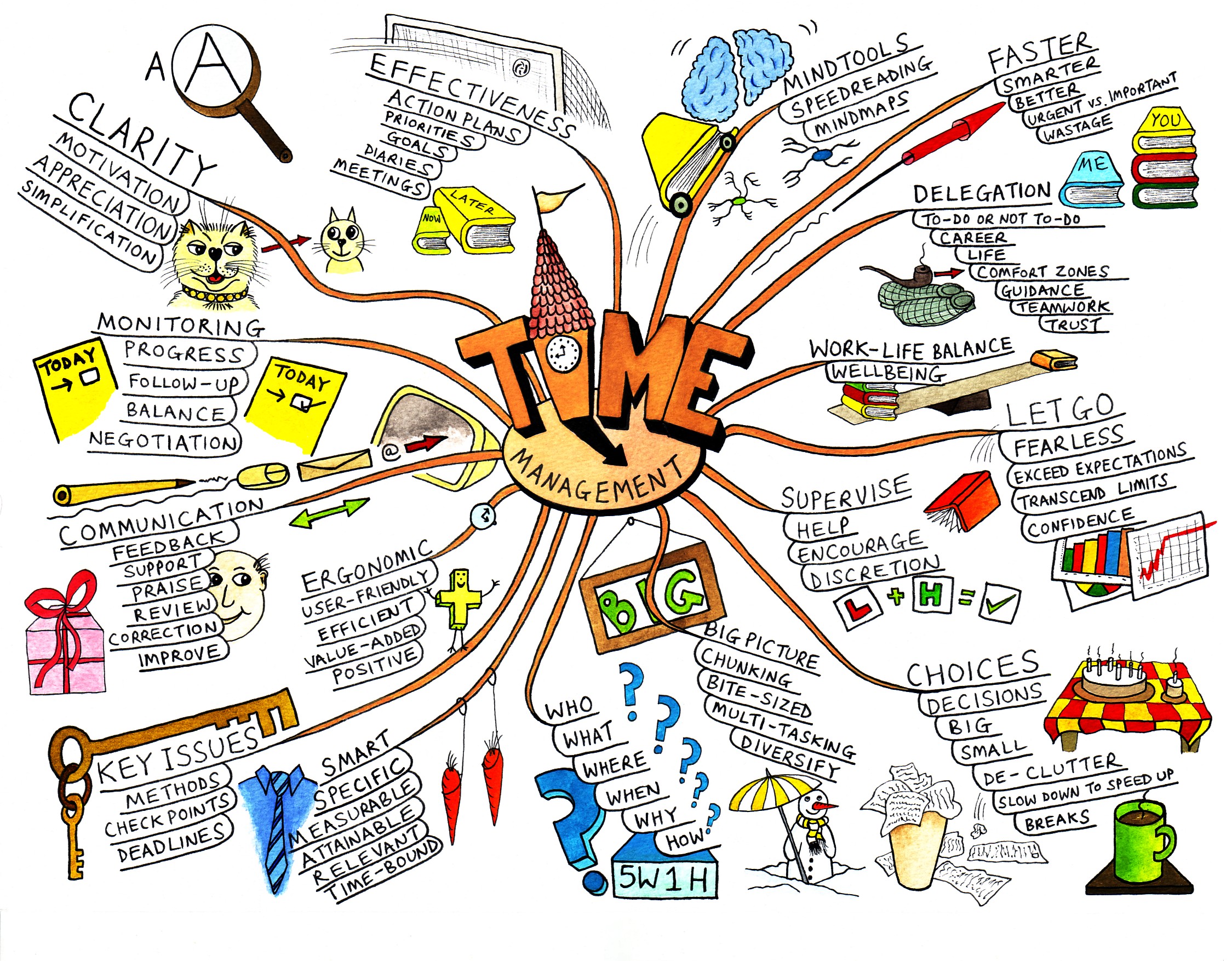
If you want random associations, follow links on the web. Browse Wikipedia, open new random tabs. Learn new topics, discover new interesting things! Just don't use Mind Maps.
Re: Interactive Mind Map for learning
#17In my opinion, Mind Maps are not great for organizing information, learning things or keeping track of things. Notice how the Github read-me itself is formed like a Table of Contents. Table of Contents (or other organized lists) are better for organizing your information and placing it in thematically similar topics, etc. In cases where you're presenting or recalling information, the more linear narrative of a Table…
Mind maps are great for recalling terminology hierarchies (for the lack of better word). I have not used them much in my engineering studies but I have taken some courses in history and philosophy where I often had to recall lots of terminology related to, for example, certain time periods or philosophical theories. The spatial aspect of a mind map really helps me. Just drawing the map is usually enough for me to remember everything that's in it for a few days. I simply close my eyes and picture the map in my head.
This, however, requires that I draw the map myself by hand. Drawing it by hand forces me to carefully look at every pixel of the map. Adding some fancy fonts and pictures like in your example can help in the sense that you spend more time looking at the pixels.
Re: Interactive Mind Map for learning
#18This looks similar to https://metacademy.org . I am curious how these maps are built and how resources are being selected (methodology-wise)?
This particular map looks to be curated by the author of the GitHub repo.
Re: Interactive Mind Map for learning
#19Mind maps are interesting tools, and even overlapping mind maps can be useful ways of showing where multiple sources of understanding can work together...but I feel like this is just arriving at semantic graphs again. And those graphs are already very well trod.
Re: Interactive Mind Map for learning
#20Am I the only one that when I click on anything, the image just zooms and there's no link?
You have to click on the link with the mind map (http://bit.ly/learning-mind).