Live data from Hacker News

Radeon Instinct – Optimized Machine and Deep Learning

radeon.com

11–20 of 88 posts

Re: Radeon Instinct – Optimized Machine and Deep Learning

#11

Does anyone use AMD for deep learning in scientific / industry ? All the libraries for deep learning I have seen require CUDA and NVIDIA is winning by merely being the most popular API. Searching github it looks like they are university assignment projects see https://github.com/search?utf8=%E2%9C%93&q=opencl+deep+learn...

I remember that a few years ago AMD had the only sensible solution for virtualizing GPUs, and you could make a bunch of them work together as a single unit without much trouble. But I didn't have a Radeon card so I never got to try it. Don't know what happened with that, it's true that they really lagged behind NVIDIA.

Re: Radeon Instinct – Optimized Machine and Deep Learning

#12
What's particularly interesting here is that the Fiji card they propose is a very different beast than any of the NVIDIA offerings.

The MI8 card's HBM has a great power and performance advantage (512 GB/s peak bandwidth) even if it's on 28 nm. NVIDIA has nothing that has even remotely comparable bandwidth in this price/perf/TDP regime. None of the NVIDIA GP10[24] Teslas have GDDR5X -- not to surprising given that it was rushed to marked, riddled with issues, and barely faster than GDDR5. Hence, the P4 has only 192 Gb/s peak BW; while the P40 does have 346 GB/s peak, it is far higher TDP, different form factor and not intended for cramming in into custom servers.

[I don't work in the field, but] To the best of my knowledge inference is often memory bound (AFAIK GEMV-intensive so low flops/byte), so the Fiji card should be pretty good at inference. In such use-cases GP102 can't compete in bandwidth. So the MI8 with 1.5 the Flop rate, 2.5x bandwidth and likely ~2x higher TDP (possibly configurable like the P4) offers an interesting architectural balance which might very well be quite appealing for certain memory-bound use-cases -- unless of course the same cases are also need large memory.

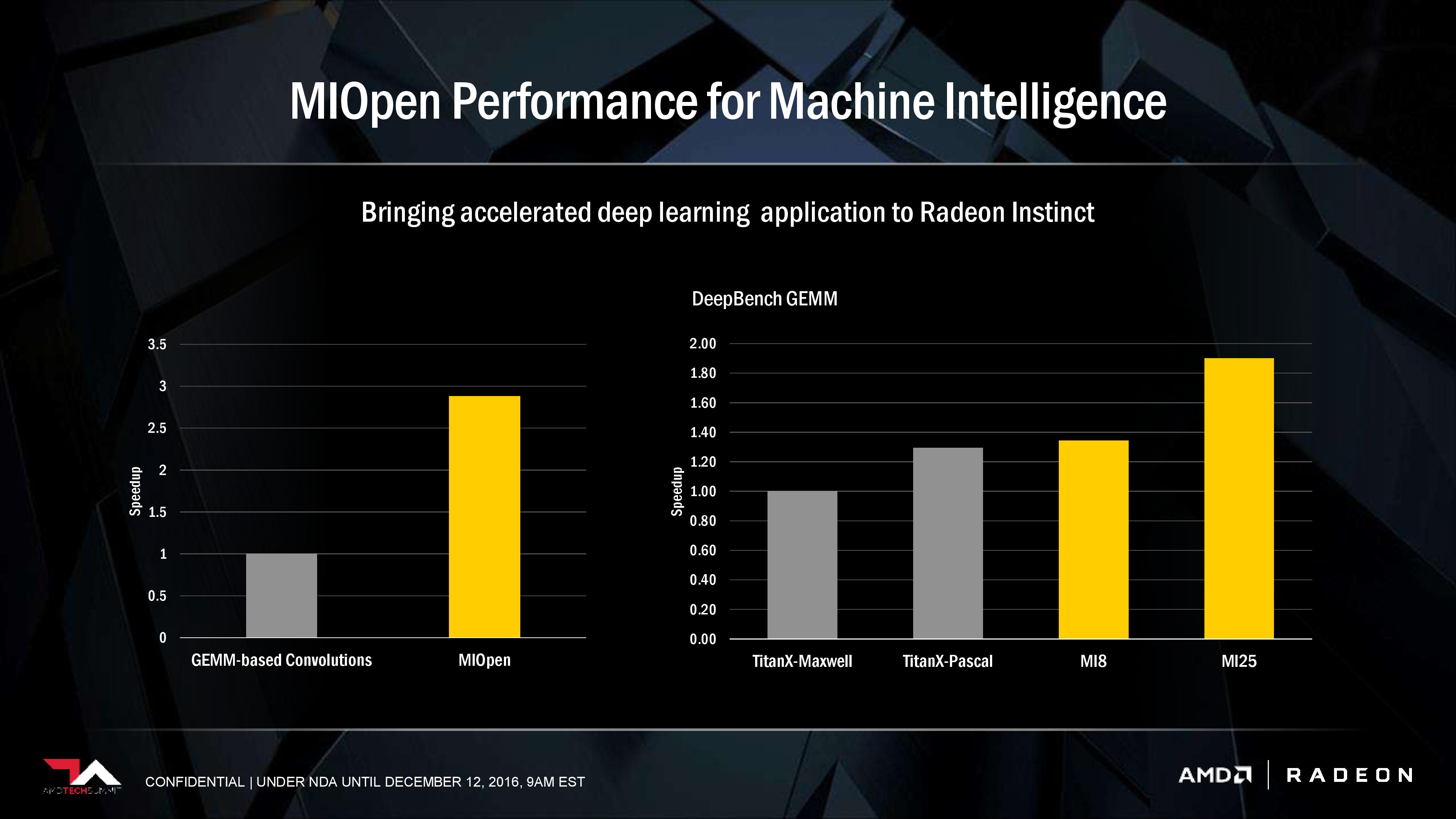
Update: should have looked closer at the benchmarks in the announcement; in particular the MIOpen benchmarks [1] MI8 clearly beating even TitanX-Pascal which has higher BW than the P40 indicates that this card will be pretty good for latency-sensitive inference as long as stuff fits in 4 GB.

[1] http://images.anandtech.com/doci/10905/AMD%20Radeon%20Instin...
Re: Radeon Instinct – Optimized Machine and Deep Learning

#13
post #4

Earlier quoted context omitted.

For what it's worth, AMD has been working on a CUDA compatibility solution for at least a year now. Announcement[0] and Progress[1] [0] http://www.anandtech.com/show/9792/amd-sc15-boltzmann-initia... [1] http://www.anandtech.com/show/10831/amd-sc16-rocm-13-release...

It only works for the basic functionality they can't interop the "operational" CUDA features.

> can't interop the "operational" CUDA features

What exactly do you that mean?

Re: Radeon Instinct – Optimized Machine and Deep Learning

#15
post #10
post #4

Earlier quoted context omitted.

For what it's worth, AMD has been working on a CUDA compatibility solution for at least a year now. Announcement[0] and Progress[1] [0] http://www.anandtech.com/show/9792/amd-sc15-boltzmann-initia... [1] http://www.anandtech.com/show/10831/amd-sc16-rocm-13-release...

Additionally, here's an example of how Caffe was porting using HIP [1]. To be honest, if the approach really does work, you might see a very quick increase in the number of applications ported. All in all, given how elegant HIP is and that HCC seems to make GPUs more approachable than CUDA (and less silly than OpenACC), there is a great potential for AMD to gain some traction. My greatest concern is the quality and r…

The catch, which AMD are quick to gloss over, is that Caffes performance on Nvidia hardware largely comes from its use of Nvidia's proprietary cuDNN kernels.

AMDs HIP port is using the "fallback" open-source CUDA kernels, which are nowhere near as fast as the hand-optimized cuDNN code.

Re: Radeon Instinct – Optimized Machine and Deep Learning

#16
post #13

Earlier quoted context omitted.

It only works for the basic functionality they can't interop the "operational" CUDA features.

> can't interop the "operational" CUDA features What exactly do you that mean?

DMA, networking, storage and direct i/o, virtualization etc.

Re: Radeon Instinct – Optimized Machine and Deep Learning

#17
post #7

I really don't think this will make a dent in CUDA's platform. CUDA has a well established ecosystem in deep learning and compatible cards like Quadro coupled with very matured platform makes it miles ahead of platform. That said, I would love to be proven wrong. Healthy competition such as this fosters much better results. Also CUDA is not without issues in certain matters.

Just speaking from a personal perspective, I took a parallel computing course at my uni this past semester and CUDA was the main platform we worked on (and I'm an undergraduate). Nvidia also has a great Udacity course they offer for free. Unless AMD gets CUDA compatibility working soon, I really don't see how they're going to catch up as far as adoption goes.

Re: Radeon Instinct – Optimized Machine and Deep Learning

#18
One thing that would be interesting is if you could use cards like this for rendering multiple instances of X, for the purpose of running things like WebGL browser screenshotters.

I had to ship out a high-end gamer GPU with a dummy HDMI adapter for this purpose recently. But it's obviously not very efficient. It would also be nice to be able to run multiple screens in parallel, not just one per GPU.

I doubt there will ever be a product for my use case, but one can dream...

That said, these are cool. I think they're lower power than the Nvidia equivalent, but I could be mistaken (I just recall the Tesla models being power hungry.. enough to cause a real problem in a datacenter rack).

Re: Radeon Instinct – Optimized Machine and Deep Learning

#19
post #7

I really don't think this will make a dent in CUDA's platform. CUDA has a well established ecosystem in deep learning and compatible cards like Quadro coupled with very matured platform makes it miles ahead of platform. That said, I would love to be proven wrong. Healthy competition such as this fosters much better results. Also CUDA is not without issues in certain matters.

The ML/deep learning technologies are peaking or will peak in the coming years on the hype curve [1], so it is not too late for AMD to join the show, there is plenty of newcomers and growing entities to buy hardware. So even though the CUDA ecosystem is far more established, let's not forget how much room for growth there is under an exponential growth curve!

Even Intel is late to the game (and so far can't even compete with AMD in terms of hardware).

[1] https://www.gartner.com/newsroom/id/3412017

Re: Radeon Instinct – Optimized Machine and Deep Learning

#20
post #12

What's particularly interesting here is that the Fiji card they propose is a very different beast than any of the NVIDIA offerings. The MI8 card's HBM has a great power and performance advantage (512 GB/s peak bandwidth) even if it's on 28 nm. NVIDIA has nothing that has even remotely comparable bandwidth in this price/perf/TDP regime. None of the NVIDIA GP10[24] Teslas have GDDR5X -- not to surprising given that it…

The PCIE NVIDIA P100 has peak memory bandwidth of 730GB/s, at 250 Watts, which is almost exactly the same bw/watt as the MI8 (well, there are two PCIE P100s, I mean the better one).
Post reply on HN