Interesting. They should post more examples (not with just faces), or make an online demo, like waifu2x [1]
Subpixel: A subpixel convolutional neural network implementation with Tensorflow
11–20 of 47 posts
Re: Subpixel: A subpixel convolutional neural network implementation with Tensorflow
#12So, basically, this is the thing in a crime detective movie where the forensic analyst is looking at a terrible pixelated surveillance camera still and says "enhance," and the computer magically increases the resolution to reveal the culprit's face. Just another entry on the "things that are supposed to be impossible that convolutional nets can do now."
And that's how that guy whose face appeared a few times in ImageNet became the world's most wanted terrorist, on the run for thousands of crimes.
Re: Subpixel: A subpixel convolutional neural network implementation with Tensorflow
#13Earlier quoted context omitted.
If you have multiple images of the same scene (for example, from video frames), you should be able to use information across frames for a true enhancement?
;) sshh! don't say that too loud yet. but, remember our names...
So you're saying this could be useful for stereo imagery and video? ;- )
Re: Subpixel: A subpixel convolutional neural network implementation with Tensorflow
#14The problem with subpixel images is that there are RBG and GBR monitors. Not only that, there are horizontal and vertical variations. And there's no way to tell which one the user is using on the web. And that's not even counting all the mobile number like pentile.
It's still useful though, browsers, for instance, could use it for displaying downscaled images.
Re: Subpixel: A subpixel convolutional neural network implementation with Tensorflow
#15The problem with subpixel images is that there are RBG and GBR monitors. Not only that, there are horizontal and vertical variations. And there's no way to tell which one the user is using on the web. And that's not even counting all the mobile number like pentile. It's still useful though, browsers, for instance, could use it for displaying downscaled images.
this is supposed to be used in the data processing step. you load your image from jpeg or your video using ffmpeg, enhance the images and then pass it to the next step where color rendering is done. you can do that in the browser or mobile just as fine.
Re: Subpixel: A subpixel convolutional neural network implementation with Tensorflow
#16The problem with subpixel images is that there are RBG and GBR monitors. Not only that, there are horizontal and vertical variations. And there's no way to tell which one the user is using on the web. And that's not even counting all the mobile number like pentile. It's still useful though, browsers, for instance, could use it for displaying downscaled images.
This project is using 'subpixel' not to refer to monitor subpixels, but instead, lost information between existing pixels in an image.
You're right though, and that's why chroma hinting for subpixel AA has fallen out of favor. It also doesn't work on mobile where the screen can be rotated from RGB-horz to RGB-vert at a moment's notice. This was changed for ClearType in Windows 8 (DirectWrite never did chroma hinting).
Re: Subpixel: A subpixel convolutional neural network implementation with Tensorflow
#17The explanation in the README of the github project is excellent and well-written! Here's a really great set of animations by Vincent Dumoulin on how various conv operators work: https://github.com/vdumoulin/conv_arithmetic
Re: Subpixel: A subpixel convolutional neural network implementation with Tensorflow
#18Interesting image "upscale" algorithm. I'm not familiar enough with the field to understand how the "neutral net" part feeds in, other than to do parallel computation on the x-pos, y-pos, (RGB) color-type-intensity tensor interpolated/weighted into a larger/finer tensor. (linear algebra speak for upscaling my old DVD to HD, that sort of thing) At the risk of exposing my ignorance, this has nothing to do with "AI", ri…
yeah, no AI. Its low level computer vision. There is no implicit understanding of the scene to enhance it here. We show the neural nets several examples of low and high quality images it learns a function that makes the low quality looks more like the high quality. this may make you feel disappointed now, but in the write up we are also pitching this same module to be used in generative networks and other models that…
I'm glad to hear that, I feared it might just paste any eyes where it sees some eyes, but like this it might be much closer to what is really in the pixels.
Re: Subpixel: A subpixel convolutional neural network implementation with Tensorflow
#19I think it's always problematic to compare to images upscaled via nearest-neighbor. The big pixels are hard to parse for our brain, we detect all the blocky edges.
A good content unaware upscaling would be nice (one of the default photoshop algos)
I also wonder what they used for the downscaling. I see 4x4 pixel blocks, but also some with 3px or 7px lengths.
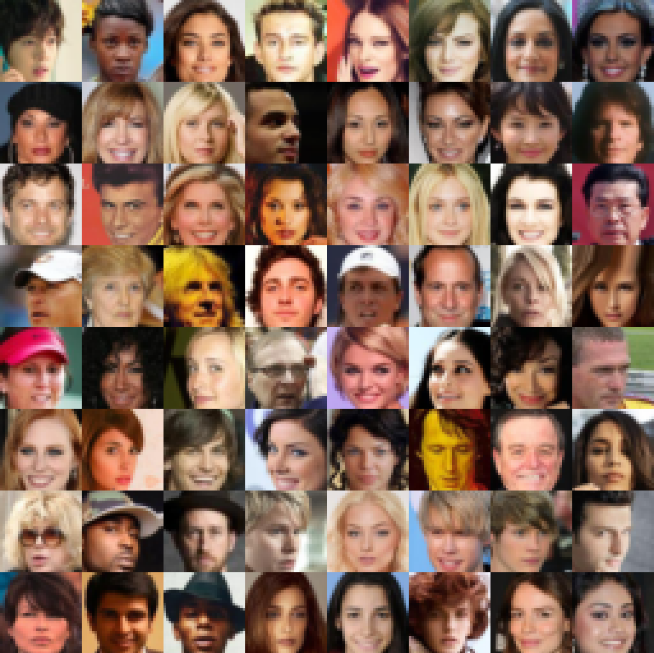
This looks pixely and is supposed to be a source file?: https://raw.githubusercontent.com/Tetrachrome/subpixel/d2e28...
Re: Subpixel: A subpixel convolutional neural network implementation with Tensorflow
#20So, basically, this is the thing in a crime detective movie where the forensic analyst is looking at a terrible pixelated surveillance camera still and says "enhance," and the computer magically increases the resolution to reveal the culprit's face. Just another entry on the "things that are supposed to be impossible that convolutional nets can do now."
I imagine you'd want PII erased from the training set, but the danger stands.