It sounds a little to me like the old "once the polys get small enough, everythings a particle system" approach. Sure you save lots of GPU by essentially doing away with surfaces and textures (by making everything a floating colored dot) but you then have to contend with massive storage, manipulation, and filtering problems. They might be at the stage where they say "we'll just make everything a point! this'll be cak…
Indeed. Through many mentions of the word "unlimited", never once was the word "storage" mentioned, or "cache" or "memory". How about the design toolchain? The only solution I can think of is to store all the assets as ... polygons. Unless there is toolchain support for a CSG/procedural approach.
Unlimited Detail Wants To Kill 3D Cards
11–20 of 70 posts
Re: Unlimited Detail Wants To Kill 3D Cards
#12Re: Unlimited Detail Wants To Kill 3D Cards
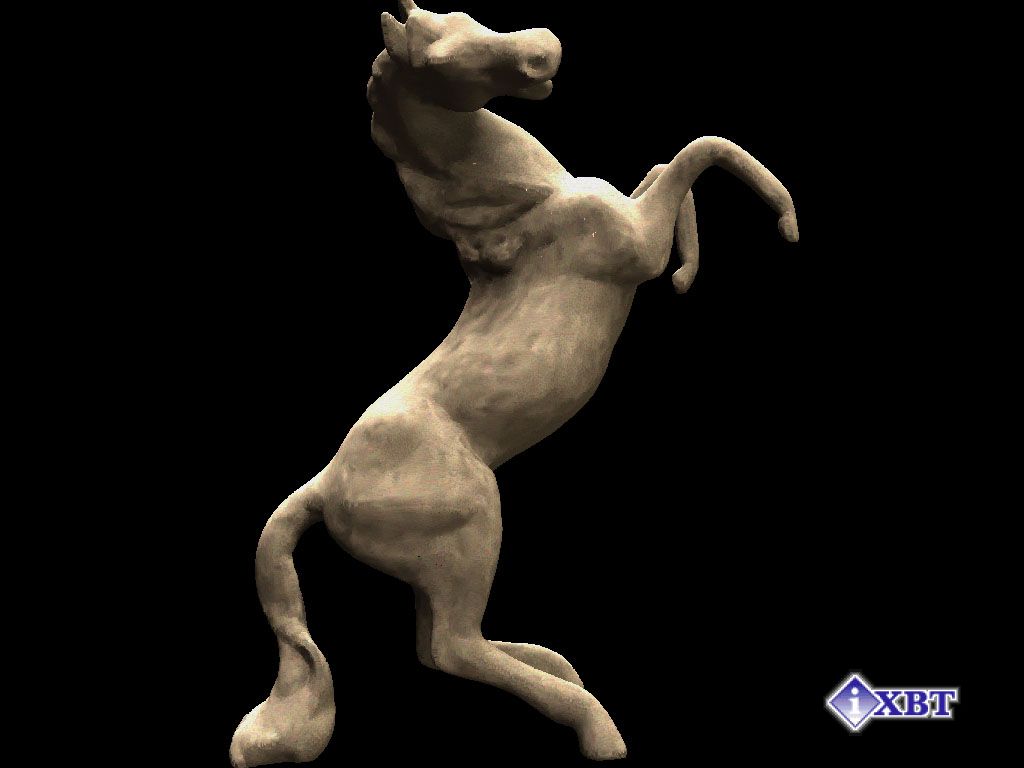
#13I'm not sold yet, it's making some incredibly bold claims. I'm aware of point cloud data models from back when it was included in the 3D Mark '01 benchmark (the rotating horse statue, the test was called point sprites http://www.ixbt.com/video/images/3dmark2001/gf3-sprites.jpg ), and found it an oddity at the time, not all that visually appealing and certainly not as a believable modelling method. It's not raytracing, although it does bare a lot of similarities.
I'll be keeping a sceptical eye and an open mind on this one.
Anyway, here's their website http://unlimiteddetailtechnology.com/
Edit: Thinking about it, it's biggest downfall will occur when physics are involved. For a static scene it's ideal, but to get the branches of the trees to blow in the wind, or to achieve any kind of real time environmental change beyond lighting would likely cause some serious difficulties.
Re: Unlimited Detail Wants To Kill 3D Cards
#14Earlier quoted context omitted.
Indeed. Through many mentions of the word "unlimited", never once was the word "storage" mentioned, or "cache" or "memory". How about the design toolchain? The only solution I can think of is to store all the assets as ... polygons. Unless there is toolchain support for a CSG/procedural approach.
Another thing I wonder is, if their "search" system, what kind of indexing is required? How long does it take, and can you re-index on the fly? Their demos have a conspicuous lack of any kind of movement at all, much less dynamic geometry. And what about shading? Shading typically require surface normals, something that's not readily available from a mess of points in 3d.
My guess is that they created a small static particle system that looks like 3d figure, "rotated" it by selectively displaying particles and got all excited.
A classic case of needing to be an expert in a field before trying to push the state of the art in order to save yourself the trouble of chasing a dead end that most people in said field already know is infeasible.
Re: Unlimited Detail Wants To Kill 3D Cards
#15I listened to their explanation and it sounds a bit shady. First they used that old salesman trick of using a British accent to appear smart, so that was already a red flag. And then their explanation of the secret to their technology sounded rather ridiculous. They said that their technology was like the google search engine or like searching for the word "money" in an MS word document (the latter was the lamest att…
If that is correct, then I think the search engine example is pretty good at explaining it.
Re: Unlimited Detail Wants To Kill 3D Cards
#16It sounds a little to me like the old "once the polys get small enough, everythings a particle system" approach. Sure you save lots of GPU by essentially doing away with surfaces and textures (by making everything a floating colored dot) but you then have to contend with massive storage, manipulation, and filtering problems. They might be at the stage where they say "we'll just make everything a point! this'll be cak…
Indeed. Through many mentions of the word "unlimited", never once was the word "storage" mentioned, or "cache" or "memory". How about the design toolchain? The only solution I can think of is to store all the assets as ... polygons. Unless there is toolchain support for a CSG/procedural approach.
Re: Unlimited Detail Wants To Kill 3D Cards
#17I listened to their explanation and it sounds a bit shady. First they used that old salesman trick of using a British accent to appear smart, so that was already a red flag. And then their explanation of the secret to their technology sounded rather ridiculous. They said that their technology was like the google search engine or like searching for the word "money" in an MS word document (the latter was the lamest att…
If I understood correctly, it seems to resemble a search engine in that it takes all the dots that compose the 3D world and search for the ones that need to be displayed to compose the 2D image on the screen at any given viewing angle? If that is correct, then I think the search engine example is pretty good at explaining it.
Re: Unlimited Detail Wants To Kill 3D Cards
#18Re: Unlimited Detail Wants To Kill 3D Cards
#19Although they call it search technology it sounds like a very effecient graphic codec - blending pixels, focusing on rendering frame vs. scene etc.
Re: Unlimited Detail Wants To Kill 3D Cards
#20It sounds a little to me like the old "once the polys get small enough, everythings a particle system" approach. Sure you save lots of GPU by essentially doing away with surfaces and textures (by making everything a floating colored dot) but you then have to contend with massive storage, manipulation, and filtering problems. They might be at the stage where they say "we'll just make everything a point! this'll be cak…