Live data from Hacker News

The Untold History of Arduino

arduinohistory.github.io

11–20 of 74 posts

Re: The Untold History of Arduino

#11

    The idea that the mere fact that Banzi was my thesis advisor
    gives him some sort of higher claim to the work done on Wiring, is, 
    to say the least, frustrating to read.
i dated an interior design student when at university

there was a competition and my so was given second place

my so was crushed and honestly thaer entry was far superior.. the ideas were more interesting and applied, and the effort was more pronounced

i quipped, 'the best entries always get second place because everyone forgets who got second place.. which makes it easier to steal your ideas'

it was meant to console with a bit of humor, but since then i have found the notion poignantly evidenced

academia can be a scary place for ideas
Re: The Untold History of Arduino

#12
post #4

How-to become a douchbag in 10 steps: 1. Be the supervisor for a thesis that will become a open-sourced project 2. Use this open sourced project in one of the classes you teach at University 3. work together with and ask for help from the creator of the open-sourced project 4. see the value of the open-sourced project 5. fork it 6. claim it as yours 7. get rich by selling it 8. write super douchy email to a previous…

Step 8 is inaccurate. JC is not the author of Wiring, he's a faculty member of IDII [0]. Banzi was saying that IDII should not try and get credit for Arduino as they did not help them with the funding (beyond ordering 50 boards). [0]: https://interactionivrea.org/

Re: The Untold History of Arduino

#13
post #12
post #4

How-to become a douchbag in 10 steps: 1. Be the supervisor for a thesis that will become a open-sourced project 2. Use this open sourced project in one of the classes you teach at University 3. work together with and ask for help from the creator of the open-sourced project 4. see the value of the open-sourced project 5. fork it 6. claim it as yours 7. get rich by selling it 8. write super douchy email to a previous…

Step 8 is inaccurate. JC is not the author of Wiring, he's a faculty member of IDII [0]. Banzi was saying that IDII should not try and get credit for Arduino as they did not help them with the funding (beyond ordering 50 boards). [0]: https://interactionivrea.org/

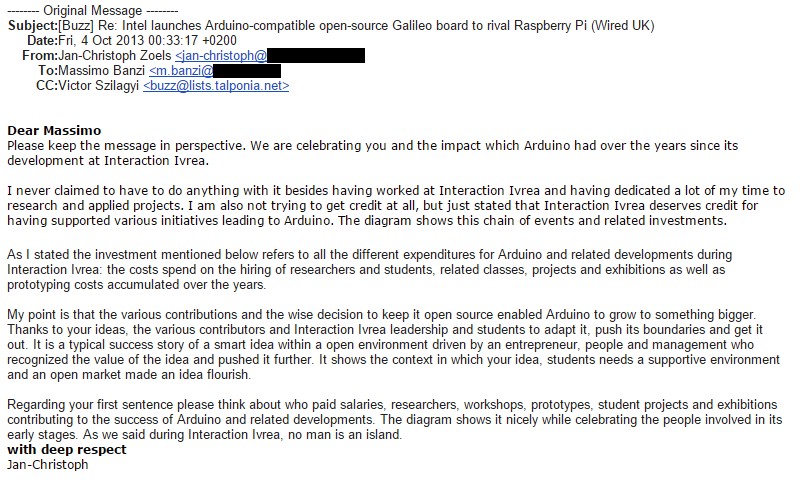
Here's Jan-Christoph Zoels' reply to that message: http://arduinohistory.github.io/images/full/JCEmailThread2.j...

Re: The Untold History of Arduino

#14

It makes a lot of sense that they forked the project. If you're selling a hardware product, like hell you're giving someone else administrative command over the code base that you're going to have to pay money to support. The code that your product's five star rating relies on. push request #800020201 "Hey, Hernando, think you can push that update to Wiring now, we're paying quite a lot in support time here. The LEDs…

Juniper sells hardware with support demands far beyond that of Arduino, and yet somehow maintains a productive downstream relationship with FreeBSD.

It's telling that Arduino is flailing now that they've extracted as much value as they possibly could out of the ideas they stole.

Re: The Untold History of Arduino

#15
I saw these boards all over pratt.edu in the school of architecture in 2005 and later. It was referred to as "wiring board" at the time - no one called it an Arduino, and I just continued to use my STK501 instead.

There were serious issues with the board design and fabrication - the location of the caps were pretty and aligned, but not "smart" for power distribution. Faulty signals, bad timing, and other issues were common with those boards. It was a terrible PCB by any measure (but looked awesome, like 2015 gamer mobos).

However the ideas behind "Wiring" and the "Sketch" were really innovative ideas for non-techs designers who mostly wanted to servo-blinky-sensor artsy stuff. And it really did open up embedded development to a whole new semi-technical audience.

Re: The Untold History of Arduino

#17
post #4

How-to become a douchbag in 10 steps: 1. Be the supervisor for a thesis that will become a open-sourced project 2. Use this open sourced project in one of the classes you teach at University 3. work together with and ask for help from the creator of the open-sourced project 4. see the value of the open-sourced project 5. fork it 6. claim it as yours 7. get rich by selling it 8. write super douchy email to a previous…

Are these the same guys from this arduino documentary?

https://vimeo.com/18539129

EDIT: Yep - the first speaker in that doc is Banzi

Re: The Untold History of Arduino

#18
The whole Arduino thing has always baffled me a bit. I've been programming 8-bit AVR chips since 2000. There have always been many different development board options. Even long before Wiring and Arduino. Sure many were more expensive but neither Wiring nor Arduino added much technically to the hardware itself.

The real innovation of Arduino has always been the Wiring programming system. Personally I prefer the low-level interface the AVR chips provide and document very well in their datasheets. I find it frustrating to have another layer, like wiring, between me and the hardware. As an embedded systems programmer my perspective is different.

To me Arduino has always been little more than a really good marketing campaign.

Re: The Untold History of Arduino

#19

One of the saddest thing I read in a long time. Damn me.

Have you read the Autodesk File [1]? By a founder and the co-creator of the famous software. I've heard it can't be hosted in the US for legal reasons.

[1] https://www.fourmilab.ch/autofile/www/autofile.html

Re: The Untold History of Arduino

#20

It makes a lot of sense that they forked the project. If you're selling a hardware product, like hell you're giving someone else administrative command over the code base that you're going to have to pay money to support. The code that your product's five star rating relies on. push request #800020201 "Hey, Hernando, think you can push that update to Wiring now, we're paying quite a lot in support time here. The LEDs…

> The guy should 100% get more credit, and if this happened to me I would always be a little hurt about it, but at the same time, would it be a big deal if it had never extended past a thesis somewhere?

That's not the argument. He's not upset Arduino was a huge success, nor is he all that upset that he is not involved with Arduino (as far as I can tell from this article, as it's written very professionally). The argument is that there is a rather significant fight between the co-founders of the Arduino project about who owns what of the Arduino brand. This article paints a picture that in reality, the product behind the brand was essentially ripped off of someone else's hard work with very little contributed back to the original project. I don't think anyone wouldn't start to feel rather frustrated if someone forked their open source project, made it hugely successful (while complying with licenses and other conditions, but without directly contributing back) and then started fighting within themselves over who "started the project all on their own".

Post reply on HN