Chance of nuclear war is greater than you think
news.stanford.edu
Chance of nuclear war is greater than you think
1–10 of 19 posts
Re: Chance of nuclear war is greater than you think
#2Well I imagined the possibility of nuclear war around 0%, so I'm not too suprised.
Re: Chance of nuclear war is greater than you think
#3I fail to understand why North Korea is seen as a serious threat. The country can't fire a missile much further than Japan, failed miserably when attempting to launch a microwave-oven satellite, and has no technical abilities that are not given to them by China. According to South Korean friends, North Korea is seen as a joke even by its closest neighbor who it has vowed to destroy.
Contrast this with Iran, who clearly has the brilliant minds necessary to weaponize nuclear technology, and pairs those minds with funding and equipment. Their neighbor, Israel, is clearly nervous (as they should be), and the country has demonstrated that it can fire long range missiles.
And yet, it seems that every time I turn on the news I hear some horror story about how NK has done another stupid crazy thing, all the while Iran is moving closer and closer to nuclear weapons.
Re: Chance of nuclear war is greater than you think
#4It might be hard for younger people to understand - but when films like The Terminator [1984] were made, this kind of thing had battered the news for decades, probably since the cuban missile crisis. The movies talked about a near future that many fully expected to happen. The endless hysteria and doom-mongering were enough to make many weary of the always-about-to-happen nuclear war, or devastating consequences of just having nuclear weapons around.
In fact game theory informs us quite correctly why it was never a really serious threat.
Anyone who grew up in that era will quite rightly be highly cynical about the advent of nuclear war.
I'll leave it to the curious reader to perhaps imagine what hobgoblins are used to scare the young and naive these days, now that global thermonuclear war is worn out, and only useful for spoof spy movies plot points.
Re: Chance of nuclear war is greater than you think
#5I fail to understand why North Korea is seen as a serious threat. The country can't fire a missile much further than Japan, failed miserably when attempting to launch a microwave-oven satellite, and has no technical abilities that are not given to them by China. According to South Korean friends, North Korea is seen as a joke even by its closest neighbor who it has vowed to destroy. Contrast this with Iran, who clear…
Like Israel actually, North Korea runs one of the most competent smuggling groups in the world. They smuggle drugs into Australia and Japan regularly, and possess all the resources needed to infiltrate borders of most of their neighbours with ease. In spite of what we think about what a 'traditional nuclear strike' would/should look like, the fact is that a two-man team carrying a portable nuclear device is quite a valid threat to a lot of modern western democracies, and this is quite well understood by most governments. (In fact, its the basis of Israels' own investment in nuclear armament: the David option ..)
So, don't just consider the ideal that nuclear weapons have to be delivered by missile. They can also be delivered by donkey.
Re: Chance of nuclear war is greater than you think
#6Lets say a nuclear weapon fired kills a 1 million people (Over estimate, a crappy North Korean one probably more like 10,000)
It'd take 500+ to be launched over a kids life time to hit the 10%. And assuming you're not hitting the same spot where you've wiped out most people.
Doubt it.
Flue killing 10% I'd believe
Re: Chance of nuclear war is greater than you think
#7Well, at least the US government also believes this and has most of it's bases covered to prevent this kind of event from occurring.
(NSA) The US govt. does have a cyber intelligence agency which is capable of infiltrating hostile nations computer systems and figuring out where exactly missiles are being kept.
(NRO) Also the ability to spy from some very advanced and very expensive satellites.
(CIA) Ground assets to acquire more intelligence and eliminate targets if necessary.
(US Air Force) Capable of infiltrating enemy skies and delivering bunker busting bombs such as the Massive Ordnance Penetrator or nuclear bombs / missiles much larger than any other country. Our nukes have actually been tested for 50+ years and we know they work.
http://en.wikipedia.org/wiki/Massive_Ordnance_Penetrator - Mainly developed for destroying hardened bunkers housing nuclear weapons.
(US Navy) Submarines with Trident missiles which carry between 1 and 8 warheads apiece and their locations are unknown but you can bet that they are strategically placed outside of potentially hostile nations, meaning we can nuke anyone faster than they can nuke us. Also our radar, missile detection, and anti-missile systems are much more advanced than any other nation.
Yes, Iran might nuke Israel, but they know for a fact that the United States will spare not expense invading them and kill everyone responsible for the attack and many more.
North Korea main reason for acquiring nuclear weapons seems to be as a deterrent against invasion. You don't invade a country with nuclear capabilities unless you take out the nukes first, it's just too risky for your ground troops.
This is an image of an old Peacekeeper missile with multiple warheads. This missile has since been retired but still leaves me in awe. http://upload.wikimedia.org/wikipedia/commons/5/5f/Peacekeep...
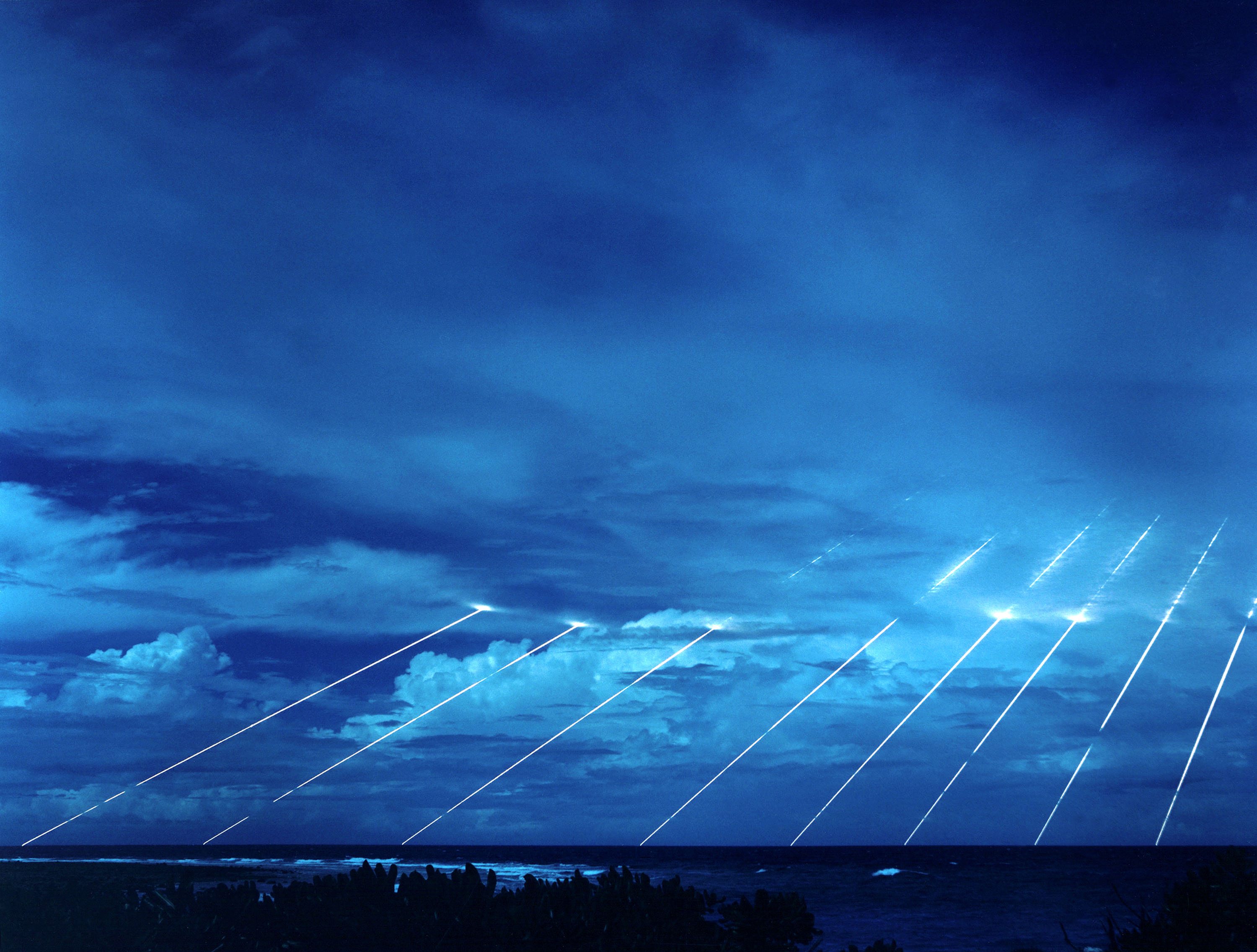
It would be a huge mistake for any country to launch a nuclear missile towards a foreign city. The world (mainly the US) would jump on them and whoever ordered that nuke would be dead very quickly.
The big problem with nuclear bombs is ensuring our borders and ensuring customs does a good job. A nuclear bomb has the problem of not leaving any trace or signature. How would you investigate it? There wouldn't be anything to investigate except where that plane or cargo ship came from.
If a plane from North Korea explodes with a nuclear bomb on it, then would we even be able to tell which plane exploded? The entire airport would be vaporized.
I honestly don't know how it hasn't happened already. People want to get rid of the NSA but maybe they're the only agency actually preventing this scenario by tracking most nuclear bombs. I can't imagine that all incoming cargo is screened sufficiently before it arrives in the US, it would truly be devastating for this to happen, all imports would be immediately halted. Maybe cargo ships or ports that export have some sort of device to detect nuclear weapons (I'm not sure how easy the are to detect).
Re: Chance of nuclear war is greater than you think
#8It might be hard for younger people to understand - but when films like The Terminator [1984] were made, this kind of thing had battered the news for decades, probably since the cuban missile crisis. The movies talked about a near future that many fully expected to happen. The endless hysteria and doom-mongering were enough to make many weary of the always-about-to-happen nuclear war, or devastating consequences of j…
A missile will probably not be launched, but a nuclear device smuggled in a cargo container or airplane (in a US harbor or airport) is a very real scenario. There would be no way to tell where the bomb came from or even what aircraft was carrying it.
Even if we knew the cargo or plane came from a hostile nation, would we immediately launch nuclear weapons at them? They would deny any involvement and I'm not sure that we could ever prove otherwise.
Re: Chance of nuclear war is greater than you think
#9So I read the actual publication[1], and it appears to be mostly a lot of conjecture, at best. The only actual risk assessment is in the appendix and matches the linked article. The 10% number cited by the article is the risk that this happens within 10 years using those numbers. However even the paper notes that the odds are time-invariant. This is quite unrealistic (which the paper fails to note) given that the geopolitical landscape has changed so much since the sample data used in the risk analysis. Instead we are asked to believe that US-Russian relations have not drastically changed since the sample data was taken. Indeed, "It also assumes that the ex- perience of the first 50 years of deterrence can be extended into the future." Given that the last sample point was 1984, this is, to put it mildly, ludicrous. It's more realistic to say that between 1945 and 1991 the risk of a Cuban Missile Crisis-type crisis causing a nuclear war was 6.5%33%10-50% per year, and since then it's been 0, than it is to say that (as of 2013) it's 3/(2013-1945)33%10-50% per year, let alone that it's .19-99% per year that the publication asserts.
Similarly, the author laments reduced public interest in disarmament because the perceived risk has gone down, but has done nothing at all to show that the perceived risk does not correlate with actual risk!
So what's the takeaway? It looks to me like the call for an in-depth risk analysis is warranted, but that the author is using sensational, cherry-picked, and unrealistic data to try to bolster support for it.
Re: Chance of nuclear war is greater than you think
#10It might be hard for younger people to understand - but when films like The Terminator [1984] were made, this kind of thing had battered the news for decades, probably since the cuban missile crisis. The movies talked about a near future that many fully expected to happen. The endless hysteria and doom-mongering were enough to make many weary of the always-about-to-happen nuclear war, or devastating consequences of j…
A missile will probably not be launched, but a nuclear device smuggled in a cargo container or airplane (in a US harbor or airport) is a very real scenario. There would be no way to tell where the bomb came from or even what aircraft was carrying it. Even if we knew the cargo or plane came from a hostile nation, would we immediately launch nuclear weapons at them? They would deny any involvement and I'm not sure that…
Indeed. It seems reasonable to postulate that a more 'unconventional' use of a nuclear weapon is the more likely scenario today. The documentary 'Count Down to Zero' discusses such scenarios (http://www.imdb.com/title/tt1572769/) at length and the impression left is somewhat terrifying. The solution? I haven't the foggiest as global disarmament seems unrealistic but the aspiration to progress beyond these ghastly devices as a global community is surely a sensible and just one.