Dark matter scaffolding of universe detected for the first time
1–10 of 51 posts
Re: Dark matter scaffolding of universe detected for the first time
#2This is really cool. If you look at this graph of the Standard Model interactions http://upload.wikimedia.org/wikipedia/commons/4/4c/Elementar... you will see the ways in which all of the particles we currently know about interact.
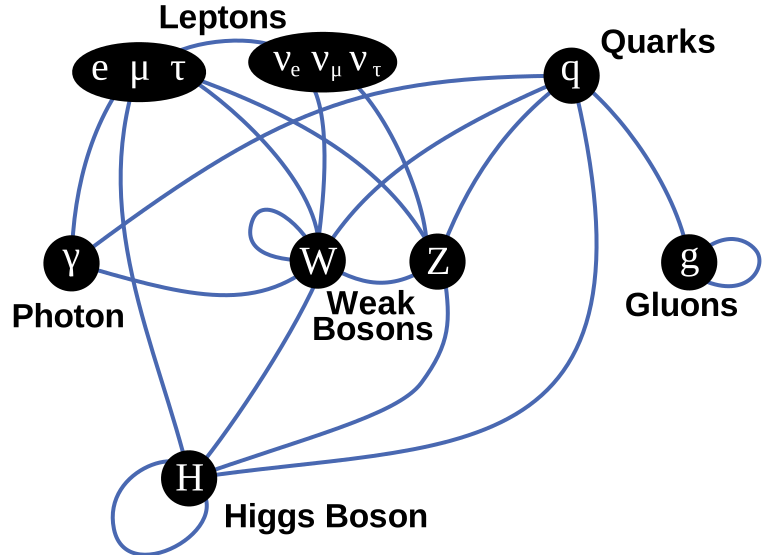
If you'll notice though, there's one interaction between ALL of the particles that is missing: gravity. Gravity affects anything with energy. Photons, leptons, quarks -- they are all attracted to each other because they possess energy (negligible, unmeasurable attractions, but still extant).
Wouldn't it be interesting if the only way that dark matter interacted with the other particles was through the gravitational force? Maybe from some alien's perspective it would constitute the matter of everyday life, but because it didn't interact with any of our particles except through gravity we would be missing out on a large aspect of our universe!
Furthermore, is it that far-fetched to think there might exist particles that do not interact at all with the ones we have discovered? Gluons, for example, only interact with themselves and with quarks. Some other particle may interact with nothing we are familiar with -- and thus we could never study it. Is it even "real" then?
(Any particle physicists on here, please feel free to educate me further!)
Re: Dark matter scaffolding of universe detected for the first time
#3It is worth noting that there was no direct detection of dark matter. It comes from a measurement of gravitational lensing, which has been going on for awhile˟˟.
Critical response: http://www.scilogs.eu/en/blog/the-dark-matter-crisis/2012-07...
Source: http://www.nature.com/nature/journal/v487/n7406/full/nature1...
˟˟ http://physicsworld.com/cws/article/news/2006/aug/25/gravity...
Re: Dark matter scaffolding of universe detected for the first time
#4Just as predicted by Mr. Jean-Pierre Petit: http://jp-petit.org/science/colloque2001/Colloque_2001_1.htm
Re: Dark matter scaffolding of universe detected for the first time
#5This is really cool. If you look at this graph of the Standard Model interactions http://upload.wikimedia.org/wikipedia/commons/4/4c/Elementar... you will see the ways in which all of the particles we currently know about interact. If you'll notice though, there's one interaction between ALL of the particles that is missing: gravity. Gravity affects anything with energy . Photons, leptons, quarks -- they are all attr…
> Some other particle may interact with nothing we are familiar with -- and thus we could never study it. Is it even "real" then?
Philosophically, this is equivalent to the question of whether other universes, which do not interact with ours and therefore we cannot study, exist or are "real". It is not a question that Science can answer.
Re: Dark matter scaffolding of universe detected for the first time
#6This is really cool. If you look at this graph of the Standard Model interactions http://upload.wikimedia.org/wikipedia/commons/4/4c/Elementar... you will see the ways in which all of the particles we currently know about interact. If you'll notice though, there's one interaction between ALL of the particles that is missing: gravity. Gravity affects anything with energy . Photons, leptons, quarks -- they are all attr…
> Some other particle may interact with nothing we are familiar with -- and thus we could never study it. Is it even "real" then? Philosophically, this is equivalent to the question of whether other universes, which do not interact with ours and therefore we cannot study, exist or are "real". It is not a question that Science can answer.
I think it's very interesting that there's reasonable questions about things that science can't answer. If you can't study it, can't predict it, or can't reproduce it, then it isn't in the domain of science.
Re: Dark matter scaffolding of universe detected for the first time
#7This is really cool. If you look at this graph of the Standard Model interactions http://upload.wikimedia.org/wikipedia/commons/4/4c/Elementar... you will see the ways in which all of the particles we currently know about interact. If you'll notice though, there's one interaction between ALL of the particles that is missing: gravity. Gravity affects anything with energy . Photons, leptons, quarks -- they are all attr…
Gluons also interact gravitationally, like anything with energy. So would any other hypothetical particle, since it would have to have energy to exist at all.
Re: Dark matter scaffolding of universe detected for the first time
#8This is really cool. If you look at this graph of the Standard Model interactions http://upload.wikimedia.org/wikipedia/commons/4/4c/Elementar... you will see the ways in which all of the particles we currently know about interact. If you'll notice though, there's one interaction between ALL of the particles that is missing: gravity. Gravity affects anything with energy . Photons, leptons, quarks -- they are all attr…
Gluons also interact gravitationally, like anything with energy. So would any other hypothetical particle, since it would have to have energy to exist at all.
I said earlier in the post "there's one interaction between ALL of the particles that is missing: gravity", so it was implied. Perhaps I should have made that a little clearer.
Re: Dark matter scaffolding of universe detected for the first time
#9Earlier quoted context omitted.
> Some other particle may interact with nothing we are familiar with -- and thus we could never study it. Is it even "real" then? Philosophically, this is equivalent to the question of whether other universes, which do not interact with ours and therefore we cannot study, exist or are "real". It is not a question that Science can answer.
I think it's very interesting that there's reasonable questions about things that science can't answer. If you can't study it, can't predict it, or can't reproduce it, then it isn't in the domain of science.
> can't predict it
This is the one a lot of people miss out on. Standard theories predict several types of "other universes"--thus that question is answered from science's view, it's just not an answer people like. See http://arxiv.org/pdf/astro-ph/0302131v1 for a general overview. "Containing unobservable entities does clearly not per se make a theory non-testable."
Re: Dark matter scaffolding of universe detected for the first time
#10There's one thing I don't understand about the mystery of dark matter. I don't understand why the simple explanation for it isn't just that it's regular matter that is not stars. Maybe there are just bajillions of planets and dust clouds out there. Matter that isn't directly circling stars, thus not reflecting light. Why is the popular assumption that if the mass isn't stars or things in orbit of stars, that it must be a mystery substance? I assume there's scientific reasoning behind this, but I've never heard it explained before. If someone could fill me in, that would be awesome.