Building a BitTorrent client from the ground up in Go (2020)
1–10 of 93 posts
Re: Building a BitTorrent client from the ground up in Go (2020)
#2Very cool, and surprisingly simple. I was always mystified as a kid how these file-sharing protocols actually work, but if you just look at a torrent as a collection of fixed-size pieces you are asking peers managed by a tracker for, it becomes really straightforward to implement.
Now I wonder how clients protect themselves against abusers (i.e.. people who never upload a single bit but only download). I often noticed that when I set the maximum upstream to 0, clients would stop sending me pieces. Do clients share a predefined list of configuration parameters with each other or with the tracker (Max upstream, max downstream, etc.)? Or is it something more sophisticated?
Re: Building a BitTorrent client from the ground up in Go (2020)
#3i wanted to do the same when i got fed up with bt clients. but then i found there already are go clients and i found i like qbt. but it is a good read nevertheless.
Re: Building a BitTorrent client from the ground up in Go (2020)
#4CodeCrafters has a BitTorrent client building challenge that I watched Jon Gjengset do on a stream, if someone wants to try and build their own client in an iterative and checked way.
Re: Building a BitTorrent client from the ground up in Go (2020)
#5This looks surprisingly simple. A perfect project to learn programming language by creating thing you can interact with and not get overwhelmed by domain complexity.
Do you know more such problems?
Re: Building a BitTorrent client from the ground up in Go (2020)
#6This looks simple not only because the article is written well but also because Go is the go-to-language for complex networking situations. Doing things in parallel, even pipelining? This would make quite some spaghetti algorithm in C/C++, even async rust/python world would not look so clean as in Go. This is clearly a big strength of the language.
Re: Building a BitTorrent client from the ground up in Go (2020)
#7This looks simple not only because the article is written well but also because Go is the go-to-language for complex networking situations. Doing things in parallel, even pipelining? This would make quite some spaghetti algorithm in C/C++, even async rust/python world would not look so clean as in Go. This is clearly a big strength of the language.
> Go is the go-to-language for complex networking situations
And Elixir / Erlang for serious ones.
Re: Building a BitTorrent client from the ground up in Go (2020)
#8This looks simple not only because the article is written well but also because Go is the go-to-language for complex networking situations. Doing things in parallel, even pipelining? This would make quite some spaghetti algorithm in C/C++, even async rust/python world would not look so clean as in Go. This is clearly a big strength of the language.
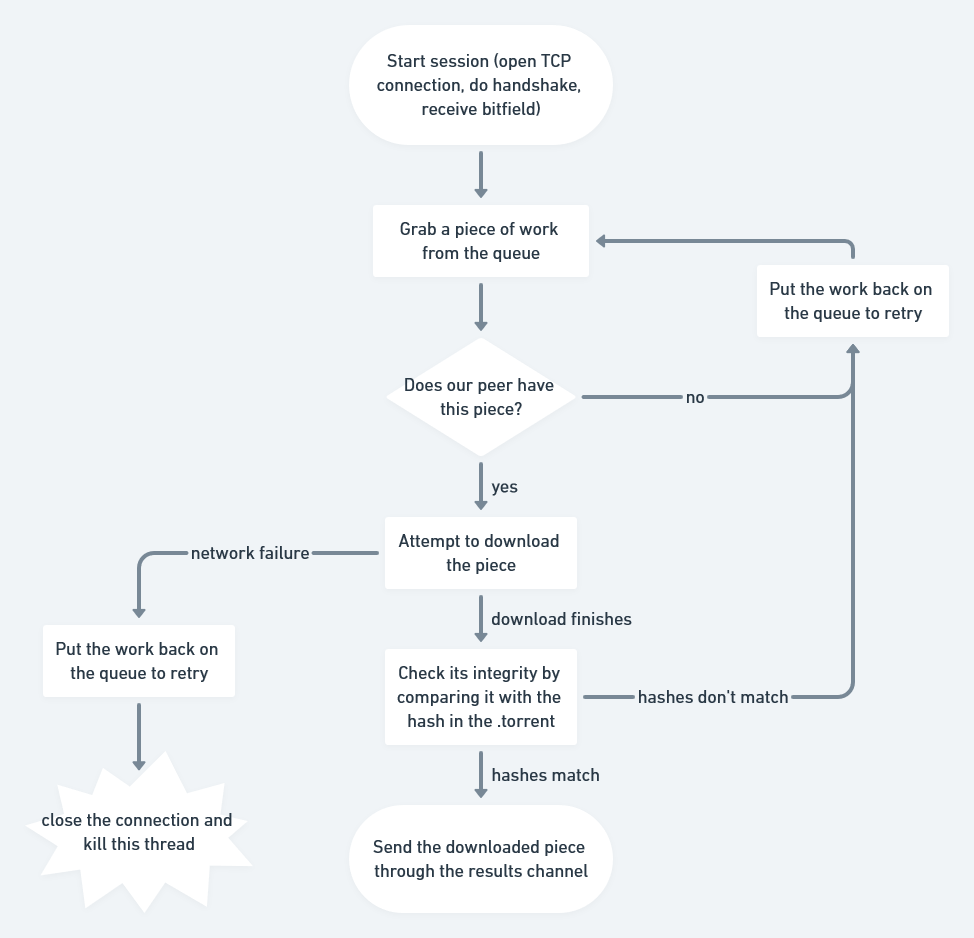
Agree with C and old style C++, but going off the flowchart [1] in the article this could be done quite cleanly with boost::asio and C++20 coroutines as well.
Re: Building a BitTorrent client from the ground up in Go (2020)
#9Very cool, and surprisingly simple. I was always mystified as a kid how these file-sharing protocols actually work, but if you just look at a torrent as a collection of fixed-size pieces you are asking peers managed by a tracker for, it becomes really straightforward to implement. Now I wonder how clients protect themselves against abusers (i.e.. people who never upload a single bit but only download). I often notice…
There's private tracker which forces their user to upload.
Re: Building a BitTorrent client from the ground up in Go (2020)
#10One thing that I find hard to understand is how you're able to connect to a random peer online with just an IP and port combination. The peer is likely behind a NAT proxy, and never communicated with you to begin with. In my head, NAT shouldn't allow this connection through, or be able to associate the port with the individual peer machine since the connection source (you) is arbitrary.
This is possible with port forwarding. But that's a niche set of peers, who have the power to configure port forwarding on a NAT proxy.