Lingua Graeca Per Se Illustrata
seumasjeltzz.github.io
Lingua Graeca Per Se Illustrata
1–10 of 71 posts
Re: Lingua Graeca Per Se Illustrata
#2I was concerned that the Latin title might be a bad sign, but it turns out the main title is Ἡ Ἑλληνικὴ γλῶσσα καθ᾿ αὑτὴν φωτιζομένη and the Latin is only an explanation for people who are familiar with Lingua Latina Per Se Illustrata.
Re: Lingua Graeca Per Se Illustrata
#3Thank you for posting this! I gave myself a pat on the back for being able to get through the first chapter unaided thanks to my A-Level in Greek mumble years ago...
Re: Lingua Graeca Per Se Illustrata
#4The idea seems cool but I don't understand how this is meant to be used in practice, for a beginner. As support for a structured course?
Re: Lingua Graeca Per Se Illustrata
#5The idea seems cool but I don't understand how this is meant to be used in practice, for a beginner. As support for a structured course?
> Can I use LGPSI to teach myself Greek? Honestly, not yet. Would I like LGPSI to get to the point where you could entirely use it, by itself, by yourself, to learn Greek (as you can do with LLPSI)? Yes, certainly. It's not at that point, and I don't expect it to reach that point especially quickly.
https://seumasjeltzz.github.io/LinguaeGraecaePerSeIllustrata...
Re: Lingua Graeca Per Se Illustrata
#6[deleted]
Re: Lingua Graeca Per Se Illustrata
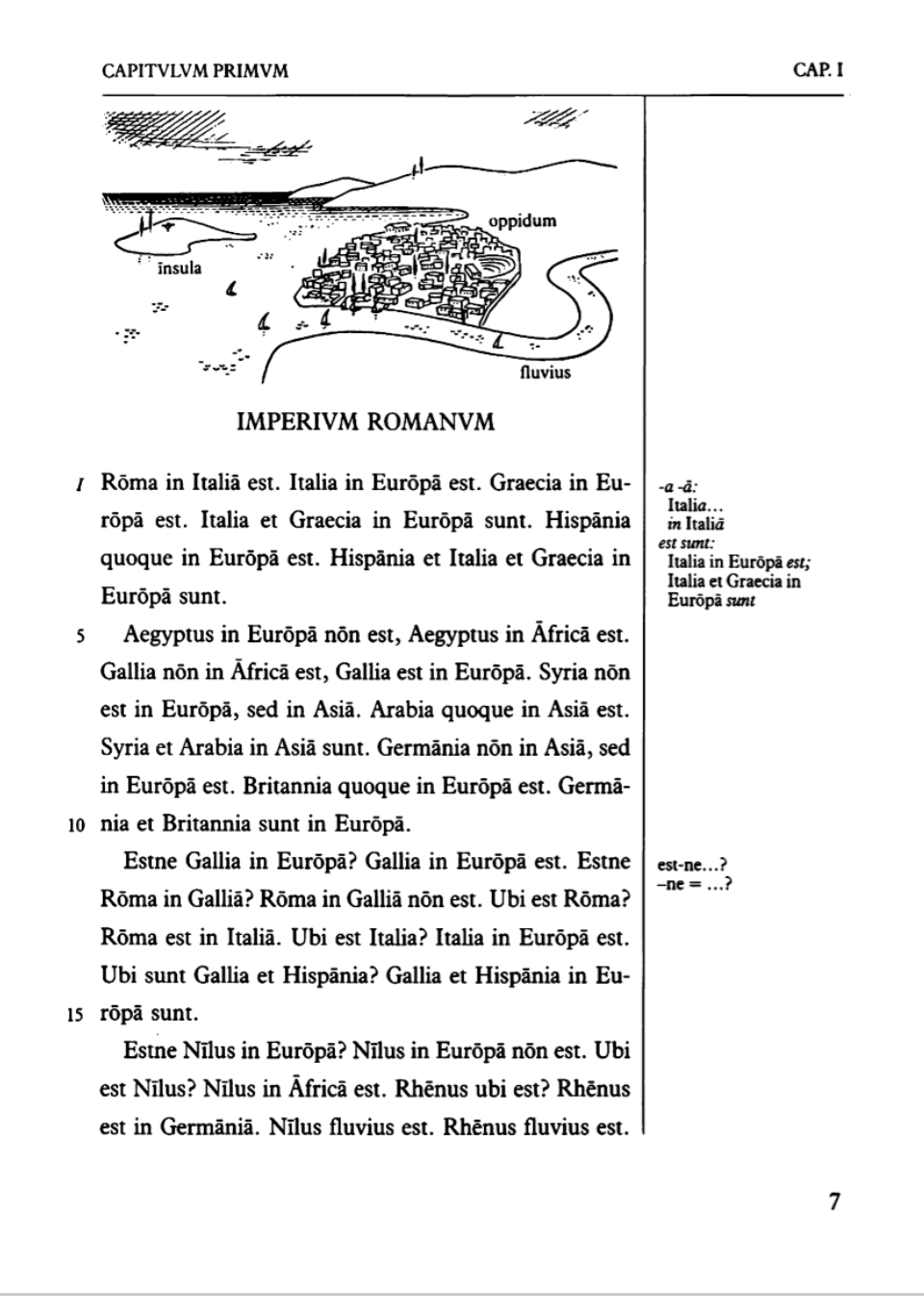
#7This is clearly riffing on Ørberg's Lingua Latīna per sē illūstrāta, which is a great introductory book to teaching yourself Latin. There are no explanations of anything; you have to deduce the meaning of the Latin phrases using the contextual clues given to you in the form of pictures and maps. And it works well.
Re: Lingua Graeca Per Se Illustrata
#8This is clearly riffing on Ørberg's Lingua Latīna per sē illūstrāta , which is a great introductory book to teaching yourself Latin. There are no explanations of anything; you have to deduce the meaning of the Latin phrases using the contextual clues given to you in the form of pictures and maps. And it works well.
Duolingo also has a Latin course:
* https://www.duolingo.com/course/la/en/Learn-Latin
Haven't tried it myself.
Re: Lingua Graeca Per Se Illustrata
#9For reference: this book is obviously a (praiseworthy) ambition to have a Greek counterpart to the Lingua Latina Per Se Illustrata[1] by Hans Ørberg.
Ørberg's way of teaching Latin is, in my view, excellent because it is based on a natural view of learning a language: show something, say what its name is, use its name in simple sentences, work up from there. Each time introducing new words surrounded by already-known ones and letting the pupil figure it out. All in the target language itself, exactly how we acquired our mother tongues. Vocabulary is acquired through repetition, grammar is acquired through "getting a feel for what sounds right". Using the brain's own mechanisms for deducing meaning and deriving rules.
The book is definitely going to need illustrations, just like in LLPSI[2]. Hard to understand what 'πόλις' means per se, but not if I take you up a mountain and point at [3] while saying "πόλις".
[1] https://en.wikipedia.org/wiki/Hans_%C3%98rberg
[2] https://blog.nina.coffee/img/lingua-latina.png
[3] https://i.pinimg.com/originals/f5/c3/10/f5c31074eeb418bc51e7...

Re: Lingua Graeca Per Se Illustrata
#10For reference: this book is obviously a (praiseworthy) ambition to have a Greek counterpart to the Lingua Latina Per Se Illustrata[1] by Hans Ørberg. Ørberg's way of teaching Latin is, in my view, excellent because it is based on a natural view of learning a language: show something, say what its name is, use its name in simple sentences, work up from there. Each time introducing new words surrounded by already-known…
Also worth pointing out that LLPSI is essentially Hans Ørberg's life's work. It's been adjusted and fine-tuned for decades, and it really shows.
While at a surface level it looks fairly simple, it is no small task to repeat the process with another language.