Why “direct” PostScript makes sense
anastigmatix.net
Why “direct” PostScript makes sense
1–10 of 28 posts
Re: Why “direct” PostScript makes sense
#2I'm not sure I'd ever try it myself — for one thing, PostScript would only be useful for preparing documents destined for print, not HTML — but if I ever did need such a thing, I'd be interested to try it out.
Re: Why “direct” PostScript makes sense
#3I'm not sure I'd ever try it myself — for one thing, PostScript would only be useful for preparing documents destined for print, not HTML — but if I ever did need such a thing, I'd be interested to try it out.
Whether the rasterization in the end targets a printer or it ends up in a .png doesn't really matter at all.
But yeah, sadly there's no readily available system nowadays with true Display PostScript. Not very likely that Oracle will release the NeWS sources, and OS X switched to DirectPDF.
Have to check GNUStep…
Re: Why “direct” PostScript makes sense
#4I like hand-coding PostScript. Been doing it since the early 90's. It doesn't need to be a mess and can be beautifully concise and clean. It does have some odd ideas for the beginner (the page always starts at the bottom left coordinate and goes up, not down) but that's not hard.
Its a very cool language -- Forth derived.
Re: Why “direct” PostScript makes sense
#5I'm not sure I'd ever try it myself — for one thing, PostScript would only be useful for preparing documents destined for print, not HTML — but if I ever did need such a thing, I'd be interested to try it out.
Whether the rasterization in the end targets a printer or it ends up in a .png doesn't really matter at all. But yeah, sadly there's no readily available system nowadays with true Display PostScript. Not very likely that Oracle will release the NeWS sources, and OS X switched to DirectPDF. Have to check GNUStep…
Yes, OS X uses direct PDF to write to the screen, and will helpfully rasterise PS to PDF on the fly.
The 3B2 typesetting system does write display PS to the screen, though. Even the old DOS version.
Re: Why “direct” PostScript makes sense
#6I like hand-coding PostScript. Been doing it since the early 90's. It doesn't need to be a mess and can be beautifully concise and clean. It does have some odd ideas for the beginner (the page always starts at the bottom left coordinate and goes up, not down) but that's not hard. Its a very cool language -- Forth derived.
I like to write Perl scripts which generate Postscript pictures. It gives me better interactivity of Perl development combined with the exactness of the results of Postscript.
The end result is usually a PDF file.
Still I've never learned to embed external fonts in my scripts, does anybody have some straightforward text about that part? As far as I know I'm legally 100% clean if I manage to use any font as long as I only distribute the PDF at the end.
Re: Why “direct” PostScript makes sense
#7I like hand-coding PostScript. Been doing it since the early 90's. It doesn't need to be a mess and can be beautifully concise and clean. It does have some odd ideas for the beginner (the page always starts at the bottom left coordinate and goes up, not down) but that's not hard. Its a very cool language -- Forth derived.
I remember back in the days of "early" Linux, when printer drivers were still a bit rare, there was lots of software that generated somewhat readable PS, i.e. the programmers wrote it and then used it as a template, like you'd be using HTML templates nowadays. The timetables for a German railway info site did that.
And I made heavy use of Jamie Zawinski's audio-tape.ps [1] back then. Never got through Thinking in PostScript [2] completely, though…
Re: Why “direct” PostScript makes sense
#8PDF displaced Postscript for two reasons: (i) lower resource usage, and (ii) better handling of fonts.
Since then PDF has become more sophisticated, handling metadata, tagging, and embedding media. It's been a long time since Postscript has been "the universal language for graphical and printed work".
A shame, since Postscript is fun.
Re: Why “direct” PostScript makes sense
#9I like hand-coding PostScript. Been doing it since the early 90's. It doesn't need to be a mess and can be beautifully concise and clean. It does have some odd ideas for the beginner (the page always starts at the bottom left coordinate and goes up, not down) but that's not hard. Its a very cool language -- Forth derived.
I like to write Perl scripts which generate Postscript pictures. It gives me better interactivity of Perl development combined with the exactness of the results of Postscript. The end result is usually a PDF file. Still I've never learned to embed external fonts in my scripts, does anybody have some straightforward text about that part? As far as I know I'm legally 100% clean if I manage to use any font as long as I…
It's been a long time since, but as far as I remember it basically boils down to pasting the pfa into your file (pfb2pfa is your friend here).
And it totally is a murky legal situation, many fonts don't allow embedding into a pdf, and you may not use almost all fonts in any way at all if you do not have a valid license. Fonts in the abstract may or may not be copyrightable depending on where you live, but the actual pfa-code you put in your file and the representation generated from that when converting to PDF definitely are.
Re: Why “direct” PostScript makes sense
#10I've written piles of "Direct PostScript" code for the NeWS window system -- http://en.wikipedia.org/wiki/NeWS ...
Pie menu widget: http://www.donhopkins.com/home/code/piemenu.ps.txt
PizzaTool graphical Pizza ordering gui: http://www.donhopkins.com/home/code/pizzatool.ps.txt Illustration: http://www.donhopkins.com/home/catalog/images/pizzatool.gif
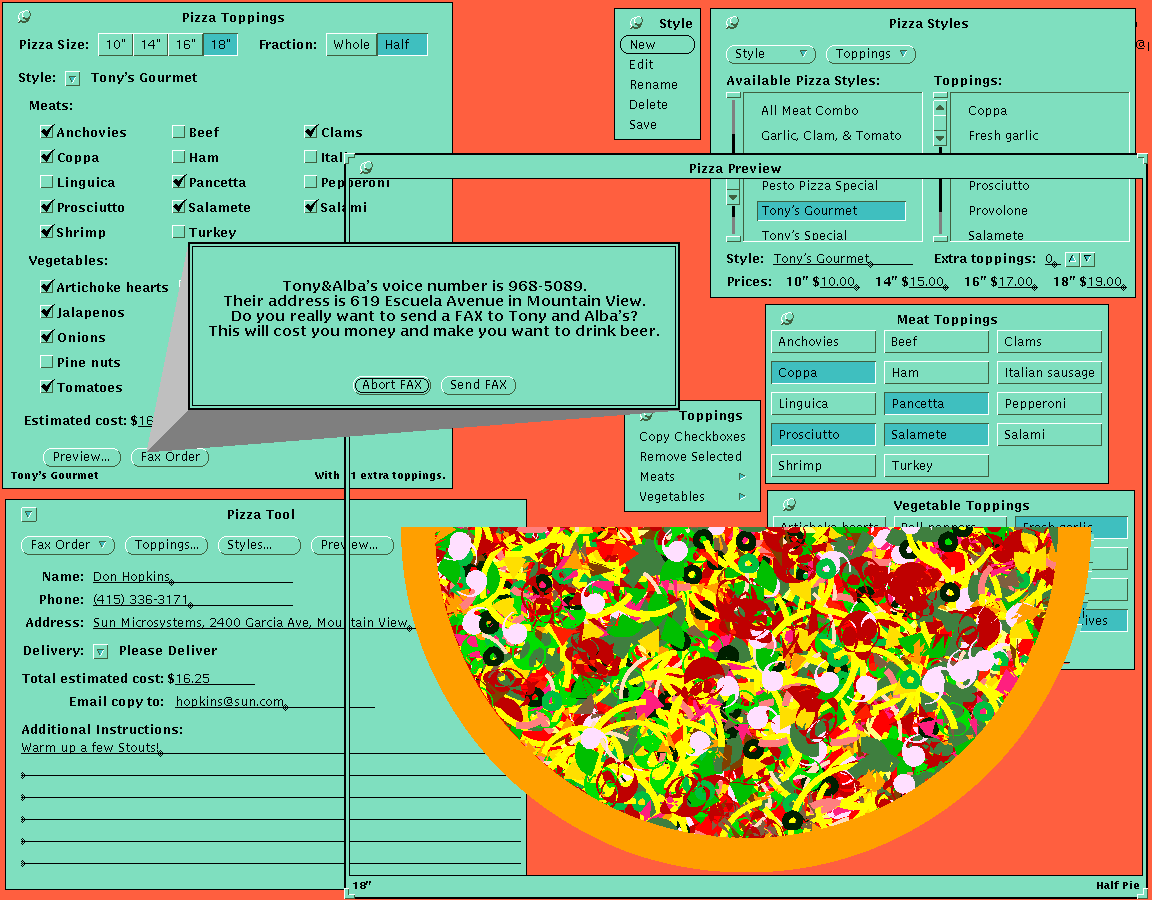
VT100 terminal emulator: http://www.donhopkins.com/home/code/newterm.ps.txt
UniPress (Gosling) Emacs display driver: http://www.donhopkins.com/home/code/emacs.ps.txt
Metacircular PostScript interpreter: http://www.donhopkins.com/home/code/ps.ps.txt
PSIBER Space Deck (visual PostScript debugger and programming environment): http://www.donhopkins.com/home/code/litecyber.ps.txt More about that: http://www.donhopkins.com/drupal/node/97
A lunar lander game James Gosling wrote in 1988: http://www.donhopkins.com/home/code/lander.ps.txt
HeapSort by Owen Densmore: http://www.donhopkins.com/home/code/heapsort.ps.txt
QuickSort by Don Woods (an incredibly twisty maze of stack manipulation, by the Adventure dude): http://www.donhopkins.com/home/code/quicksort.ps.txt
BubbleSort by Bobo Leffler (he was afraid this might come back to haunt him): http://www.donhopkins.com/home/code/bubblesort.ps.txt