The Hotdog web browser and browser engine
1–10 of 148 posts
Re: The Hotdog web browser and browser engine
#2I was really hoping that this was some sort of reboot of the HotDog[0] HTML editor by Sausage Software[1].
[0] https://archive.org/details/tucows_194462_HotDog_Professiona...
Re: The Hotdog web browser and browser engine
#3I was really hoping that this was some sort of reboot of the HotDog[0] HTML editor by Sausage Software[1]. [0] https://archive.org/details/tucows_194462_HotDog_Professiona... [1] https://en.wikipedia.org/wiki/Sausage_Software
I thought the same thing! I was pretty excited.
https://web.archive.org/web/20020603235020/http://www.sausag...
https://web.archive.org/web/20040605112000/http://www.sausag...
Re: The Hotdog web browser and browser engine
#4I was really hoping that this was some sort of reboot of the HotDog[0] HTML editor by Sausage Software[1]. [0] https://archive.org/details/tucows_194462_HotDog_Professiona... [1] https://en.wikipedia.org/wiki/Sausage_Software
Same. Hotdog was the first html editor I ever used as a kid and got me interested in creating on the internet. It felt revolutionary to me.
Re: The Hotdog web browser and browser engine
#5Ultimately, pursuing a full-featured graphical web browser might not be the right approach for a volunteer-/hobby-driven project to develop a web browser. But it would absolutely make sense that a newly implemented terminal-based browser in Go (or any other memory-safe language) could/should replace Lynx and w3m.
It's actually pretty surprising that there hasn't been a niche surge in websites specifically meant to work well in textmode browsers, considering how many programmers claim to spend 90% of their time inside either a terminal window or in a web browser. Even now on HN I'm typing this in Firefox. And Sourcehut, too is widely acclaimed for being "simple" and/or "minimal", but it's not exactly great (or even clear) to look at in the two browsers I just checked.
Re: The Hotdog web browser and browser engine
#6I think it's a cool project, and might even lead somewhere. At the moment we badically have only Webkit and Mozilla baded browsers available
It definitely shows how mature and versatile golang has become.
Are you building this based on a tutorial?
Re: The Hotdog web browser and browser engine
#7I was really hoping that this was some sort of reboot of the HotDog[0] HTML editor by Sausage Software[1]. [0] https://archive.org/details/tucows_194462_HotDog_Professiona... [1] https://en.wikipedia.org/wiki/Sausage_Software
Gotta be a nod, right?
Re: The Hotdog web browser and browser engine
#8Ultimately, pursuing a full-featured graphical web browser might not be the right approach for a volunteer-/hobby-driven project to develop a web browser. But it would absolutely make sense that a newly implemented terminal-based browser in Go (or any other memory-safe language) could/should replace Lynx and w3m. It's actually pretty surprising that there hasn't been a niche surge in websites specifically meant to wo…
This has been happening, just not really on the web. It’s more located on protocols like gopher[0] or Gemini[1].
Gemini in particular has quite a large amount of projects hosted on sourcehut, and sourcehut even serves pages on its new pages service to Gemini.
Re: The Hotdog web browser and browser engine
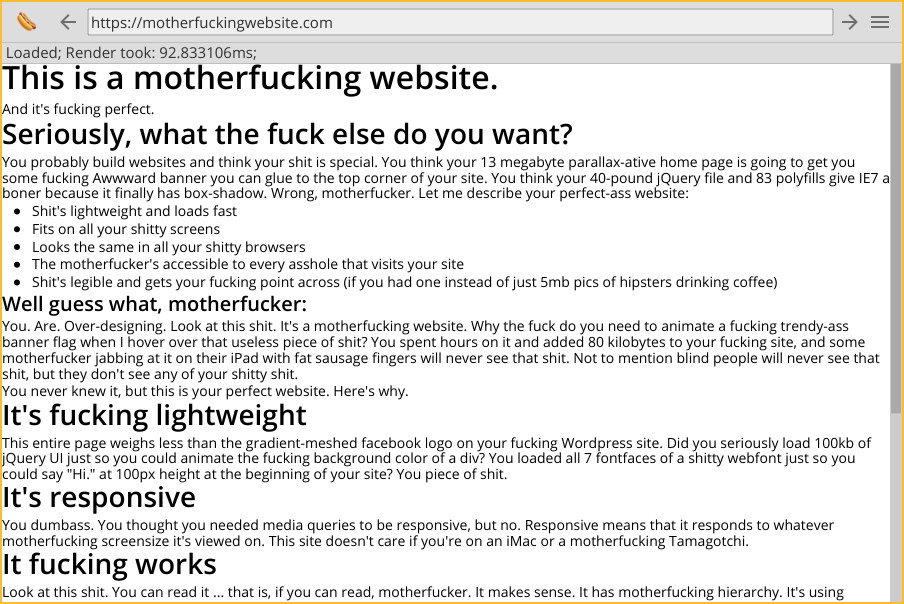
#9Screenshots are LACED chalk-full of explicit vocabulary...
https://raw.githubusercontent.com/danfragoso/thdwb/master/im...
Re: The Hotdog web browser and browser engine
#10It's great to see yet another attempt at writing a web browser --- and I say this as someone who has been (slowly) working on one myself.
The browser is far from stable, spec-compliant, or even really useful, but, I'm slowly working on bringing more features and supporting more sites.
When the specs are constantly churning in order to keep one gigantic company's browser an effective monopoly, maybe it isn't really that important to follow them so closely... especially if you're aiming for something more like an actually-user-friendly (i.e. with the UI and controls you actually want, not some designer's flavour-of-the-month) hypertext document viewer than a web application runtime/OS. From that perspective, even HTML4+CSS2 would probably be quite sufficient.
Maybe if enough of these "minimal browsers" show up, people might even realise that basic HTML and CSS is quite sufficient for a lot of things and start creating simpler, more efficient sites, thus dissolving the monopoly. I realise it's going to be extremely difficult to fight corporate interests, but one can hope and dream...