Why Jewish History Is So Hard to Write
newyorker.com
Why Jewish History Is So Hard to Write
1–10 of 165 posts
Re: Why Jewish History Is So Hard to Write
#2Schama who the article discusses produced a similar series that's on prime:
Re: Why Jewish History Is So Hard to Write
#3Schama who the article discusses produced a similar series that's on prime: https://www.amazon.com/In-the-Beginning/dp/B00J97O91Q/
If you're UK based then it's on iPlayer:
https://www.bbc.co.uk/iplayer/episode/b0398rkj/the-story-of-...
I actually started watching last night after never really been taught (or remember being taught) much about them.
Re: Why Jewish History Is So Hard to Write
#4There are much earlier archaeological artefacts including stone writing from much earlier than 457 B.C. This is the time after the destruction of the first temple by the Babylonians who dispersed the Jews around the area. Since then there were Jewish communities all over the middle east including in Egypt. I don't understand why the writer of the article is so baffled about this.
Just as an example, the Merneptah Stele is the first to mention the name Israel and is dated to 1203 BC. Ahab and Omri the Israeli biblical kings are mentioned in the Kurkh Monoliths and the Mesha Stele from 850 BC so to start to research Jews just from 457 BC looks a bit too late in the game.
Re: Why Jewish History Is So Hard to Write
#5Wow amazing how the bound of religion and ethinicy can led people to survive thousands of years and still maintain an identity.
Re: Why Jewish History Is So Hard to Write
#6Wow amazing how the bound of religion and ethinicy can led people to survive thousands of years and still maintain an identity.
I didn't got that from the article. As far I understood it, during all this time, multiple iddentities appeared, evolved, split and disappeared, even if all can be traced back to the original Israel Kingdom.
Re: Why Jewish History Is So Hard to Write
#7Wow amazing how the bound of religion and ethinicy can led people to survive thousands of years and still maintain an identity.
Not strange at all, integration is an exception more than the norm. The various chinatowns, italian quarters, irish quarters etc should be a testament to that: communities always tried to stick together thorough time and space, now and in the past. There are comparatively few cases of succesful long term non violent integration.
Re: Why Jewish History Is So Hard to Write
#8Wow amazing how the bound of religion and ethinicy can led people to survive thousands of years and still maintain an identity.
Not strange at all, integration is an exception more than the norm. The various chinatowns, italian quarters, irish quarters etc should be a testament to that: communities always tried to stick together thorough time and space, now and in the past. There are comparatively few cases of succesful long term non violent integration.
> There are comparatively few cases of succesful long term non violent integration.
I beg to differ. I live in Eastern Europe, at the crossroads of different migration waves, and I'd say we've been quite successful at integrating people over the millennia. Just look at this widely circulated genetic map of Europe (http://brilliantmaps.com/wp-content/uploads/2015/04/genetic-...), you can see that Romania (the country from where I'm from) is pretty diverse, and that happened because we're at the crossroads between "mainland" Europe, the Asian steppes, Anatolia/the Middle East etc.
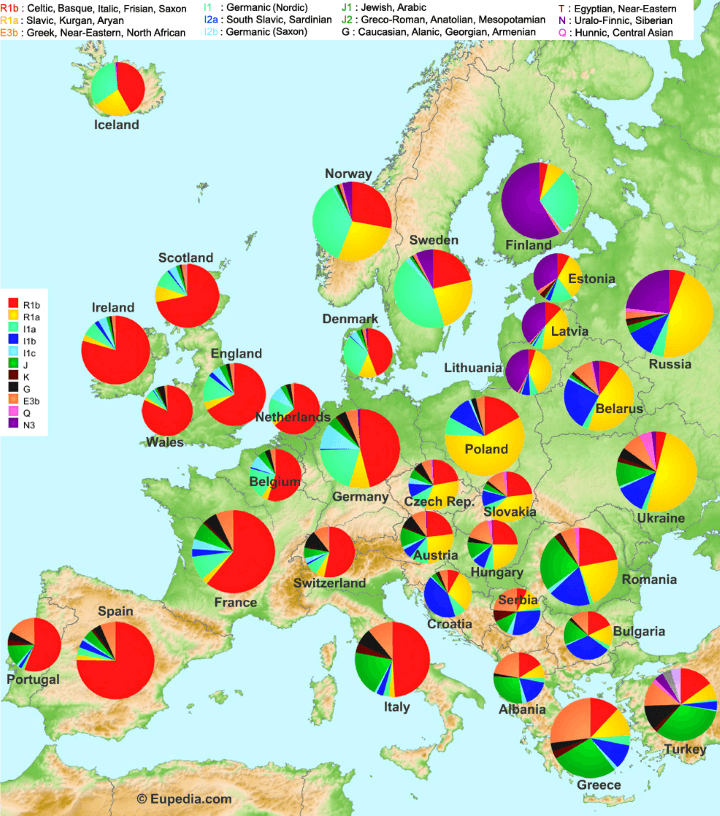
And looking past genetics, I can give you countless examples of Transylvanian Saxons and Hungarians who, once they had passed the Carpathians into Wallachian and Moldavian lands, ended up by giving up their religion and language and completely assimilated (yeah, it took them a couple of generations or more, but the process was generally irreversible). The local Jews were also quite well integrated in terms of customs and everything, in fact one of the most famous Yiddish songs ("Roumania Roumania - https://www.youtube.com/watch?v=vuj-qjyUjxY") mentions Romanian foods like "mamaliga" or "pastrama" (which we stole from the Turks, but everybody from the Balkans did that) in a melancholic way, like it also belonged to them, the Jewish people who used to live here.
Re: Why Jewish History Is So Hard to Write
#9There are much earlier archaeological artefacts including stone writing from much earlier than 457 B.C. This is the time after the destruction of the first temple by the Babylonians who dispersed the Jews around the area. Since then there were Jewish communities all over the middle east including in Egypt. I don't understand why the writer of the article is so baffled about this. Just as an example, the Merneptah Ste…
Not (known if) specifically Jewish but there is a semitic slave figure in the Hecht Museum [1] from 18-19 Century BCE: https://en.wikipedia.org/wiki/File:Figurine_from_Egypt_of_se...
.jpg)
[1] https://en.wikipedia.org/wiki/File:Figurine_from_Egypt_of_se...
Re: Why Jewish History Is So Hard to Write
#10Wow amazing how the bound of religion and ethinicy can led people to survive thousands of years and still maintain an identity.
There is little in the way of ethnicity. Ashkenazi Jews are an ethnicity, Jews in general, aren't. They even spoke different languages before Hebrew became a thing in early XX century, and many of them still do.