There's No Fire Alarm for Artificial General Intelligence
intelligence.org
There's No Fire Alarm for Artificial General Intelligence
1–10 of 209 posts
Re: There's No Fire Alarm for Artificial General Intelligence
#2The crisis narrative is, roughly "somebody will do something bad like pollute the earth".
Well, that's a bit vague. Speaking of the future of the earth and unspecified miracles is a matter of scripture. The thinking is, if we can't fit a crisis about artificial intelligence into a crisis narrative, then we have some other unspecified crisis, a newsroom crisis.
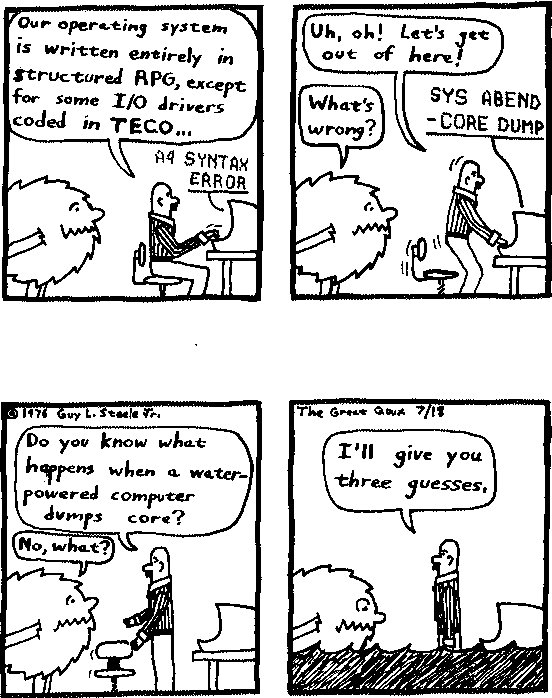
In other words, the crisis is that you can't fit one crisis you expected into a crisis narrative because the crisis isn't arriving on time. It's either too late or the data is wrong or the Russians hacked us or some other unforeseen catastrophe is interfering...or the monster artificial intelligence with a robot army is actually a water-based computer.
Re: There's No Fire Alarm for Artificial General Intelligence
#3That seems to be a very interesting article. However, it’s quite long. Anybody ok with writing a short synthesis or abstract? Thanks
Re: There's No Fire Alarm for Artificial General Intelligence
#4Why AGI and not "Artificial Consciousness" ? Is it because people think that consciousness is a by-product emerging from many kinds of pattern detection algorithms that suit all cases? (if so, what is the evidence for that?)
Re: There's No Fire Alarm for Artificial General Intelligence
#5The only non-speculative and relevant claim here is that the experts were wrong about Winograd Schemas. The paper Eliezer cites to prove that we've made unexpected progress in Winograd Schemas only deals with a very specific type of Winograd Schemas, and not an arbitrary one. This is awfully dishonest for someone purporting to be a skepticist.
Also, the wording seems to imply that WS performance is already pretty high in the 50%-60% range. WS is a binary task. Randomly picking the answer would have 50% accuracy. Even 70% performance on a small subset of typed WS is pretty bad, and as the authors point out in the paper, this is a start, and far from a breakthrough that would make experts/predictors nervous.
Trust the experts, please. They are wrong a lot, but the best policy is still to trust the experts and not charlatans who want to monetize fear, especially when the charlatans themselves make zero falsifiable claims, and are simply turning the table to say "Why can't YOU prove to me that God doesn't exist?".
This debate is so easily won by them. Simply come up with a falsifiable claim about the short-term future. What will the AI community get done in 2 years according to you, that all AI experts right now will say is impossible? When that thing does get done, everyone would convert. Win!
Alphago was not such an event. Yes, we did predict that Alphago is decades away, but that's assuming that academics will continue working on it at their pace using their limited resources. No expert was surprised with Alphago. No expert will be surprised when Starcraft or Dota is solved. It's simply a matter of compute and some tricks here and there. Why? Because these are closed systems, with good simulators available. You just need to keep playing and storing the actions in a big lookup table a la Ned Block, and you're done.
Re: There's No Fire Alarm for Artificial General Intelligence
#6That seems to be a very interesting article. However, it’s quite long. Anybody ok with writing a short synthesis or abstract? Thanks
I think the strongest point in the article is this: "After the next breakthrough [in AI], we still won’t know how many more breakthroughs are needed, leaving us in pretty much the same epistemic state as before." That means that if we aren't prepared to start work on AI alignment now, there's not likely to be any sort of future event that will convince us of that.
Re: There's No Fire Alarm for Artificial General Intelligence
#7That seems to be a very interesting article. However, it’s quite long. Anybody ok with writing a short synthesis or abstract? Thanks
> One of the major modes by which hindsight bias makes us feel that the past was more predictable than anyone was actually able to predict at the time, is that in hindsight we know what we ought to notice, and we fixate on only one thought as to what each piece of evidence indicates. If you look at what people actually say at the time, historically, they’ve usually got no clue what’s about to happen three months before it happens, because they don’t know which signs are which.
> When I observe that there’s no fire alarm for AGI, I’m not saying that there’s no possible equivalent of smoke appearing from under a door.
> What I’m saying rather is that the smoke under the door is always going to be arguable; it is not going to be a clear and undeniable and absolute sign of fire; and so there is never going to be a fire alarm producing common knowledge that action is now due and socially acceptable.
Should give you the general idea.
Re: There's No Fire Alarm for Artificial General Intelligence
#8That seems to be a very interesting article. However, it’s quite long. Anybody ok with writing a short synthesis or abstract? Thanks
It's worth reading. With that said, the jist is that for every technological advance that hindsight will later show to be a precursor to AGI, it will be easy for AI "luminaries" to explain why it is not AGI, until it is, and then it will be too late.
Re: There's No Fire Alarm for Artificial General Intelligence
#9The only non-speculative and relevant claim here is that the experts were wrong about Winograd Schemas. The paper Eliezer cites to prove that we've made unexpected progress in Winograd Schemas only deals with a very specific type of Winograd Schemas, and not an arbitrary one. This is awfully dishonest for someone purporting to be a skepticist. Also, the wording seems to imply that WS performance is already pretty hig…
If the article's main claim was "AGI is imminent", that would be a valid criticism. But it isn't (as the article says explicitly). The main claim is that technological progress is hard to forecast in general, especially for those not personally at the cutting edge of the field, and that almost no one right now is even really trying. Therefore, we should be very uncertain about AGI timelines. There's plenty of historical evidence, both in this article and elsewhere, to back up those claims.
(edit: I think your point about Winograd as a binary task not being explained clearly is valid, but that's not the article's main focus)
(edit 2: As far as I can tell, "trusting the experts" here means believing that we are very uncertain about AI timelines, which is essentially this article's main claim. All expert surveys I'm aware of confirm that the average AI expert is uncertain, and that there's also lots of disagreement between experts in the field. See eg. the recent paper by Grace et al.: https://arxiv.org/pdf/1705.08807.pdf)
(edit 3: "No expert was surprised with Alphago." just isn't true. See eg. this discussion: https://www.reddit.com/r/baduk/comments/2wgukb/why_do_people.... Hindsight is always 20/20.)
Re: There's No Fire Alarm for Artificial General Intelligence
#10That seems to be a very interesting article. However, it’s quite long. Anybody ok with writing a short synthesis or abstract? Thanks
Basically, humans historically are rather bad at predicting future technological advancement - even those people directly involved. The article gives the examples of Wilbur Wright saying heavier-than-air flight was 50 years away in 1901 and Enrico Fermi saying that a self-sustaining nuclear reaction via Uranium was 90% likely to be impossible 3 years before building the first nuclear pile in Chicago. So AI researchers saying that AGI is 50 years away doesn't necessarily mean any more than "I don't personally know how to do this yet" - not "you've got 40 years before you have to start worrying".
Oh, and the first sign pretty much everyone had of the Manhattan Project was Hiroshima.