Breaking open the Mt. Gox case, part 1
blog.wizsec.jp
Breaking open the Mt. Gox case, part 1
1–10 of 99 posts
Re: Breaking open the Mt. Gox case, part 1
#2So according to the following, Vinnik was aware of the origin of bitcoins that were sold on BTC-e:
> Some of the funds moved to BTC-e seem to have moved straight to internal storage rather than customer deposit addresses, hinting at a relationship between Vinnik and BTC-e.
and he was stupid enough to deposit them back to his account on MtGox:
> Moving coins back onto MtGox was what let us identify Vinnik, as the MtGox accounts he used could be linked to his online identity "WME" http://archive.is/6cFcY
All in all, there a strong suggestion that he participated in money laundering and was involved in the whole scheme.
I wonder, if BTC-e somehow artificially pumped the bitcoin valuation leveraging the huge amount of bitcoins they put hands on, same as what MtGox did.
Also, it looks like that Mark Karpeles wasn't involved in the whole scheme, and the hack was that simple thanks to the low or no security and engineering culture at MtGox:
> In September 2011, the MtGox hot wallet private keys were stolen, in a case of a simple copied wallet.dat file.
> the shared keypool of the wallet.dat file lead to address reuse, which confused MtGox's systems into mistakenly interpreting some of the thief's spending as deposits, crediting multiple user accounts with large sums of BTC and causing MtGox's numbers to go further out of balance by about 40,000 BTC. None of these users seem to have reported their "sudden luck".
Re: Breaking open the Mt. Gox case, part 1
#3I remember a time when BTC-e was the most logical exchange to use, especially in the fallout of MtGox. I really enjoyed how straightforward the exchange was, and how easy it was to get started using their API. I don't think they're coming back after this.
Re: Breaking open the Mt. Gox case, part 1
#4This would have all been avoided if MtGox had transferred its coins to a new wallet after the 2011 breach. I guess they assumed that any attacker that got access to the private keys would have immediately emptied the wallet, and the fact that this hadn't happened proved that the private keys hadn't been compromised by the breach.
I have to admit, that is a reasonable assumption. This may show the limits of the usefulness of heuristics, and the importance of organizations like exchanges, that have very significant fiduciary duties, to undertake a systematic process after a security breach to eliminate all possible remaining vulnerabilities, no matter how unlikely and counterintuitive.
Re: Breaking open the Mt. Gox case, part 1
#5So according to the following, Vinnik was aware of the origin of bitcoins that were sold on BTC-e: > Some of the funds moved to BTC-e seem to have moved straight to internal storage rather than customer deposit addresses, hinting at a relationship between Vinnik and BTC-e. and he was stupid enough to deposit them back to his account on MtGox: > Moving coins back onto MtGox was what let us identify Vinnik, as the MtGo…
>All in all, there a strong suggestion that he participated in money laundering and was involved in the whole scheme.
Well duh, anyone involved in the Bitcoin community was very well aware of this. BTC-e has been flagrantly disregarding AML and KYC laws for it's entire existence.
Re: Breaking open the Mt. Gox case, part 1
#6So according to the following, Vinnik was aware of the origin of bitcoins that were sold on BTC-e: > Some of the funds moved to BTC-e seem to have moved straight to internal storage rather than customer deposit addresses, hinting at a relationship between Vinnik and BTC-e. and he was stupid enough to deposit them back to his account on MtGox: > Moving coins back onto MtGox was what let us identify Vinnik, as the MtGo…
[deleted]
Re: Breaking open the Mt. Gox case, part 1
#7Can't wait to get my refund :)
It's still insane to me that MtGox never moved coins to a wallet or acknowledged the breach until long after it was too late. You would think if you have billions of dollars sitting somewhere and you realize someone is starting to take them you would, you know, do something.
Re: Breaking open the Mt. Gox case, part 1
#8Never a dull moment in Bitcoin.
Re: Breaking open the Mt. Gox case, part 1
#9The coin flow graph is terrific: http://wizsec.jp/images/theft_flow.svg
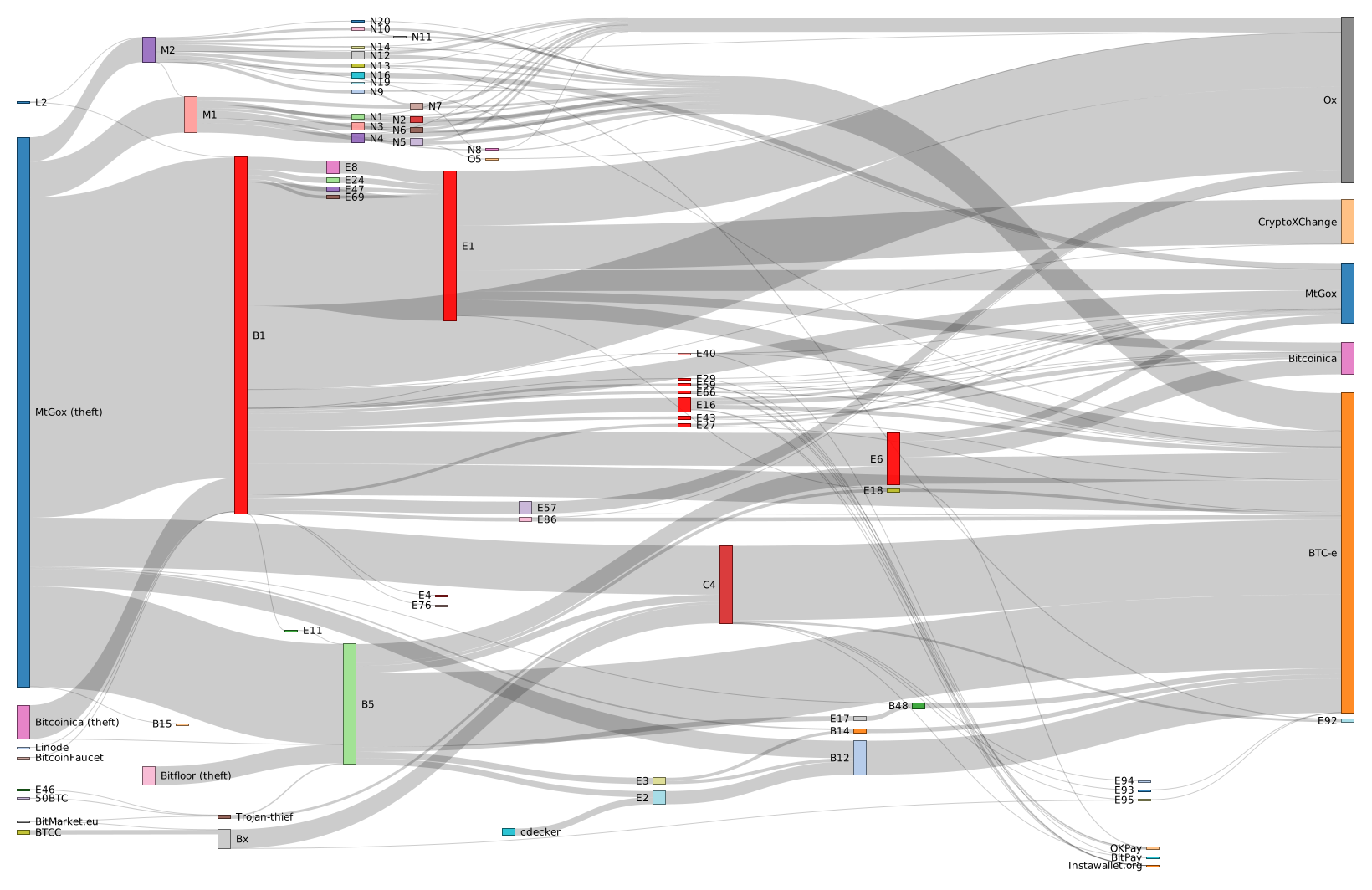
Is this type of visualization common in Bitcoin? Is it a tool anyone can easily use?
Edit, let me restate my question. "Is there a tool that generates Sankey diagrams from blockchain data that is easy to use?"
Re: Breaking open the Mt. Gox case, part 1
#10The coin flow graph is terrific: http://wizsec.jp/images/theft_flow.svg Is this type of visualization common in Bitcoin? Is it a tool anyone can easily use? Edit , let me restate my question. "Is there a tool that generates Sankey diagrams from blockchain data that is easy to use?"
This is relatively easy to do since all bitcoin traffic is transparent and open for easy tracking. You can probably do this in gnuplot.
Anyone who has the blockchain downloaded can run their own analysis algorithms on it - it's already there for you to see.