True Link (YC S13) is launching an investment division
1–10 of 15 posts
Re: True Link (YC S13) is launching an investment division
#2How is this better than a Vanguard Target Retirement fund?
Re: True Link (YC S13) is launching an investment division
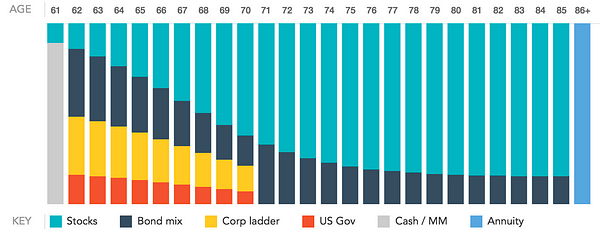
#3The glide path shown here [1] seems to advise being ~90% in cash at age 61 and then ramping up risk until you're ~90% in equities by age 86. What's the logic behind that?
[1] https://cdn-images-1.medium.com/max/600/1*TnBmuHLdCi1VGwBMS7...
Re: True Link (YC S13) is launching an investment division
#4There's a big challenge for RIAs trying to do right by their clients and offer appropriate glide path investment portfolios:
The products and potential returns that honest legit RIAs discuss with potential clients will always be unappealing compared what competitor, dishonest RIAs (who are willing to exaggerate) will be offering.
One lesson from the election: it's hard to convince people of a reality they don't want to hear and warn them of others who are promising wildly optimistic scenarios are not being totally honest with them. Potential investors want to believe exaggerated talk of huge returns by dishonest RIAS and honest RIAs lose clients because of this.
Re: True Link (YC S13) is launching an investment division
#5The glide path shown here [1] seems to advise being ~90% in cash at age 61 and then ramping up risk until you're ~90% in equities by age 86. What's the logic behind that? [1] https://cdn-images-1.medium.com/max/600/1*TnBmuHLdCi1VGwBMS7...
I don't know this particular company's methodology but, in a nutshell, usually they consider a number of glide paths and then run Monte Carlo simulations for each, then choose the best performing one. The goal is to minimize the probability of running out of money before dying, assuming the retiree withdraws a constant amount every year. Some studies concluded that a rising-equity path performs better.
Of course it's more complicated than that. There's a lot of assumptions embedded in those simulations: life expectancy, bonds and stocks returns, etc. See below for more info.
The Case for Increasing Stock Exposure in Retirement https://www.aier.org/research/case-increasing-stock-exposure...
Reducing Retirement Risk with a Rising Equity Glide Path https://www.onefpa.org/journal/Pages/Reducing%20Retirement%2...
Re: True Link (YC S13) is launching an investment division
#6I've long been interested in an investment company that had a variable cut that was directly based on the customers' preferences. Ultimately you'd want the managers incentives based on the fees to be exactly aligned with the customers' needs, which means that different fee structures are needed for different kinds of customers.
Basically the hedge fund fee structure extended. So someone who wanted more risk would give a higher cut of fees for higher gains and a lower cut of fees for lower gains, and vice versa. The average expected value to the manager should be a constant percentage of assets, but the distribution changes for each customer.
One cool thing that naturally falls out of this idea is negative fees: if someone is risk averse enough, then the incentives require the manager to lose money if the customer loses, which causes the manager to be risk averse as well for those funds.
(I have more detailed thoughts on this that this margin is too small to contain; feel free to email me for some disorganized elaboration on the above.)
Re: True Link (YC S13) is launching an investment division
#7The glide path shown here [1] seems to advise being ~90% in cash at age 61 and then ramping up risk until you're ~90% in equities by age 86. What's the logic behind that? [1] https://cdn-images-1.medium.com/max/600/1*TnBmuHLdCi1VGwBMS7...
I don't know this particular company's methodology but, in a nutshell, usually they consider a number of glide paths and then run Monte Carlo simulations for each, then choose the best performing one. The goal is to minimize the probability of running out of money before dying, assuming the retiree withdraws a constant amount every year. Some studies concluded that a rising-equity path performs better. Of course it's…
That's interesting, because increasing the percentage of equities over time is literally the opposite of what most other investment advice sources preach. Thanks for the links. :)
Re: True Link (YC S13) is launching an investment division
#8The glide path shown here [1] seems to advise being ~90% in cash at age 61 and then ramping up risk until you're ~90% in equities by age 86. What's the logic behind that? [1] https://cdn-images-1.medium.com/max/600/1*TnBmuHLdCi1VGwBMS7...
Hi! Kai here from True Link. #1 lesson from the launch so far is that graph is totally incomprehensible! We love it here in the office but it's going to be totally re-done in the next release.
That graph is how your money is invested today – we divide your money up based on what age you need it and invest it differently, so what the graph is saying is that "money you need for age 61" is 90% in cash, and "money you need for age 86" is 85% in equities.
People are so used to seeing the glide path graph that like half of people see our graph and are like, wow that's incredibly smart, and half are like, your glide path is upside down.
Also, probably didn't help that I cropped out the axis labels so it would fit nicer on Medium. Thanks for noticing! I'm going to fix that right now.
Re: True Link (YC S13) is launching an investment division
#9The glide path shown here [1] seems to advise being ~90% in cash at age 61 and then ramping up risk until you're ~90% in equities by age 86. What's the logic behind that? [1] https://cdn-images-1.medium.com/max/600/1*TnBmuHLdCi1VGwBMS7...
Hi! Kai here from True Link. #1 lesson from the launch so far is that graph is totally incomprehensible! We love it here in the office but it's going to be totally re-done in the next release. That graph is how your money is invested today – we divide your money up based on what age you need it and invest it differently, so what the graph is saying is that "money you need for age 61" is 90% in cash, and "money you ne…
As it happens, our glide path in aggregate ends up within conventional bounds – we have a screen in the tool that compares the equity percentages to what you'd have in a Vanguard or T Rowe Price target date fund and usually it's in the same ballpark.
Re: True Link (YC S13) is launching an investment division
#10I've long been interested in an investment company that had a variable cut that was directly based on the customers' preferences. Ultimately you'd want the managers incentives based on the fees to be exactly aligned with the customers' needs, which means that different fee structures are needed for different kinds of customers. Basically the hedge fund fee structure extended. So someone who wanted more risk would giv…
The place this ends up sticky is that a manager with multiple clients can jointly maximize fees – e.g. instead of properly hedging a bet within each client's portfolio, you can put the bet in one client's portfolio and the hedge in another's. If risk preferences are divergent enough the manager can basically be making one-way bets – and frankly the point of this is it could be socially efficient for two of your clients to bet against each other, that's the point, but for almost any nonlinear compensation structure you dream up (even just sharing a little bit in upside, like venture) you can figure out that the manager maximizes his/her own risk adjusted return by playing clients off against each other or creating scenarios that sometimes throw a client under the bus.
To be clear, a flat fee is the ULTIMATE one-way bet… but making the one-way bet simple rather than complex means that it doesn't incentivize one type of behavior over another, you get the one-way bet even without throwing a client under the bus. And maybe at the end of the day your broker or advisor is a good human and, barring any incentive to the contrary, will do his/her best for the client. Kind of a crazy bet, but…