Live data from Hacker News

Show HN: Jukedeck – create unique, royalty-free music for your videos using A.I.

jukedeck.com

91–100 of 216 posts

Re: Show HN: Jukedeck – create unique, royalty-free music for your videos using A.I.

#91
post #45
post #4

It sounds like one of those recursive ANN things. On the scale of seconds, it's quite good. But there's no higher-level structure. For "folk", this is obvious; for ambient, you'd probably never notice. The goal for this technology is to beat the two guys who write most popular music.[1] Another few years. [1] http://nypost.com/2015/10/04/your-favorite-song-on-the-radio...

I'm glad you like it on the scale of seconds! Higher-level structure is definitely a challenge, and is something we're working on.

Your electronic offerings are OK. While I'm skeptical about your business model, as it stands, one possible pivot would be to pitch it at musicians as a dynamic arrangement/compositional tool.

I would very much like to try it with MIDI output, as I personally enjoy tweaking synths and effects more than the compositional tasks of harmonizing melodies etc.
Re: Show HN: Jukedeck – create unique, royalty-free music for your videos using A.I.

#93
post #84

This is a business I know well. Jukedeck is an example of how founders and investors do not conduct appropriate market research. There is a limited market demand for low-cost royalty-free music for videos. One could argue there is an oversupply* of royalty-free music relative to buyers. The quality is not good enough to disrupt the billion dollar Production music industry that is top heavy, a relative small amount of…

Wow. I think this is the perfect example of "failure of imagination" GoPro is a $2.5B company based around low cost equipment for amateur film makers. They produce film editors that let you edit your films around per-licensed sound tracks. Let me say that again - you make your film around the sound track they supply . The opportunity for Jukedeck isn't competing with the thousands of individual composers 1-on-1. It i…

But that's how most editors work anyway, even Hollywood ones - if they don't have a score to work with they take temp music from some film they already like and later commission something similar. I'm not sure why you think this is such a radical concept.

Re: Show HN: Jukedeck – create unique, royalty-free music for your videos using A.I.

#94

To me the exciting thing about automatic music composition isn't royalty-free prerecorded music, but the potential for real-time composition. Imagine a video game where your actions instantly affect the music, not just by splicing together prerecorded clips but actually by having new music composed and performed in real time. Or, somewhat more fancifully, imagine a set of headphones that play a continuous soundtrack…

Spore (2008) had a soundtrack that evolved based on your actions and your creature's evolution.

Re: Show HN: Jukedeck – create unique, royalty-free music for your videos using A.I.

#95
post #3

Earlier quoted context omitted.

Agree. Here's an Ambient Sparse one (generated before I saw this one) https://www.jukedeck.com/share/a0126f548a92b5e60df8e78e3a629... I'm specifically curious how much variation there is between tracks -- perhaps we can get more HNers to post?

Aggressive drum 'n bass with a fast tempo. https://www.jukedeck.com/share/4b576db534b17c0c6b8f708ede487... Meditative percussion'd ambient yoga music with a fast tempo. https://www.jukedeck.com/share/48c5695b3faf1211b216fec2dd591...

I feel lucky with the first song I generated: https://www.jukedeck.com/share/2220b4dea9fde155ffbe9ccc7015b... It sounds really good.

Re: Show HN: Jukedeck – create unique, royalty-free music for your videos using A.I.

#96
post #15

Earlier quoted context omitted.

This isn't a legal opinion and shouldn't be taken as legal advice. Interestingly, I think New Zealand law does have this case covered. There's special mention of "computer-generated" works under Section 5[1] of the Copyright Act which states (as I read it) that the person who wrote the computer program to generate the audio is the author of the audio. [1] http://www.legislation.govt.nz/act/public/1994/0143/latest/D..…

What happens if write a program to generate all data in the world? 000000 000001 000010 000011 000100 Do I own every file?

No, because you didn't create those other files, your enumerated bits won't have the right color ;)

"Bits don't have Colour; computer scientists, like computers, are Colour-blind. That is not a mistake or deficiency on our part: rather, we have worked hard to become so. Colour-blindness on the part of computer scientists helps us understand the fact that computers are also Colour-blind, and we need to be intimately familiar with that fact in order to do our jobs.

The trouble is, human beings are not in general Colour-blind. The law is not Colour-blind. It makes a difference not only what bits you have, but where they came from. [...] The law sees Colour.

Suppose you publish an article that happens to contain a sentence identical to one from this article, like "The law sees Colour." That's just four words, all of them common, and it might well occur by random chance. Maybe you were thinking about similar ideas to mine and happened to put the words together in a similar way. If so, fine. But maybe you wrote "your" article by cutting and pasting from "mine" - in that case, the words have the Colour that obligates you to follow quotation procedures and worry about "derivative work" status under copyright law and so on. Exactly the same words - represented on a computer by the same bits - can vary in Colour and have differing consequences. When you use those words without quotation marks, either you're an author or a plagiarist depending on where you got them, even though they are the same words. It matters where the bits came from." - from http://ansuz.sooke.bc.ca/entry/23

Basically, non-recorded metadata about how a sequence of bits was created matters too. Not just the bits themselves.

Re: Show HN: Jukedeck – create unique, royalty-free music for your videos using A.I.

#97
post #5

According to their pricing page ( https://www.jukedeck.com/pricing ), you can use the track free of royalty, but if you want to actually own it, you have to pay $199. But this falls kind of in a gray area. If the AI created the tracks, why does the company own the copyright (and thus, have the right to sell it)? In December 2014, the United States Copyright Office stated that works created by a non-human are not subj…

Here's an—in my opinion—almost exact equivalence: a font is a little program in a nearly-Turing-complete language. Nobody really cares what fonts end up on your computer. But if you create an image (e.g. an advertisement) that contains pixels manipulated by the font-program you ran on your own computer, then you have to pay to license that use of the font.

Within the realm of audio production, there's an even closer equivalence: soundfonts, which are also little nearly-Turing-complete programs. Playing a MIDI file "through" a soundfont? No problem. Putting that track on a CD and selling it? Nope, need to license the font.

Really, you could think of procedural music generation as a really complex and "stateful" soundfont program that has a nonlinear relationship with its input.

Re: Show HN: Jukedeck – create unique, royalty-free music for your videos using A.I.

#98

Earlier quoted context omitted.

What's harsh is burning through 3 million dollars while you're trying to figure out what's wrong. If my statments leads to a major change that saves the company that is a good thing.

3 million dollars is nothing. It took a million dollars to make a single very low-quality video game, circa 2008. Salaries are expensive. The investment model is set up to let founders "burn through" money while they explore new approaches to old industries. The investors don't really care that the money is lost. To be an investor, you have to assume 9 out of 10 of your investments will be write-offs. So if you're no…

I have actually helped a company where our initial interaction was via an internet comment, so don't make assumptions. Stating market reality is not being harsh, there is an abundant supply of royalty free music available at a very low cost or for free. If you're demoralized because someone states the facts of a competitive market than that is very unfortunate and you're not really fit to be an entrepreneur in a highly competitive market. From experience, working on a product that is failing is very demoralizing. I actually will like to see them do something novel and great with their technology.

Moreover there is great ideas* in this thread that can actually help the company.

* https://news.ycombinator.com/item?id=10707389

Re: Show HN: Jukedeck – create unique, royalty-free music for your videos using A.I.

#99
post #89
post #44

Earlier quoted context omitted.

This is a false claim. The Library of Babel is far from complete; the site itself only claims completion up to 3200-character texts. And that's limited only to lower-case alphabetic letters, periods, commas, and spaces. So there is still a vast amount of possible texts that haven't yet been created.

The Library of Babel that is online has those limits, yes. Which is why I explicitly mentioned I wasn't referring to the website. >(There is an extended Library that contains entire novels to be searched - the web version is a bit smaller/limited to pages.) The creator has variations of the code that aren't online. For example, lower-case alphabetical letters was a choice to "remain true to the original concept" but…

I'm not challenging the claim that it contains a lot of texts; I'm challenging the claim that "everything has already been created and just needs to be found." That claim is explicitly false, regardless of the version of the Library of Babel you are using.

Edit: Reply to your reply: One inherent limitation with the current code is that it has to assume some encoding. Currently, there is no encoding that contains all known glyphs (e.g the Prince symbol, uncommon kanji, etc) so there will be texts that can not currently be generated, regardless of how much you increase the character set.

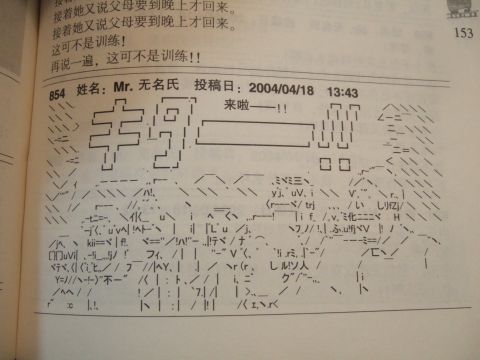
Edit2: Even if one were to allow ASCII art to represent a character, you then have the problem of how to distinguish between ASCII art substitution and actual ASCII art. Consider "Densha Otoko," which basically consists of message board posts that often contain ASCII art.

http://portal.nifty.com/2007/04/15/b/img/012.jpg

Post reply on HN