Live data from Hacker News

Show HN: SHA-256 explained step-by-step visually

sha256algorithm.com

41–50 of 145 posts

Re: Show HN: SHA-256 explained step-by-step visually

#41
post #36

So, how do people come up with these things? I assume every aspect of the design is carefully considered to defend it against various attacks. For example, why "right rotate 7 XOR right rotate 18 XOR right shift 3" and not "right rotate 2 XOR right rotate 3 XOR right shift 4"?

Visualized like this it feels like security through obscurity, but there must be reason for this. I did wonder why initialization is like: 1. Initialize hash value h0 to h7: first 32 bits of the fractional parts of the square roots of the first 8 primes 2..19). 2. Initialize array of K constants: first 32 bits of the fractional parts of the cube roots of the first 64 primes 2..311

https://news.ycombinator.com/item?id=23166713

It seems like a "nothing up my sleeve" way to initialize the variables.

Re: Show HN: SHA-256 explained step-by-step visually

#42
post #36

So, how do people come up with these things? I assume every aspect of the design is carefully considered to defend it against various attacks. For example, why "right rotate 7 XOR right rotate 18 XOR right shift 3" and not "right rotate 2 XOR right rotate 3 XOR right shift 4"?

Visualized like this it feels like security through obscurity, but there must be reason for this. I did wonder why initialization is like: 1. Initialize hash value h0 to h7: first 32 bits of the fractional parts of the square roots of the first 8 primes 2..19). 2. Initialize array of K constants: first 32 bits of the fractional parts of the cube roots of the first 64 primes 2..311

[deleted]

Re: Show HN: SHA-256 explained step-by-step visually

#43
post #30

You should be very satisfied with how well you conveyed the algorithm. Well done. What was your approach to arriving at this result?

Thanks :) I first implemented sha256 in js to understand its inner workings. Then I started displaying its variables with react and adding this stepped mechanism. Finally, I added some notes on the left to add some context of what is going on.

Re: Show HN: SHA-256 explained step-by-step visually

#44
post #36

So, how do people come up with these things? I assume every aspect of the design is carefully considered to defend it against various attacks. For example, why "right rotate 7 XOR right rotate 18 XOR right shift 3" and not "right rotate 2 XOR right rotate 3 XOR right shift 4"?

Visualized like this it feels like security through obscurity, but there must be reason for this. I did wonder why initialization is like: 1. Initialize hash value h0 to h7: first 32 bits of the fractional parts of the square roots of the first 8 primes 2..19). 2. Initialize array of K constants: first 32 bits of the fractional parts of the cube roots of the first 64 primes 2..311

from what I've seen, there's a lot of "obscurity" to this; there are many seemingly arbitrary choices all over the place.

In the end most encryption algorithms boil down to doing 'random' (arbitrary, hard to justify why) things to data and then undoing them exactly in order to decrypt.

the math is all incredibly abstract but not all that complex, the high level of abstraction does make it quite difficult to grasp.

What's worse is that I fear there are incentives (mostly political/security interests) to keep the field small and to keep many people far away from this very practical use for all these beautiful, elegant, simple (but extremely abstract) mathematics (refering to the entire cryptography field).

Re: Show HN: SHA-256 explained step-by-step visually

#46
I love single-purpose websites like this that put a potentially complex implementation behind an elegantly simple interface. This website’s design and styling are pretty too :) Another useful one is https://www.h-schmidt.net/FloatConverter/IEEE754.html . I’d say even https://godbolt.org/ counts!

Re: Show HN: SHA-256 explained step-by-step visually

#47
post #44

Earlier quoted context omitted.

Visualized like this it feels like security through obscurity, but there must be reason for this. I did wonder why initialization is like: 1. Initialize hash value h0 to h7: first 32 bits of the fractional parts of the square roots of the first 8 primes 2..19). 2. Initialize array of K constants: first 32 bits of the fractional parts of the cube roots of the first 64 primes 2..311

from what I've seen, there's a lot of "obscurity" to this; there are many seemingly arbitrary choices all over the place. In the end most encryption algorithms boil down to doing 'random' (arbitrary, hard to justify why) things to data and then undoing them exactly in order to decrypt. the math is all incredibly abstract but not all that complex, the high level of abstraction does make it quite difficult to grasp. Wh…

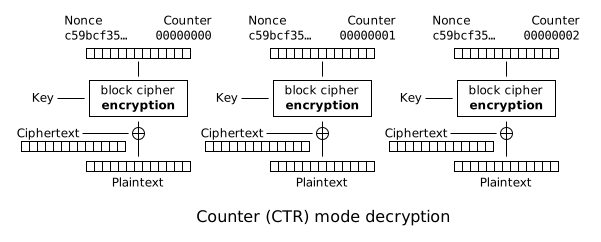
Not all decryption is doing exactly the same things in reverse. For example, with CTR mode (and thus GCM mode, which is CTR plus GMAC), you call the /encryption/ routine regardless of whether you're encrypting or decrypting data. This means in an embedded environment you can save die space because your program doesn't need the e.g. AES decryption routines too.

https://upload.wikimedia.org/wikipedia/commons/4/4d/CTR_encr...

https://upload.wikimedia.org/wikipedia/commons/3/3c/CTR_decr...

(Note the bold text)

Re: Show HN: SHA-256 explained step-by-step visually

#48
post #30

You should be very satisfied with how well you conveyed the algorithm. Well done. What was your approach to arriving at this result?

Thanks :) I first implemented sha256 in js to understand its inner workings. Then I started displaying its variables with react and adding this stepped mechanism. Finally, I added some notes on the left to add some context of what is going on.

Very nice. Have you built any other algorithm visualizations? I have a very strong interest in how algorithms are visualized so that they are more easily understood.

Re: Show HN: SHA-256 explained step-by-step visually

#49
post #44

Earlier quoted context omitted.

from what I've seen, there's a lot of "obscurity" to this; there are many seemingly arbitrary choices all over the place. In the end most encryption algorithms boil down to doing 'random' (arbitrary, hard to justify why) things to data and then undoing them exactly in order to decrypt. the math is all incredibly abstract but not all that complex, the high level of abstraction does make it quite difficult to grasp. Wh…

Not all decryption is doing exactly the same things in reverse. For example, with CTR mode (and thus GCM mode, which is CTR plus GMAC), you call the /encryption/ routine regardless of whether you're encrypting or decrypting data. This means in an embedded environment you can save die space because your program doesn't need the e.g. AES decryption routines too. https://upload.wikimedia.org/wikipedia/commons/4/4d/CTR_e…

I mean it in the sense that they undo the 'noise' added to (or reverse the scrambling of) the initial input .

even if they do it in a different way.

Re: Show HN: SHA-256 explained step-by-step visually

#50
Man, this is amazing. I had to hand-unroll bit packing in a binary encoding scheme we used in a game. Rare enough that making a tool wasn't worth it, but damn I love your visualizations! Doing something like that would have helped others understand how I was "seeing the matrix."
Post reply on HN