Live data from Hacker News

Show HN: Iceoryx2 – Fast IPC Library for Rust, C++, and C

ekxide.io

31–40 of 53 posts

Re: Show HN: Iceoryx2 – Fast IPC Library for Rust, C++, and C

#31
post #17
post #16

Earlier quoted context omitted.

At $work we are evaluating different IPC strategies in Rust. My colleague expanded upon 3tilley's work, they have updated benchmarks with iceoryx2 included here[0]. I suppose the current release should perform even better. [0]: https://pranitha.rs/posts/rust-ipc-ping-pong/

Interesting that on Linux Unix Domain Sockets are not faster than TCP. People often say that the TCP stack overhead is high but this benchmark does not confirm that.

i couldn't resist reproducing on bare metal linux (8th gen core i5, ubuntu 22.04):

  cargo run --release -- -n 1000000 --method unixstream
  cargo run --release -- -n 1000000 --method tcp
~9μs/op for unixstream, ~14μs/op for TCP.

unixstream utilizes two cores at ~78% each core, tcp only utilizes ~58% of each core. so there is also something wrong in the benchmarks where blocking is happening and cores are not being fully utilized.
Re: Show HN: Iceoryx2 – Fast IPC Library for Rust, C++, and C

#32
post #26

This smells like they are using shared memory, which is almost certainly a security nightmare. The way they are selling it makes me fear they aren't aware of what a time bomb they are sitting on. Shared memory works as a transport if you either assume that all parties are trusted (in which case why do IPC in the first place? Just put them in a monolith), or you do hardcore capturing (make a copy of each message in th…

> Shared memory works as a transport if you either assume that all parties are trusted (in which case why do IPC in the first place? Just put them in a monolith) There are all sorts of domains where mutually-trusted parties need IPC. Off the top of my head and in no particular order: - Applications that pass validated data to/from captive subprocesses. Not everything is available as a natively-linked library. Not eve…

If you use shared memory with a captive process, that process can probably hack you if it gets taken over by an attacker.

I agree with your parallelism counter-argument in principle. However even there it would probably make sense to not trust each other, to limit the blast radius of successful attacks.

In your next point the "careful" illustrates exactly my point. Using shared memory for IPC is like using C or C++ and saying "well I'll be careful then". It can work but it will be very dangerous and most likely there will be security issues. You are much better off not doing it.

Postgres is a beautiful argument in that respect. Yes you can write a database in C or C++ and have it use shared memory. It's just not recommended because you need professionals of the caliber of the Postgres people to pull it off. I understand many organizations think they have those. I don't think they actually do though.

Re: Show HN: Iceoryx2 – Fast IPC Library for Rust, C++, and C

#33
post #18

Earlier quoted context omitted.

In my experience shared memory is really hard to implement well and manage: 1. Unless you're using either fixed sized or specially allocated structures, you end up paying for serialization anyhow (zero copy is actually one copy). 2. There's no way to reference count the shared memory - if a reader crashes, it holds on to the memory it was reading. You can get around this with some form of watchdog process, or by othe…

Thanks for sharing here -- yeah these are definitely huge issues that make shared memory hard -- the when-things-go-wrong case is definitely quite hairy. I wonder if it would work well as a sort of opt-in specialization? Start with TCP/UDS/STDIN/whatever, and then maybe graduate, and if anything goes wrong, report errors via the fallback? I do agree it's rarely worth it (and same-machine UDS is probably good enough),…

The other thing is 10x improvement on basically nothing is quite small. Whatever time it takes for a message to be processed is going to be dominated by actually consuming the message. If you have a great abstraction, cool - use it anyhow, but it's probably not worth developing a shared memory library yourself.

Re: Show HN: Iceoryx2 – Fast IPC Library for Rust, C++, and C

#34
post #26

This smells like they are using shared memory, which is almost certainly a security nightmare. The way they are selling it makes me fear they aren't aware of what a time bomb they are sitting on. Shared memory works as a transport if you either assume that all parties are trusted (in which case why do IPC in the first place? Just put them in a monolith), or you do hardcore capturing (make a copy of each message in th…

> This smells like they are using shared memory, which is almost certainly a security nightmare.

Yes, we are using shared memory, and I agree that shared memory is a challenge but there are some mechanisms that can make it secure.

The main problem with shared memory is, that one process can corrupt the data structure while another process is consuming it. Even verifying the contents of the data structure is insufficient since it can always be corrupted afterwards. We have named the problem "modify-after-delivery problem" - a sender modifies the data after it has been delivered to a receiver.

This can be handled with:

1. memfd: The sender acquires it, writes its payload, seals it so that it is read-only and then transfers the file descriptor to all receivers. The receiver can verify the read-only seal with fcntl. Since linux guarantees us that it cannot be reverted the receiver can now safely consume the data. This allows it to be used even in a zero-trust environment. [1] provides a good introduction (see the File-Sealing IPC subsection). 2. Memory protection keys [2]: I do not have too much experience with them, but as far as I understand, they solve the problem with mprotect, meaning, the sender can call mprotect and make the segment read only for it self, but the receiver has no way of verifying it or to prevent the sender from calling mprotect again and granting it read/write access again to corrupt the data.

So, the approach is that a sender acquires shared memory, writes its payload into it, makes it read-only, and then transfers it to the receivers.

> Shared memory works as a transport if you either assume that all parties are trusted (in which case why do IPC in the first place?

Robustness is another use case. In mission-critical systems you trust each process but a crash caused by a bug in one sub-system shall not bring down the whole system. So you split up the monolith in many processes and the overall system survives if one process goes down or deadlocks, assuming you have a shared memory library that itself is safe. If you detect a process crash, you can restart it and continue operations.

[1] https://dvdhrm.wordpress.com/2014/06/10/memfd_create2/ [2] https://www.kernel.org/doc/html/latest/core-api/protection-k...

Re: Show HN: Iceoryx2 – Fast IPC Library for Rust, C++, and C

#35
post #26

This smells like they are using shared memory, which is almost certainly a security nightmare. The way they are selling it makes me fear they aren't aware of what a time bomb they are sitting on. Shared memory works as a transport if you either assume that all parties are trusted (in which case why do IPC in the first place? Just put them in a monolith), or you do hardcore capturing (make a copy of each message in th…

> Shared memory works as a transport if you either assume that all parties are trusted (in which case why do IPC in the first place? Just put them in a monolith), or you do hardcore capturing (make a copy of each message in the framework before handing it off). Their web page mentions zero copy, so it's probably not the second one.

This is an extremely puzzling comment. I can think of thousands of such cases.

First, there are many reasons to split your program into processes instead of threads (e.g. look at browsers) so even if you have a monolith, you may need IPC between trusted parties simply because of software engineering practices. As a more extreme example, if you're writing code in a language like Python, where multi-threading is a huge liability due to GIL and the standard solution is to just use multi-processing, you'll need a channel between your processes (even if they're just fork()'d) and so you need to use something like filesystem, unix pipe, postgresql, redis, some ipc lib (e.g. TFA)... whatever as a way to communicate.

Second, your comment implies there is no scenario where implementing two separate programs is preferable to building a monolith. Even though you believe in general monoliths are better, it doesn't follow that they have to always be the right approach for every software. You may have a program that requires extremely different computational techniques, e.g. one part written in Prolog because it needs logical constraint satisfaction solving, or one part needs X language because you have to use a specialized library only available in language X, or you may need one part of your program to be in C/C++/Go/Rust for improved latency, or you may need part of your program in "slow" Y language because every other codebase in your company is written in Y. This language barrier is simply one reason. I can come up with many others. For example, parts of the software may be developed by two separate teams and the IPC is decided as the interface between them.

Long story short, it's pretty normal to have a monolithic codebase, but N processes running at the same. In such cases since all N processes are written by you, running in hopefully-trusted hardware, using an IPC framework like this is a good idea. This is not necessarily the most common problem in software engineering, but if you do enough systems programming you'll see that a need for IPC between trusted processes is hardly niche. I personally reach for tools like iceoryx quite frequently.

Re: Show HN: Iceoryx2 – Fast IPC Library for Rust, C++, and C

#36
post #23

I'm in robotics education and we mostly work with Python, to make life easier for students. I'd love to push for more Rust, but so far there's no point to it. Multiprocess communication is something that we found lacking in Python (we want everything to be easily pip installable) and we ended up using shared memory primitives, which is a lot of code to maintain. What is the main roadblock for iceoryx2 Python bindings…

The only real roadblock for this is time. We'd welcome any contributor, especially with such an impactful contribution as this. Making iceoryx2 an option for Python would be amazing. If you or someone you know wants to take it on, we would support as much as possible.

So far for this topic, we have only done some brief research on the options available to us, such us going over the C API or using something like PyO3.

Re: Show HN: Iceoryx2 – Fast IPC Library for Rust, C++, and C

#37

Been doing some IPC experiments recently following the 3tilley post[0], because there just isn't enough definitive information (even if it's a snapshot in time) out there. Shared memory is crazy fast, and I'm surprised that there aren't more things that take advantage of it. Super odd that gRPC doesn't do shared memory, and basically never plans to?[1]. All that said, the constructive criticism I can offer for this p…

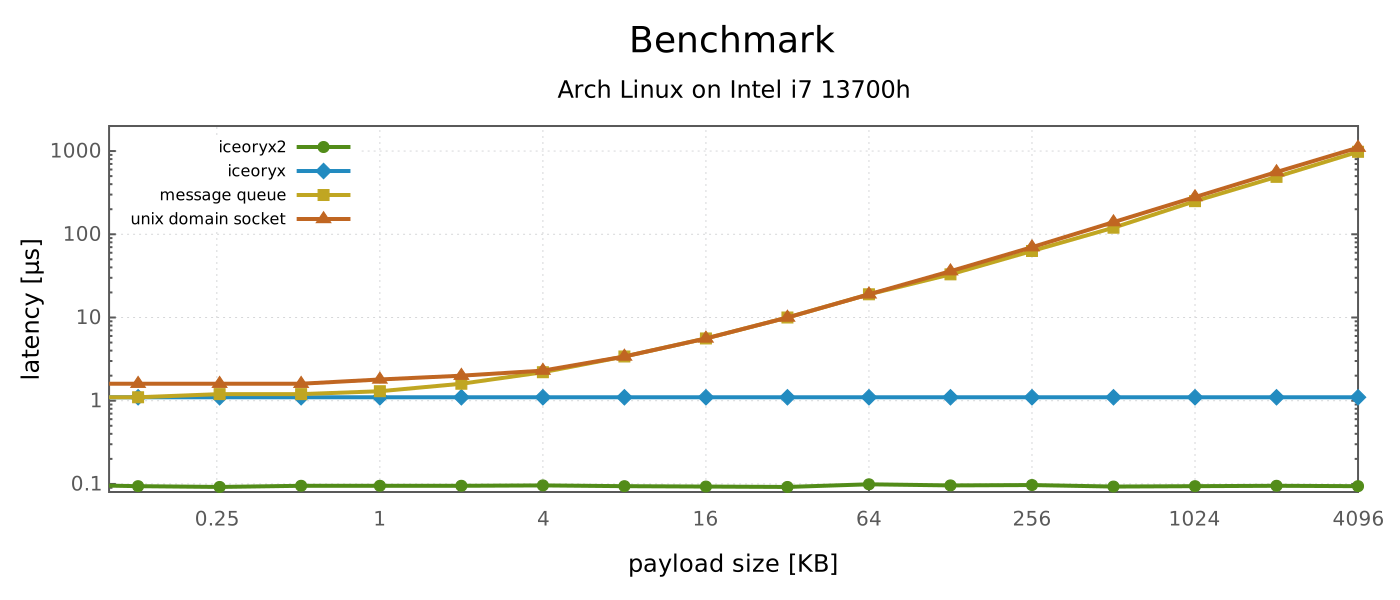
Thanks for the tips. We have a comparison with message queues and unix domain sockets [1] on the repo on github [2].

~~It's nice to see that independent benchmarks are in the same ballpark than the one we perform.~~ Edit: sorry, I confused your link with another one which also has ping-pong in its title

We provide data types which are shared memory compatible, which means one does not have to serialize/deserialize. For image or lidar data, one also does not have to serialize and this is where copying large data really hurts. But you are right, if your data structures are not shared memory compatible, one has to serialize the data first and this has its cost, depending on what serialization format one uses. iceoryx is agnostic to this though and one can select what's the best for a given use case.

[1]: https://raw.githubusercontent.com/eclipse-iceoryx/iceoryx2/r... [2]: https://github.com/eclipse-iceoryx/iceoryx2

Re: Show HN: Iceoryx2 – Fast IPC Library for Rust, C++, and C

#38
post #18

Been doing some IPC experiments recently following the 3tilley post[0], because there just isn't enough definitive information (even if it's a snapshot in time) out there. Shared memory is crazy fast, and I'm surprised that there aren't more things that take advantage of it. Super odd that gRPC doesn't do shared memory, and basically never plans to?[1]. All that said, the constructive criticism I can offer for this p…

In my experience shared memory is really hard to implement well and manage: 1. Unless you're using either fixed sized or specially allocated structures, you end up paying for serialization anyhow (zero copy is actually one copy). 2. There's no way to reference count the shared memory - if a reader crashes, it holds on to the memory it was reading. You can get around this with some form of watchdog process, or by othe…

> In my experience shared memory is really hard to implement well and manage:

I second that. It took us quite some time to get the correct architecture. After all, iceoryx2 is the third incarnation of this piece of software, with elfepiff an me working on the last two.

> 1. Unless you're using either fixed sized or specially allocated structures, you end up paying for serialization anyhow (zero copy is actually one copy).

Indeed, we are using fixed size structures with a bucket allocator. We have ideas on how to enable the usage on types which support custom allocators and even with raw pointers but that is just a crazy idea which might not pan out to work.

> 2. There's no way to reference count the shared memory - if a reader crashes, it holds on to the memory it was reading. You can get around this with some form of watchdog process, or by other schemes with a side channel, but it's not "easy". > > 3. Similar to 2, if a writer crashes, it will leave behind junk in whatever filesystem you are using to hold the shared memory.

Indeed, this is a complicated topic and support from the OS would be appreciated. We found a few ways on how to make this feasible, though.

The origins of iceoryx are in automotive and there it is required to split functionality up into multiple processes. When one process goes down, the system can still operate in a degraded mode or just restart the faulty process. With this, one needs an efficient and low-latency solution else the CPU is spending more time on copying data than on doing real work.

Of course there are issues like the producer mutating data after delivery, but here are also solutions for this. It will of course affect the latency but should still be better than using e.g. unix domain sockets.

Fun fact. For iceoryx1 we supported only 4GB memory chunks and some time ago someone came and asked if we could lift this limitation since he wanted to transfer a 92GB large language model via shared memory.

Re: Show HN: Iceoryx2 – Fast IPC Library for Rust, C++, and C

#39
post #16

Been doing some IPC experiments recently following the 3tilley post[0], because there just isn't enough definitive information (even if it's a snapshot in time) out there. Shared memory is crazy fast, and I'm surprised that there aren't more things that take advantage of it. Super odd that gRPC doesn't do shared memory, and basically never plans to?[1]. All that said, the constructive criticism I can offer for this p…

At $work we are evaluating different IPC strategies in Rust. My colleague expanded upon 3tilley's work, they have updated benchmarks with iceoryx2 included here[0]. I suppose the current release should perform even better. [0]: https://pranitha.rs/posts/rust-ipc-ping-pong/

Sweet. Can we link to your benchmark from the main iceoryx2 readme?

Re: Show HN: Iceoryx2 – Fast IPC Library for Rust, C++, and C

#40
post #19

Been doing some IPC experiments recently following the 3tilley post[0], because there just isn't enough definitive information (even if it's a snapshot in time) out there. Shared memory is crazy fast, and I'm surprised that there aren't more things that take advantage of it. Super odd that gRPC doesn't do shared memory, and basically never plans to?[1]. All that said, the constructive criticism I can offer for this p…

Yeah, I think it is about time we re-focus on multi-processing as extension mechanism, given the available hardware we have nowadays. Loading in-process plugins was a great idea 20 - 30 years ago, however it has been proven that is isn't such a great idea in regards to host stability, or exposed to possible security exploits. And shared memory is a good compromise between both models.

Indeed. That's our goal :)
Post reply on HN