Can someone break this down for me? I'm seeing "Thanos committing fraud" in a section about "useful lies". Given that the founder is currently in prison, it seems odd to consider the lie useful instead of harmful. It kinda seems like the AI found a bunch of loosely related things and mislabeled the group. If you've read these books I'm not seeing what value this adds.
I guess the lies were useful until she got caught?
Show HN: I used Claude Code to discover connections between 100 books
101–110 of 159 posts
Re: Show HN: I used Claude Code to discover connections between 100 books
#102Earlier quoted context omitted.
I guess the lies were useful until she got caught?
Why lie if it isn’t useful? Lying is generally bad, why do a generally bad thing if there isn’t at least a justification, a “use” if you will.
Another model can be post-rationalization. People just do stuff instinctively, then rationalize why they did them after the fact. "She lied without thinking about it, then constructed a reasoning why the lie was rational to begin with".
At the extremes, some people will never lie, even to their detriment. Usually they seem to attribute this to virtue. Others will always lie. They seem to feel not lying is surrendering control. Most people are somewhere in between.
Re: Show HN: I used Claude Code to discover connections between 100 books
#103Earlier quoted context omitted.
give it a more thorough look maybe? https://trails.pieterma.es/trail/collective-brain/ is great
It’s any interesting thread for sure, but while reading through this I couldn’t help but think that the point of these ideas are for a person to read and consider deeply. What is the point of having a machine do this “thinking” for us? The thinking is the point.
Re: Show HN: I used Claude Code to discover connections between 100 books
#104Earlier quoted context omitted.
I'm not sure I understand what the connections are exactly, or whether they go much deeper than certain words and phrases.
I'm really not trying to be mean, but one of the things we learn in the humanities is that basically any two texts can be connected via extremely broad statements (e.g. "Perfect is the enemy of the good"). This is like the joke on twitter about how every couple of years someone in tech invents the concept of public transportation.
Re: Show HN: I used Claude Code to discover connections between 100 books
#105Re: Show HN: I used Claude Code to discover connections between 100 books
#106Earlier quoted context omitted.
I got the idea from an old post on here called Story of Mel[0] where OP talks about the beauty of Mel's intricate machine code on a RPC-4000. This is the part that always stuck with me: I have often felt that programming is an art form, whose real value can only be appreciated by another versed in the same arcane art; there are lovely gems and brilliant coups hidden from human view and admiration, sometimes forever,…
Thank you for sharing that story. Mel seems virtuousic, but is that really art? Optimizing pattern positioning on a drum for maximum efficiency. Is that expression?
Re: Show HN: I used Claude Code to discover connections between 100 books
#107https://medium.com/gft-engineering/using-text-embeddings-and...
Validation is a problem here - you find relationships, but so what? Is it right.... I can't say. It is interesting though.
Re: Show HN: I used Claude Code to discover connections between 100 books
#108Earlier quoted context omitted.
I got the idea from an old post on here called Story of Mel[0] where OP talks about the beauty of Mel's intricate machine code on a RPC-4000. This is the part that always stuck with me: I have often felt that programming is an art form, whose real value can only be appreciated by another versed in the same arcane art; there are lovely gems and brilliant coups hidden from human view and admiration, sometimes forever,…
Thank you for sharing that story. Mel seems virtuousic, but is that really art? Optimizing pattern positioning on a drum for maximum efficiency. Is that expression?
If it wasn't expression everyone would get the same result. But no one else at Royal McBee did things the way Mel Kaye did things.
Kaye had a strong artistic vision for how things should be done; he didn't want to use the ergonomic features of the RPC-4000 because they didn't align with his vision. I think he found the idea of rigging the blackjack program offensive in part for the same reason.
Speaking for myself, I have always found the story and "pessimal" instructions beautiful. It's my favorite piece of folklore of all time. Kaye and Nather are both artists to me.
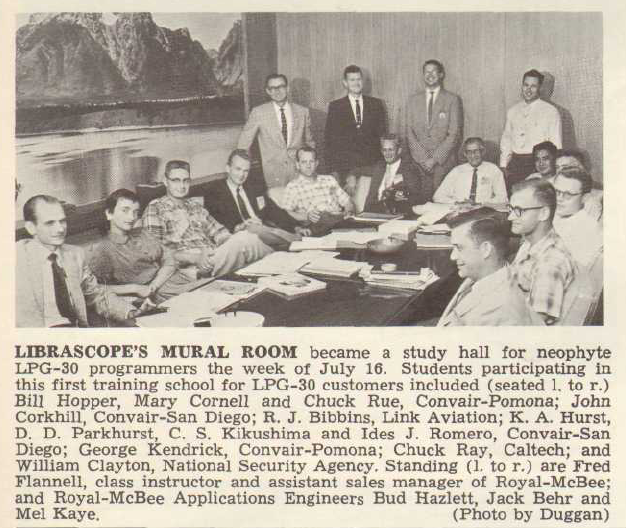
Tangentially, Kaye is standing on the far right in this photo.
https://zappa.brainiac.com/MelKaye.png
And here is Nather.
https://en.wikipedia.org/wiki/Ed_Nather#/media/File:Ednather...
Re: Show HN: I used Claude Code to discover connections between 100 books
#109Re: Show HN: I used Claude Code to discover connections between 100 books
#110This is a beautiful piece of work. The actual data or outputs seem to be more or less...trash? Maybe too strong a word. But perhaps you are outsourcing too much critical thought to a statistical model. We are all guilty of it. But some of these are egregious, obviously referential LLM dog. The world has more going on than whatever these models seem to believe. Edit/update: if you are looking for the phantom thread be…
give it a more thorough look maybe? https://trails.pieterma.es/trail/collective-brain/ is great