I would love to see a video of someone reviewing the app to understand a little bit more.
Show HN: My iOS app to practice sight reading (10 years in the App Store)
101–110 of 140 posts
Re: Show HN: My iOS app to practice sight reading (10 years in the App Store)
#102Earlier quoted context omitted.
> But why in that order? Well, it's in the alphabetical order.
Maybe more importantly, it is in that specific order because it is the key of C major! The A major scale is for example would be A, B, C♯, D, E, F♯, and G♯ ... In fixed Solfège, that would become La Si Do ... but in movable Solfège, Do would be A, Re would be B ...
Of course, there's the C Major thing :)
And I didn't know about Movable Solfège, thanks! I'll have to study that.
But, to put it in audio perspective rather than comparing words and letters, why is the note that corresponds to 440 Hz named A and not F -- implying that, going lower and lower from 440 Hz for each note, 261.63 Hz would not be named C but rather A instead.
Or, to use maybe a comparison that would work from whence those two notation systems were created/named (I figure with a keyboard nearby), why is the first note of a standard piano octave (you know, this: [1]) labelled C and not A? Since it's the first note of the octave and since the German system is using the alphabet (which, well, starts with A), wouldn't it have made sense to have that first octave piano key be labelled A too :)
[1]: https://www.hellosimply.com/blog/wp-content/uploads/2022/03/...
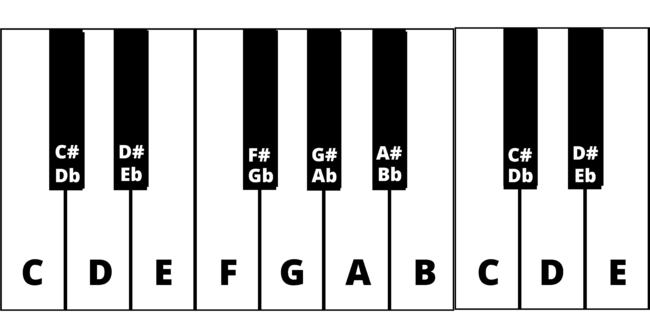
I've seen this conversation several times online, and it's funny to see how participants cannot agree on what is being talked about here, and no conclusion is reached. So I'm aware that I might be asking a super dumb beginner question, but I really do wonder why Do=C and not Do=A.
Don't hesitate to slap me with a "origins of musical notation systems" link, I love to read about music and history :)
Re: Show HN: My iOS app to practice sight reading (10 years in the App Store)
#103congrats! what made you decide to Show HN now?
Re: Show HN: My iOS app to practice sight reading (10 years in the App Store)
#104I'm trying it and I love it! can I ask you a question? I'm not playing piano since at least 15 years, but why are you using C,D,E,etc instead of the real notes? I found an option to enable do,re,mi,etc but it's only applying on the piano notes instead of the middle screen "note" to play Am I missing something?
> instead of real notes? C, D, ... are real notes? Some countries do Solfège, some don't.
TIL this, thank you! I'm italian and only knew about the do re mi fa sol la si do :D
From ChatGPT:
The choice between using letter names (C, D, E, etc.) and solfege (do, re, mi, etc.) largely comes down to tradition and purpose: • Historical Convention: In Western music, the letter system has been the standard for centuries. It provides a clear, concise way to notate specific pitches on a staff, which is especially useful for instruments like the piano or guitar. • Clarity in Notation: Letters denote fixed pitches, making it easier to communicate musical ideas in written form. This helps performers quickly identify which keys or notes to play without additional context. • Educational Focus: Solfege is typically used as a tool for vocal training and ear development. It emphasizes the relationship between pitches (intervals) and is often taught using a movable system (where “do” represents the tonic of any given scale) or a fixed system (where “do” is always C). This system helps singers internalize pitch relationships and improve sight-singing. • Different Purposes: Essentially, the letter system is more suited to the precision required in written music scores, while solfege is more about developing a musician’s internal sense of pitch and harmony.
In short, both systems have their place in music, with letters serving as the backbone of Western musical notation and solfege acting as an invaluable educational tool.
Re: Show HN: My iOS app to practice sight reading (10 years in the App Store)
#105Earlier quoted context omitted.
Maybe more importantly, it is in that specific order because it is the key of C major! The A major scale is for example would be A, B, C♯, D, E, F♯, and G♯ ... In fixed Solfège, that would become La Si Do ... but in movable Solfège, Do would be A, Re would be B ...
Of course, there's the C Major thing :) And I didn't know about Movable Solfège, thanks! I'll have to study that. But, to put it in audio perspective rather than comparing words and letters, why is the note that corresponds to 440 Hz named A and not F -- implying that, going lower and lower from 440 Hz for each note, 261.63 Hz would not be named C but rather A instead. Or, to use maybe a comparison that would work fr…
The easy answer is that the piano is not the "reference" instrument. If you look at a violin, the A major scale is generally the first scale you learn -- not C.
The piano has C natural in the middle of a full 88 keyboard, which is why it is a "natural" scale to pick (C major only uses the white keys, while A major would use three black keys).
So if you are learning another instrument, your "base" note will sometimes be entirely different.
Many "non-western" tradition also aren't tuned to 440 Hz, and even many _western_ traditions don't use 440 Hz for A, 415 Hz is also common.
[addendum] And why Do/Ut, Re, Mi? Because of a Gregorian chant where each sound sorta fell into a vocal range of monks ... then you adopt Do to whatever "sound" the instrument is closest, many years pass and deviations and standardizations ...
[addendum] I recommend starting out researching Guido d'Arezzo (and the Guidonian hand) a bit, that is where we get do/re/mi .. which was used as a teaching aid (which is maybe why Solfege as a term is often used in combination to sight reading or singing from sheet music). Almost no matter what language someone sings/voices Do/Re/Mi/... ... it falls naturally into a vocal range, irrespective of octave.
And then one could look into the hexachord ... and deep into a very deep well of confusion.
Re: Show HN: My iOS app to practice sight reading (10 years in the App Store)
#106Guitar player here. App looks great, but shame it's only for piano. I used a different app that does pretty much the same thing and really benefited from it, the improvement was noticeable after each session. If you add guitar support it will be an immediate download for me.
Another vote for guitar. Will love to get this for guitar.
...guitar....and
Re: Show HN: My iOS app to practice sight reading (10 years in the App Store)
#107Guitar player here. App looks great, but shame it's only for piano. I used a different app that does pretty much the same thing and really benefited from it, the improvement was noticeable after each session. If you add guitar support it will be an immediate download for me.
Why not use Tab notation for guitar?
Tab notation doesn't provide full time signature information, if you're picking up a piece of music which you've never heard played before
In tablature, imagine one string's line shows ---10-----7--8------11----13. How long do you hold each note? Clearly 7 to 8 is quick, but how quick? Sheet music gives you this exact information.
Re: Show HN: My iOS app to practice sight reading (10 years in the App Store)
#108Earlier quoted context omitted.
Maybe more importantly, it is in that specific order because it is the key of C major! The A major scale is for example would be A, B, C♯, D, E, F♯, and G♯ ... In fixed Solfège, that would become La Si Do ... but in movable Solfège, Do would be A, Re would be B ...
yeah but why isn't C major called A major
The piano is a new instrument, when it was created its natural "place" was within the C major scale (all white keys); while A major requires 3 black keys.
All instruments have a "sweet" spot for where they like to make sound. The baroque flute for example, prefers the key of D -- not C. The violin is very at home in the key of A.
If you sit down at a piano, and find a place to put your fingers a somewhat natural place would where there are two white keys beside two black keys.
And then press them in order.. C major scale.
Re: Show HN: My iOS app to practice sight reading (10 years in the App Store)
#109[dead]
Re: Show HN: My iOS app to practice sight reading (10 years in the App Store)
#110I would love to see a video of someone reviewing the app to understand a little bit more.
I agree. I need a YouTube presence for this app in general