Live data from Hacker News

Ask HN: Why did consumer 3D printing take so long to be invented?

news.ycombinator.com

71–80 of 215 posts

Re: Ask HN: Why did consumer 3D printing take so long to be invented?

#71
It took that long because nobody was working on it, because it wasn't obvious that a low-cost 3-D printer was feasible.

The 3-D printers you're seeing today are basically the series of RepRap designs, named after famous scientists who studied self-reproduction: Darwin, Mendel, and Huxley. The RepRap project, which started in 02005, is the reason this happened. For the first several years, it was about half a dozen people: Rhys Jones, Patrick Haufe, Ed Sells, Pejman Iravani, Vik Olliver, Chris Palmer (aka NopHead) and Adrian Bowyer. The last three of these did most of the early work. Once they got it basically working, after many years of work, a lot of other people got involved.

There were a series of developments that had to happen together to get a working low-cost printer. They had to use PLA, because the plastics conventionally used (mostly ABS) had such a high thermal coefficient of expansion that they needed a heated build chamber. They had to design their own electronics, because Arduino didn't exist. They had to figure out how to build a hotend that wouldn't break itself after a few hours. They had to write a slicer. They had to write a G-code interpreter. They weren't industrial engineers, so they didn't know about Kapton. They wasted a lot of time trying to make it work without even a heated bed, to keep costs down. They improvised leadscrews out of threaded rod and garden hose. They made rotational couplings from aquarium tubing. Lots and lots of inventions were needed to get the cost down from US$60k to US$0.3k, and lots and lots of time was wasted on figuring out how to get the resulting janky machines to be reliable enough to be usable at all.

Starting in the mid-90s, Don Lancaster was excited about 3-D printers, which he called "Santa Claus machines" https://www.tinaja.com/santa01.shtml, when he could see that they were possible. He wrote lots of technical articles about building what he called "flutterwumpers": "low cost machines that spit or chomp". https://www.tinaja.com/flut01.shtml. For example, in https://www.tinaja.com/glib/muse140.pdf in 01999, he describes Gordon Robineau's low-cost PCB drill driven by MS-DOS software over a serial port, with a schematic. (The fishing-line cable drive sounds imprecise, since this was years before Spectra braided fishing line.) But nobody listened. I don't know if he ever built so much as a sign cutting machine himself.

Journalists like to talk about the patents, maybe because they're legible to nontechnical people in a way that difficulties with your retraction settings aren't, but when I was obsessively reading the RepRap blogs in the period 02005–02010, I can't recall that they ever mentioned the patents. They were just constantly hacking on their software, fixing their machines, having then break again after a few more hours of printing, and trying new stuff all the time. I don't think the patents even existed in their countries, and they were researchers, anyway, and generally patents don't prevent research. Maybe there's a vast dark-matter bulk of for-profit hackers who would have gotten involved and started up profitable consumer 3-D printing companies before 02005 if it hadn't been for the patents, but who never got interested because of the patents.

But what I saw was that businesspeople started commercializing RepRaps once the open-source RepRap hackers got them to work somewhat reliably. Before that, they mostly weren't thinking about it. After that, most of them spent a lot of years shipping very slightly tweaked RepRap designs. Josef Prusa got involved in the RepRap project and redesigned Ed Sells's Mendel, and everybody copied him, and he famously started selling it himself, very successfully. https://reprap.org/wiki/The_incomplete_RepRap_Prusa_Mendel_b... And more recently Bambu Labs has apparently gotten the machines to be much easier to use.

Re: Ask HN: Why did consumer 3D printing take so long to be invented?

#72

The pieces did NOT exist in the 1970s. Fast microcontrollers, stepper motors, precision miniaturized manufacturing, reliable and cheap miniaturized DC electronics, and far far more technology was non-existent at any kind of affordable price point. Look at kitchen appliances or metal/wood shop machinery from this era, still heavily analog, mostly made from sheet steel, mostly non-computerized. The 80s would bring bett…

Microcontrollers and stepper motors were already controlling 2-D printers in the 01970s and early 01980s at higher speeds and similar powers to currently popular 3-D printers. The first RepRaps did not "use a full-power PC as their host machine"; they were controlled by AVRs, just like Arduino (which didn't exist yet). Generating motor control waveforms on a full-power PC is a nightmare nowadays, and was already a nightmare in 02005. The LinuxCNC people would do it by running Linux under a real-time hypervisor. The first CNC machining was done in the 01950s with IBM 704s, comparable in power to an Intel 8008. The 6502 used by the Commodore 64 to drive its floppy drive would have worked fine, though it is much slower than the AVR and doesn't have built-in PWM generation hardware.

I agree that the pieces did not exist in the 01970s, but the missing pieces weren't the computation.

Re: Ask HN: Why did consumer 3D printing take so long to be invented?

#73
Have you ever seen 1970s CNC gear? I came across a 1970s CNC lathe in a surplus store once. The thing was the size of a small car. The electronics box was the size of two racks. Inside were cards that handled one bit of one register. Input was from a paper tape. No CPU; all special purpose electronics.

Directly controlling industrial machines from a microprocessor was very rare before the 1980s.

Re: Ask HN: Why did consumer 3D printing take so long to be invented?

#74
post #72

The pieces did NOT exist in the 1970s. Fast microcontrollers, stepper motors, precision miniaturized manufacturing, reliable and cheap miniaturized DC electronics, and far far more technology was non-existent at any kind of affordable price point. Look at kitchen appliances or metal/wood shop machinery from this era, still heavily analog, mostly made from sheet steel, mostly non-computerized. The 80s would bring bett…

Microcontrollers and stepper motors were already controlling 2-D printers in the 01970s and early 01980s at higher speeds and similar powers to currently popular 3-D printers. The first RepRaps did not "use a full-power PC as their host machine"; they were controlled by AVRs, just like Arduino (which didn't exist yet). Generating motor control waveforms on a full-power PC is a nightmare nowadays, and was already a ni…

Now I'm very tempted to build a 3D printer with an 8-bit home computer and vintage parts.

Re: Ask HN: Why did consumer 3D printing take so long to be invented?

#75
post #25

I think it's probably correct that few people *really* cared until the Reprap project showed a real DIY 3D printer was possible. Early machines were industrial machines with huge price tags, proper linear motion systems, complicated extrusion systems and so on. There is a bit of a mental leap to go from seeing $100k+ machine and dreaming to design something that can be built for $200-500. The problems were: no "refer…

I'm curious how much better the printers are these days as I'd love to get another one. I had a Wanhao Duplicator i3 in 2015 and found it required a lot of tinkering and calibration every time I wanted to use it. I ended up selling it as it was so time consuming to get everything correctly set up that it just killed any interest I had in it.

Check out Bambu Lab printers if you want something more modern. They have several models available for less than $1000 and give good results with little messing around.

I say this as someone who doesn’t want 3d-printing as a hobby. It’s just a tool I want to occasionally use in order to get something else done and the less time I have to spend tramming and calibrating, the better.

Re: Ask HN: Why did consumer 3D printing take so long to be invented?

#76
post #25

I think it's probably correct that few people *really* cared until the Reprap project showed a real DIY 3D printer was possible. Early machines were industrial machines with huge price tags, proper linear motion systems, complicated extrusion systems and so on. There is a bit of a mental leap to go from seeing $100k+ machine and dreaming to design something that can be built for $200-500. The problems were: no "refer…

I'm curious how much better the printers are these days as I'd love to get another one. I had a Wanhao Duplicator i3 in 2015 and found it required a lot of tinkering and calibration every time I wanted to use it. I ended up selling it as it was so time consuming to get everything correctly set up that it just killed any interest I had in it.

I bought the cheapest printer available, the Kobra Go I believe, and with very little tweaking I had it running well enough that I don’t care to tweak more. I owned a delta printer ten years ago which I spent $1200 plus another $600 in custom parts and it ran about the same as my current one (though it was bigger) and my current one cost $150 plus shipping. I don’t suggest the cheapest one if you have the money but I only use mine once a month or less so it was the perfect price vs. functionality. I did build the old one from a kit and modified nearly every mechanism though, so I’m relatively confident with these machines. I do suggest the more expensive, better quality printers if you don’t want to tweak stuff much.

Re: Ask HN: Why did consumer 3D printing take so long to be invented?

#77

The pieces did NOT exist in the 1970s. Fast microcontrollers, stepper motors, precision miniaturized manufacturing, reliable and cheap miniaturized DC electronics, and far far more technology was non-existent at any kind of affordable price point. Look at kitchen appliances or metal/wood shop machinery from this era, still heavily analog, mostly made from sheet steel, mostly non-computerized. The 80s would bring bett…

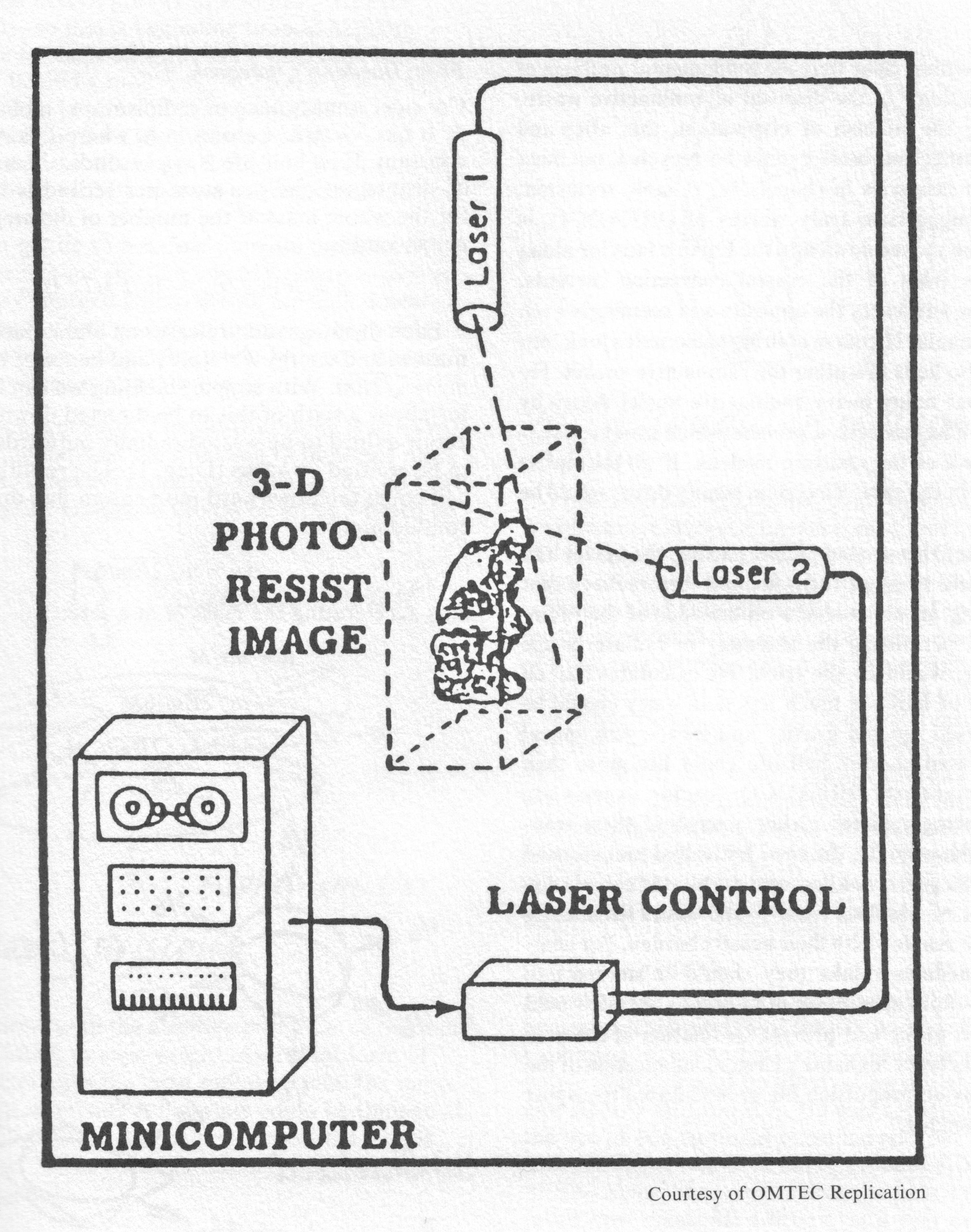
It depends how you define "affordable". Daedalus (the late David E.H. Jones) writing in New Scientist in 1974 sketched an idea for a laser-based system and almost immediately received a notice of complaint from an existing patent holder (plus ca change ...) although unlike patent trolls this patent holder had actual objects made by the process.

The system here was based around a minicomputer (or at least a successor patent of 1978 so described it) so we're talking tens of thousands of dollars for the compute involved in that scheme - but that first 1971 patent must have expired in the 90s by which time inexpensive compute was trivially available to match early 70s minicomputer capabilities.

Excerpts from the exceptionally excellent book "The Inventions of Daedalus - A Compendium of Plausible Schemes" which is sadly long out of print:

https://paperstack.com/img/photos/page%2090.jpg

https://paperstack.com/img/photos/page%2091.jpg

Re: Ask HN: Why did consumer 3D printing take so long to be invented?

#78
post #72

The pieces did NOT exist in the 1970s. Fast microcontrollers, stepper motors, precision miniaturized manufacturing, reliable and cheap miniaturized DC electronics, and far far more technology was non-existent at any kind of affordable price point. Look at kitchen appliances or metal/wood shop machinery from this era, still heavily analog, mostly made from sheet steel, mostly non-computerized. The 80s would bring bett…

Microcontrollers and stepper motors were already controlling 2-D printers in the 01970s and early 01980s at higher speeds and similar powers to currently popular 3-D printers. The first RepRaps did not "use a full-power PC as their host machine"; they were controlled by AVRs, just like Arduino (which didn't exist yet). Generating motor control waveforms on a full-power PC is a nightmare nowadays, and was already a ni…

An offtopic question: how do you manage to write all the years consistently with 0 at the start (I know why, but how), when everyone around you uses a different standard.

If I decided, IDK, to write "cnow" instead of "know", or "J" instead of "I", I wouldn't be able to do so consistently. Not in a world that massively uses the other word.

Or it would take me twice as much time to double-check everything that I have typed.

Re: Ask HN: Why did consumer 3D printing take so long to be invented?

#79
post #72

Earlier quoted context omitted.

Microcontrollers and stepper motors were already controlling 2-D printers in the 01970s and early 01980s at higher speeds and similar powers to currently popular 3-D printers. The first RepRaps did not "use a full-power PC as their host machine"; they were controlled by AVRs, just like Arduino (which didn't exist yet). Generating motor control waveforms on a full-power PC is a nightmare nowadays, and was already a ni…

Now I'm very tempted to build a 3D printer with an 8-bit home computer and vintage parts.

That sounds like a delightful project! This contemporary book from Usborne demonstrates the point that basic stepper controls from an 8-bit computer were well within hobbyist reach:

https://drive.google.com/file/d/0Bxv0SsvibDMTZ2tQMmpyOWtsRFk...

I do think that the limitations of memory (and disk) will require some ingenuity in 3D printing more than the most trivial procedurally defined objects!

Re: Ask HN: Why did consumer 3D printing take so long to be invented?

#80
post #25

I think it's probably correct that few people *really* cared until the Reprap project showed a real DIY 3D printer was possible. Early machines were industrial machines with huge price tags, proper linear motion systems, complicated extrusion systems and so on. There is a bit of a mental leap to go from seeing $100k+ machine and dreaming to design something that can be built for $200-500. The problems were: no "refer…

I'm curious how much better the printers are these days as I'd love to get another one. I had a Wanhao Duplicator i3 in 2015 and found it required a lot of tinkering and calibration every time I wanted to use it. I ended up selling it as it was so time consuming to get everything correctly set up that it just killed any interest I had in it.

I got an Ender 3 v3 CoreXY about a month ago. I just about pulled it out of the box and started hitting print. It's almost that easy. It's been printing almost continuously for about a month with very few problems.
Post reply on HN