Live data from Hacker News

Ask HN: Recommendations for learning and improving UX/UI skills?

news.ycombinator.com

41–50 of 52 posts

Re: Ask HN: Recommendations for learning and improving UX/UI skills?

#41
post #40
post #32

An alternative approach: – Start by reading "Magic Ink" by Bret Victor: http://worrydream.com/#!/MagicInk – Now you understand that UI design is actually graphic design, so start with graphic design fundamentals. They are: Drawing, Layout, Typography, Color, History. – Drawing: understand how images are created on a canvas. Includes concepts of how to use line, shade, and color to create forms, volumes, depth, etc. A…

Completing the above, now for UX: — Start by reading "Designing with the mind in mind" by Jeff Johnson ( http://www.amazon.com/Designing-Mind-Simple-Understanding-In... ) — Now you understand that UX design is actually cognitive psychology + sociology. Of course, most cognitive psychology/sociology books will only be slightly relevant to UX design. Here's a short selection to get you started: — Don Norman, Design of…

Thanks dude. Totally agree about Designing with the Mind in Mind. Another similar book is 100 Things Every Designer Needs to Know About People. Here's a little gem that summarizes some of that material: http://uxmag.com/articles/psychological-usability-heuristics

Excited to check out some of the stuff I haven't come across there.

Re: Ask HN: Recommendations for learning and improving UX/UI skills?

#42
post #32

An alternative approach: – Start by reading "Magic Ink" by Bret Victor: http://worrydream.com/#!/MagicInk – Now you understand that UI design is actually graphic design, so start with graphic design fundamentals. They are: Drawing, Layout, Typography, Color, History. – Drawing: understand how images are created on a canvas. Includes concepts of how to use line, shade, and color to create forms, volumes, depth, etc. A…

Thank you for this post - I hadn't seen Bret Victor's essay before.

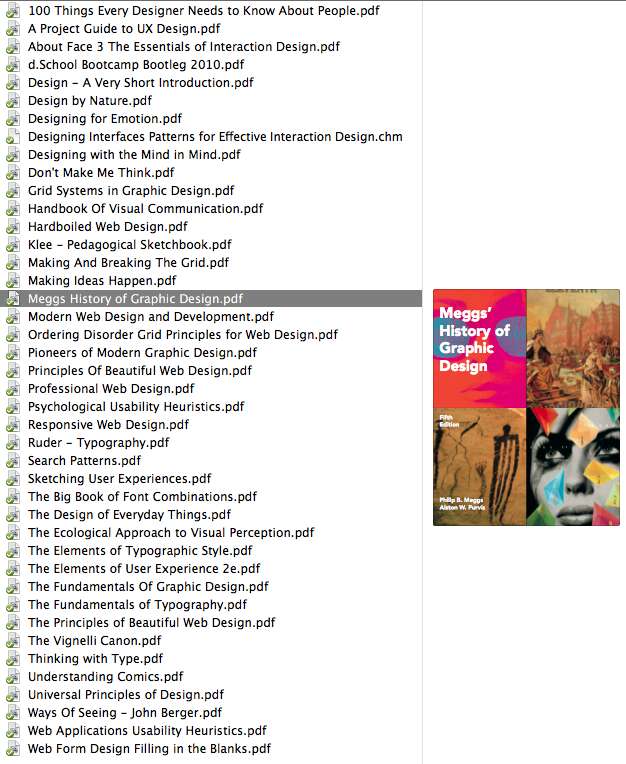
On a side note, your bookshelf link is broken (it contains a > at the end). It should be: http://img823.imageshack.us/img823/7795/screenshot20120731at...

Re: Ask HN: Recommendations for learning and improving UX/UI skills?

#43
post #17

I'm going to go out on a limb here and say that books, articles and conferences are totally insufficient to become a good (UI/UX/User centred/etc) designer. Here's an analogy with physical fitness. If you want to reach "competition level" fitness you don't just watch youtube videos and read books. You have to practice. And if you practice alone, you'll never hit competition level. You need formal TRAINING. You need a…

Who trained the trainers? Hint: They were probably self-taught.

Re: Ask HN: Recommendations for learning and improving UX/UI skills?

#44
post #15

Surely the first place to start is Jakob Nielsen's http://www.useit.com Ignore the ugliness and you'll find practical advice in the reports and Alertbox articles although his opinions are sometimes controversial and shouldn't necessarily be followed to the letter. Nevertheless they'll undoubtedly increase your awareness of the variety of user types out there and encourage you to think from their perspective, which is…

Doesn't it seem like a bad sign to say: "Here is where you should learn about UI - just ignore the bad UI." For all I know there is lots of good content there, but I'm immediately turned off of learning about UI from someone who can't even be bothered to make it easy to parse his frontpage.

But it's not bad UI per se. It's just not particularly attractive.

To put it another way, I've never had a problem finding what I was looking for on his site.

edit: here's another example of what I'm talking about: http://37signals.com/svn/posts/3215-liveauctioneers-an-unlik...

Re: Ask HN: Recommendations for learning and improving UX/UI skills?

#45
post #26

I'm a developer too, for the last year I've been working on my UI & UX skills - and I've somehow managed to get paid to built out product features for the web (UI, UX + code) professionally. Here's what I figured out (YMMV): --- For UI design Books aren't that helpful, you have learn by doing. Instead, for theory Treehouse offers a primer on HTML, CSS & UI design which provided a great foundation, they have courses o…

Developer as well here - mainly server side Java and Node.js on my spare time.

I started looking into useful material to help improve my non-design skills, because well... they are non-existent.

I started with Twitter Bootstrap but I don't think it is the way forward if you want to learn design the proper way. I recently bought this book: The Non-Designer's Design Book (http://www.amazon.com/Non-Designers-Design-Book-The-Edition/...) and would warmly recommend it to anyone who wants to put one foot or their whole body into the design world.

I now try to spend more time analyzing the design of websites, brochures, menus, etc. It is very fun and I believe it is my observing and analyzing other peoples' work (mistakes included), then practising, that you can improve your eye(s) for design.

Re: Ask HN: Recommendations for learning and improving UX/UI skills?

#46

Earlier quoted context omitted.

agreed; there are some things you just can't learn without proper training, but if it’s something fairly straight-forward, you can get pretty far in studying common practices and trying things out yourself. there’s a huge wealth of knowledge out there in just looking around you. my approach (not a pro at all) when designing anything really is just to look for cues from others. there are a lot of resource-rich players…

99% of UI/UX design is people copying each other. The remaining 1% advance the narrative. Becoming great at UI/UX means becoming the 1%, but there's no shame in just being good.

Great UI can be created without adding anything new. Use old things well, in intuitive ways, and you already are ahead of 99% of your competition anyway.

Re: Ask HN: Recommendations for learning and improving UX/UI skills?

#47
post #26

I'm a developer too, for the last year I've been working on my UI & UX skills - and I've somehow managed to get paid to built out product features for the web (UI, UX + code) professionally. Here's what I figured out (YMMV): --- For UI design Books aren't that helpful, you have learn by doing. Instead, for theory Treehouse offers a primer on HTML, CSS & UI design which provided a great foundation, they have courses o…

Thanks for recommending my eBook! I wrote it specifically to give non-designers an overview of my design process, in the same spirit as Ryan Singer's screencast.

But of course, just like with everything else you get better by actually doing, not just reading about it. Still, I think reading case studies like this can at least show you good design is a logical and iterative process, and anybody can master it with some hard work.

Re: Ask HN: Recommendations for learning and improving UX/UI skills?

#49
post #15

Surely the first place to start is Jakob Nielsen's http://www.useit.com Ignore the ugliness and you'll find practical advice in the reports and Alertbox articles although his opinions are sometimes controversial and shouldn't necessarily be followed to the letter. Nevertheless they'll undoubtedly increase your awareness of the variety of user types out there and encourage you to think from their perspective, which is…

Doesn't it seem like a bad sign to say: "Here is where you should learn about UI - just ignore the bad UI." For all I know there is lots of good content there, but I'm immediately turned off of learning about UI from someone who can't even be bothered to make it easy to parse his frontpage.

Ugliness != bad UI.

Re: Ask HN: Recommendations for learning and improving UX/UI skills?

#50
Focussing on being a better UI designer is not the way to start.

Be a better problem solver first (more so a UX Designer). You should not just start working on being a better UI designer without knowing what context your work will exist in. Specialize in UI later.

A quick overview on how to be a better UX designer - Figure out and write down in minimum words the goals and reasons for undertaking the exercise

- Figure out the main types of users you are designing for (don't try to design for everyone). Find out what relevant mental model they already have.

- Break down the problem via concept maps (involve others to brainstorm).

- Sketch several solution hypothesis using flow diagrams (boxes containing major concepts connected to each other) (involve others to brainstorm).

- Compare these flow diagrams and identify the best hypothesis to develop and test first. (Failure is okay)

- Now do UI design for each aspect of the selected flow diagram (as you will know how each page/area in the flow diagram works with the entire picture, you'll know what to show the user when.)

- Do not try to complicate your test by adding features/distractions that are not extremely crucial.

- Put in some love and care. Ideas that spawned from your brain have the possibility of giving so many others so much joy.

(Hint* For a lot of products it is about making MOST users get engaged for the LONGEST period. For many others it is about solving a user problem in the Simplest+Quickest+Most-Painless+Most-Joyful way possible.)

A bit more on how to be a better UI designer

- Go back to the basics and learn how humans sense, how the brain perceives, and what makes us get ideas, form opinions and take action. This is a big part of what UX and UI design is about (this is useful to understand and remember too - http://en.wikipedia.org/wiki/Gestalt_psychology#Properties)

- It is also about having a two way conversation between an interface and a human. Follow protocols of a decent and efficient conversation. Empathize. Introduce if you haven't met before. Maintain a flow. Be focussed on the goal. Don't distract and value their time. Be terse. Don't disrespect.

- Know that content is always more important than the user interface. Strive for harmony between what you have to say with how you are saying it with the best UI for that purpose). Use the help of a copy editor or a technical writer. Ensure they don't write more than is needed.

- Learn about the medium and context you are designing for (e.g. how users use computers, web etc)

- Learn about the existing UI patterns that you can leverage

- Browse a lot. Note down what you like, store it as a pattern in your head. Note what irritates you and think about how it could be done better for more users.

- Practice. A Lot.

- Get hold of a good designer and sit next to them. See them work. See how they make their life faster and easier while designing. Optimize your workspace continuously. Look out for new tools that can help your workflow.

- Generating consensus around the flow and UI solution is your job. Get the stakeholders to see the way you think.

-Don't use Colors initially, they derail conversations quickly as humans are prone to judging colors instinctively. Use grayscale and rough way of doing stuff first. Finalize (visual design) after that.

- Ensure that the colors did not change the flow of user's attention on a page.

-Figure out if the flow of user's attention on a page is the way you intend

- Grab five people, give then some basic context and do RITE (http://en.wikipedia.org/wiki/RITE_Method ). Don't listen to all feedback. Designers usually give feedback based on heuristics. Try to get more designers to give you feedback.

- Use web based tools as often as you can. It is easy to share your work and get feedback quickly. There are tools for getting feedback online. But have a meeting at least once initially to explain the context and thinking behind your design decisions.
Post reply on HN