Live data from Hacker News

Ask HN: Experiences with low-code systems?

news.ycombinator.com

41–50 of 76 posts

Re: Ask HN: Experiences with low-code systems?

#41

We use Appsmith for a couple of use cases but essentially all it does/we use it for is - to be a database admin interface for non-engineering users to display and edit a bunch of tables in postgres. - having an interface around calling internal API's, with a page for input parameters it's pretty good for these use cases, it allows non-engineering people to do some things that would otherwise require a custom built UI…

Thanks for using Appsmith! Appreciate the kind words. :)

If you ever need help in building more complex use cases, please reach out to me at arpit [at] appsmith.com. Will be glad to help in any way that I can.
Re: Ask HN: Experiences with low-code systems?

#42

Trying to use Microsoft Power Apps to build a "canvas" app. I was attracted by the Azure AD integration but quickly discovered that it does not support developer collaboration. I thought that I might be able to use thier component library to enable collaboration but was rebuffed instantly by the fact that you can't place a data table control/component on a custom component. Now I'm cursing myself for getting sucked i…

That feels like most of the Power/SharePoint ecosystem to me: we make the easy things easier.

Hard things = intrinsic hardness * the difficulty of working with some bizarre and incomplete Microsoft framework

Re: Ask HN: Experiences with low-code systems?

#43
post #16

I tested Retool a bit, which is great, but it is way too expensive for my projects, so I went with the open-source Appsmith instead. It has been successful, but I recently had to patch it to remove a new annoying «made with appsmith» ad on our applications that can only be disabled on the enterprise edition or if you edit the source code of the open source one and are willing to share your patch of course. Another im…

Curious if you tried Budibase? No annoying ad :-) https://docs.budibase.com/docs/kubernetes-k8s

Yes I did around December, from my notes I found it a bit more cumbersome to use for more than a few forms but I consider it a descent alternative.

Re: Ask HN: Experiences with low-code systems?

#44

I tested Retool a bit, which is great, but it is way too expensive for my projects, so I went with the open-source Appsmith instead. It has been successful, but I recently had to patch it to remove a new annoying «made with appsmith» ad on our applications that can only be disabled on the enterprise edition or if you edit the source code of the open source one and are willing to share your patch of course. Another im…

> Their Kubernetes helm chart is a mess too.

To be fair, I have yet to see a single helm chart that was not a mess. Messiness is endemic to the file format (YAML) and templater (text based). Further, there are no enforced standards defining how to format ingress, service, etc configuration keys in values.yaml so every chart developer is on their own.

Re: Ask HN: Experiences with low-code systems?

#45
I wrote a blog post that answers this question.

https://www.onedb.online/blog/why_no_code_is_better_than_ful...

Obviously I'm biased, since I'm founder of onedb a No-Code/ERP/CRM Platform. I've tried to be objective with the article. I am sure though that a Domain expert using Onedb can deliver what you need 100* faster than with traditional software tools.

Re: Ask HN: Experiences with low-code systems?

#46

I tested Retool a bit, which is great, but it is way too expensive for my projects, so I went with the open-source Appsmith instead. It has been successful, but I recently had to patch it to remove a new annoying «made with appsmith» ad on our applications that can only be disabled on the enterprise edition or if you edit the source code of the open source one and are willing to share your patch of course. Another im…

> Their Kubernetes helm chart is a mess too. To be fair, I have yet to see a single helm chart that was not a mess. Messiness is endemic to the file format (YAML) and templater (text based). Further, there are no enforced standards defining how to format ingress, service, etc configuration keys in values.yaml so every chart developer is on their own.

The qualities varies for sure.

The appsmith helm chart works out of the box, which is better than many.

My main issue is to put everything in the same stateful pod using supervisord. It doesn’t scale, I don’t want to use supervisord inside a kubernetes pod, it’s huge and slow to get ready. The helm chart does also weird things such as having a namespace définition or an autoupdate by default.

Re: Ask HN: Experiences with low-code systems?

#47

I tested Retool a bit, which is great, but it is way too expensive for my projects, so I went with the open-source Appsmith instead. It has been successful, but I recently had to patch it to remove a new annoying «made with appsmith» ad on our applications that can only be disabled on the enterprise edition or if you edit the source code of the open source one and are willing to share your patch of course. Another im…

For appsmith, were u able to make some dynamic features? e.g. a count down field which count down seconds to zero OR a list display with automatically updates from the source (Ironically, i will happily spend time build a custom back end source, if AS will take care of front end) BTW, playing with appsmith right now, it crushed and is now down for more than 15 minutes

One of our apps has some kind of auto refresh but it was not smooth to set it up from what I understood.

Re: Ask HN: Experiences with low-code systems?

#48
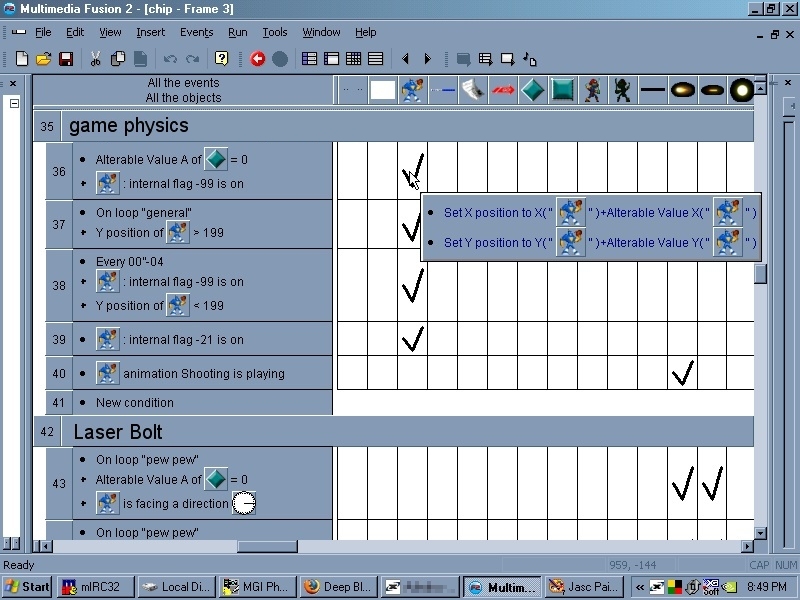
Perhaps one that's a bit off the beaten path, but I've developed a number of games using Multimedia Fusion (now known as Clickteam Fusion). It's a "no-code" system in the sense that you do all programming using a unique checkbox system which has interesting semantics regarding selectors/which objects that certain events interact with. [0]

It's super useful for developing for things like game jams, where you have a super tight time limit, but you definitely have to work within the constraints of the system. If you try to push the boundary too much on what's "expected" it becomes painful very quickly. Additionally, porting the code to other platforms is difficult since you're at the whim of Clickteam to implement it, and historically their "exporters" have been buggy, leading to a cottage industry springing up around the tool to create alternative runtimes for better performance/portability. [1]

From what I'm reading from the other comments, this experience isn't just unique to games, and seems like it applies to other low-code business application tools as well.

[0] https://media.indiedb.com/images/engines/1/1/19/mmf_eventedi...

[1] https://mp2.dk/chowdren/

Re: Ask HN: Experiences with low-code systems?

#50

Earlier quoted context omitted.

> Their Kubernetes helm chart is a mess too. To be fair, I have yet to see a single helm chart that was not a mess. Messiness is endemic to the file format (YAML) and templater (text based). Further, there are no enforced standards defining how to format ingress, service, etc configuration keys in values.yaml so every chart developer is on their own.

The qualities varies for sure. The appsmith helm chart works out of the box, which is better than many. My main issue is to put everything in the same stateful pod using supervisord. It doesn’t scale, I don’t want to use supervisord inside a kubernetes pod, it’s huge and slow to get ready. The helm chart does also weird things such as having a namespace définition or an autoupdate by default.

Ooh, yeah, supervisord doesn't sound like a good fit. Good catch.
Post reply on HN