codedorian.com already more than 100 programs with ~30 users
it's a programming language
261–270 of 1001 posts
it's a programming language
Working on https://fastsleep.app
Using this app, you may fall asleep in 20 minutes (maybe within 8 to 15 minutes)
Simply start the session and imagine what you hear. Like if you hear "calm river", imagine that. If you hear "heavy rain over a tree" imagine that. And you may fall asleep soon.
Try this tonight!
---------
Smart documents for teams. Fast, Open, and Self-Hostable.
Basically a much faster Notion.
I was tired of copying/pasting between agents, so I gave them identities, and tools to talk to each other and share tasks. I've found it so useful that I've left my job as the CTO of a German startup to focus on this.
The identities are public-key DIDs with DNS as the source of truth, as well as team membership. I also run a public registry at https://awid.ai (also OSS).
The game is going to be a farming tycoon/city builder game where you can buy farm stands and advertise to sell your goods. As your operation grows, you grow the local economy and people move to the town turning it into a city, opening up the chance to sell at farmer's markets or supermarkets. As the city grows you'll have to buy/sell land with the city and work with the mayor to plan where the city should claim new land for you to purchase so you can stay on the outskirts with healthy soil (or in the endgame, run for mayor and manage the growth of the city yourself, a la Sim City/Cities/Frostpunk)
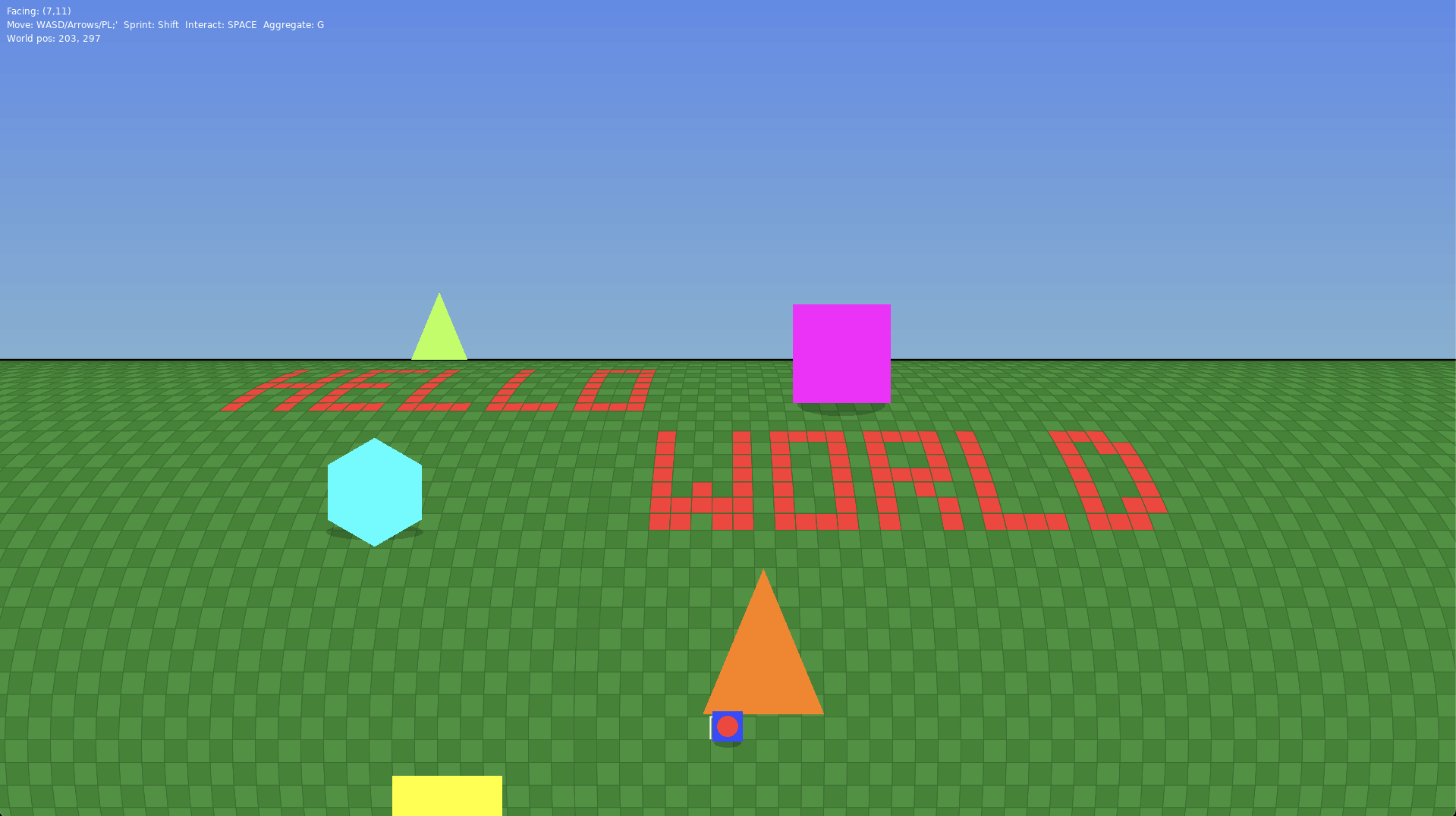
I chose Love2D as my engine so I can use the relative simplicity of 2d art in 2.5D pseudo-3D instead of 3d modeling. The world space is a 3d euclidian grid of cells wrapped around a horizontal cylinder on the x axis. The view space is perpendicular to the side of the cylinder, giving us a natural horizon at the vertex of the cylinder on screen. The world space coordinates are expressed in terms of the polar coordinates of the cylinder, giving natural rise to radius as altitude, angle theta as latitude, and x axis as longitude. All the world math can be calculated using the trigonometry of the unit circle, and converted to 3d Cartesian coordinates before converting them to screenspace coordinates. I can use regular flat plans and elevations for the texutures of building faces, and render them upon linearly transformed quad polygons. Maybe I can also do some screenspace displacement a al Crimson Desert at the finish line to give buildings window sills and ledges when you see down a side of one.
I am doing the development without LLMS as much as possible so I retain a good grasp on Logic, Language, and Math. I have been having a lot of fun digging back into these multivariable calculus and linear algebra concepts I thought were beyond me (because of some autobiographical amnesia issues I deal with) to discover that no wait, I was taught these concepts in high school and was quite comfortable applying them. All the development is done on my own private, secured git instance on my homelab server and I can pull down the latest revision to my iphone to show off, it's been really cool. Kind of a pita to find a good git app on iPhone that allows custom git servers with ports though.
screenshot of a very early hello world, before I made the mental connection between wrapping a 2d cartesian plane around a cylinder and actual 3d cylindrical polar coordinates, which is why the shapes just sit over the world rather than extending from it, I hadn't yet conceived of the radius of the cylinder being altitude: https://fucci.dev/assets/helloworldspace.png
1. Responsive artboards and flex-like layout engine
2. Deep support for design tokens
3. HTML/CSS previews and export
4. Multiplayer AI and human collaboration. Agents can connect to documents and collaborate like any other user.
Built in Swift and cross platform Mac, iPad and iPhone.
I’m designing and building the UI and implementing the underlying features with Codex. So far it’s going surprisingly well.