just look at what IDEs that runs exclusively on ios are like: crap. nobody invest into a closed platform. i expect jetbrains to came up with something marvelous for ar/vr, but it will run on the upcoming version of Microsoft or HP glasses. you know, the only ones today that works just like an external monitor without a locked in ecosystem like apple or facebook. the silly apps and games and such will net millions tho…
Ask HN: What would an IDE built for the Apple Vision Pro look like?
21–30 of 50 posts
Re: Ask HN: What would an IDE built for the Apple Vision Pro look like?
#22Re: Ask HN: What would an IDE built for the Apple Vision Pro look like?
#23Most programming work is still text editing with various amounts of debugging, refactoring, and autocompletion. It is not obvious to me how an AR interface would make a difference other than more virtual screen real estate. You would still need a way to enter text, build code, run tests, etc. This means a keyboard and pointing device (mouse, trackpad, etc.) are still needed unless something else can do it better. Gra…
> Most programming work is still text editing [...] Text no longer needs to be the primary way of conveying programs. There are practical reasons text works best on screens, but if your coding environment is boundless then there’s no reason to believe you can’t do fancier things like direct manipulation of ASTs pretty easily. Imagine "grabbing" an AST node and attaching it to a different parent, all in space. Beyond…
Re: Ask HN: What would an IDE built for the Apple Vision Pro look like?
#24Most programming work is still text editing with various amounts of debugging, refactoring, and autocompletion. It is not obvious to me how an AR interface would make a difference other than more virtual screen real estate. You would still need a way to enter text, build code, run tests, etc. This means a keyboard and pointing device (mouse, trackpad, etc.) are still needed unless something else can do it better. Gra…
> Most programming work is still text editing [...] Text no longer needs to be the primary way of conveying programs. There are practical reasons text works best on screens, but if your coding environment is boundless then there’s no reason to believe you can’t do fancier things like direct manipulation of ASTs pretty easily. Imagine "grabbing" an AST node and attaching it to a different parent, all in space. Beyond…
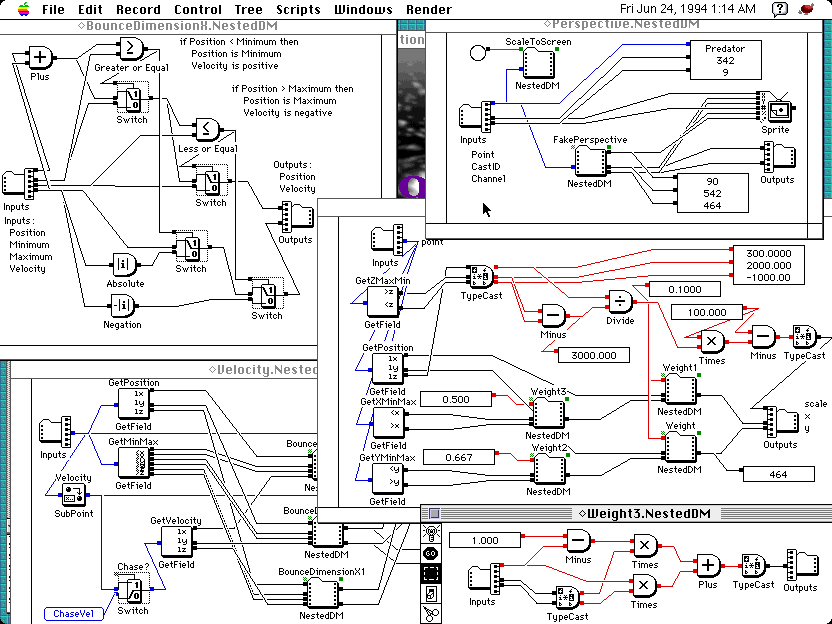
I was expressing this to a friend who was involved in VR in the 80s (VPL research) and was simultaneously elated and disheartened to learn that they had the same idea ! Googling around for it now I suppose he was telling me about "Body Electric" or "Bounce" and looks like any other 2D data flow language [0]. Maybe just ahead of its time. A patent about it [1] describes the problem with wires going everywhere and needing to provide the user the option to hide any set of connections. I'd want to accomplish this by representing the whole connectome in 4D space, and then shifting the projection into 3D to hide and reveal a subset of connections. Further visual filtering could be performed with a depth of field focus and fog effect, controlling all these parameters to isolate the subset of the system you want to inspect.
[0] http://www.art.net/~hopkins/Don/lang/bounce/SpaceSeedCircuit...
[1] https://patents.google.com/patent/US5588104 (bonus, figure 3 shows the dataglove as just a hand plugging into the PC)
Re: Ask HN: What would an IDE built for the Apple Vision Pro look like?
#25Re: Ask HN: What would an IDE built for the Apple Vision Pro look like?
#26Earlier quoted context omitted.
> Most programming work is still text editing [...] Text no longer needs to be the primary way of conveying programs. There are practical reasons text works best on screens, but if your coding environment is boundless then there’s no reason to believe you can’t do fancier things like direct manipulation of ASTs pretty easily. Imagine "grabbing" an AST node and attaching it to a different parent, all in space. Beyond…
We already have plenty of these, and they suck at doing anything serious.
Re: Ask HN: What would an IDE built for the Apple Vision Pro look like?
#27Re: Ask HN: What would an IDE built for the Apple Vision Pro look like?
#28AR VR iOS and macOS app for arbitrary code rendering in 3D space. Terminal like rendered glyph by glyph means perfect control over ever mesh and texture.
The iOS demo is fun. You can walk around your code like an art museum, draw lines of executed traces, and perform visual hierarchical search.
Re: Ask HN: What would an IDE built for the Apple Vision Pro look like?
#29Earlier quoted context omitted.
We already have plenty of these, and they suck at doing anything serious.
Sounds like a good reason to try to do better. Unless you suppose the UI of programming is solved and everyone who wants to have control over a machine just needs to bite down and learn vim ?
Re: Ask HN: What would an IDE built for the Apple Vision Pro look like?
#30just look at what IDEs that runs exclusively on ios are like: crap. nobody invest into a closed platform. i expect jetbrains to came up with something marvelous for ar/vr, but it will run on the upcoming version of Microsoft or HP glasses. you know, the only ones today that works just like an external monitor without a locked in ecosystem like apple or facebook. the silly apps and games and such will net millions tho…
This is flame-baity but honestly what Id also expect. No one is going to invest in developing IDEs for this thing to rival VS Code or whatever if Apple wants a stranglehold on its ecosystem. Maybe there will be extensions to existing editors since people can ise it as a display extension for their macs. We didn’t see this happen on windows with game dev and the quest though.