How about, if you install software such as a web browser on your computer that has a certain functionality intentionally exposed via an API, and you then visit sites that make use of that API, you have given consent for them to use it. And if you don't like it, you can reconfigure said browser to block them.
Ask HN: Shouldn't web browsers ask us before storing cookies?
21–30 of 64 posts
Re: Ask HN: Shouldn't web browsers ask us before storing cookies?
#22How about, if you install software such as a web browser on your computer that has a certain functionality intentionally exposed via an API, and you then visit sites that make use of that API, you have given consent for them to use it. And if you don't like it, you can reconfigure said browser to block them.
Well said! Now if browsers wouldn't have the option to manage certain things, that would be a different matter.
Food for thought: how about advertising companies needing to ask people for consent for showing them the ads; your local post asking for consent for delivering tou junk mail; etc... Lots of things are taken for granted and we just have to cope with it
Re: Ask HN: Shouldn't web browsers ask us before storing cookies?
#23IE had it up to version 11:
https://www.technipages.com/wp-content/uploads/2014/07/IE-Ad...
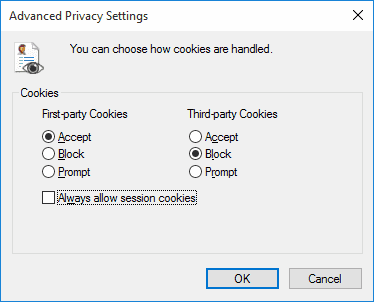
Edge is dumbed-down and removes, among other things, that option:
https://answers.microsoft.com/en-us/edge/forum/all/cookie-co...
Re: Ask HN: Shouldn't web browsers ask us before storing cookies?
#24It used to be an option in Firefox. You have to go dig around bugzilla to find the reasons they removed it - https://bugzilla.mozilla.org/show_bug.cgi?id=1249151 https://bugzilla.mozilla.org/show_bug.cgi?id=606655
Firefox Focus for Android is great. It never stores anything. Which I think is a useful default when looking at shared links, doing quick searches, reading news etc.
Re: Ask HN: Shouldn't web browsers ask us before storing cookies?
#25It would be almost impossible to enforce. Publishers have a point of contact, an address or a hosting company, some sort of physical place where you can find whoever is in charge of the site. In other words, somewhere to send legal documents and summonses should a government wish to pursue legal action.
This is only partly true for web browsers. Google, Mozilla and Microsoft have addresses. But what all the browsers that have forked from open source projects? If someone forks Chromium and adds nasty features, how do you track them down if they did everything anonymously?
More to the point, if a law is passed that says "all browsers must do X,Y and Z". How to you enforce that in a world where open source is so prevalent? The big players may add the requirements to their flagship browsers, but if those browsers have open source underpinnings they have no control over the forked versions.
It's the publishers who are abusing browser capabilities, its much easier to force them in to compliance rather than trying to legislate how browsers work.
Re: Ask HN: Shouldn't web browsers ask us before storing cookies?
#26"Shouldn't" implies some kind of higher authority capable of enforcing such a feature universally across browsers, when no such authority exists. Browsers give you all kinds of opt-out capabilities, if that's something you're interested in. The fact is, most people aren't interested.
But those opt-out capabilities are as clear-cut as most of GDPR banners. edit: mea culpa, I somehow missed bunch of keys and there is a missing negation in my comment which should read "But those opt-out capabilities aren't as clear-cut as most of GDPR banners." I mean: the UI isn't there to opt out of affiliated adtech networks or to store the amount of details the user is willing to share.
Conceptually, there is no way to make trusting cookies both simple and transparent.
Even something as simple as a unique identifier can be used for both helpful and malicious ends. You'd need to read all the code pertaining to it to have a clue if it's something you should accept, and you can't ever know what the server's backend code is, even if it claims to be open source (it can always be running extra components that are not developed in the open).
So, opt-outs are inherently a flawed idea, at least with any granularity.
Turning off cookies entirely in your browser then opting all-in for sites you choose to trust is about all you can reasonably do.
Re: Ask HN: Shouldn't web browsers ask us before storing cookies?
#27IIRC, in the early days, they did ask for every cookie.
lynx definitely had a "yes/no/all for this site" kind of question.
Re: Ask HN: Shouldn't web browsers ask us before storing cookies?
#28How about, if you install software such as a web browser on your computer that has a certain functionality intentionally exposed via an API, and you then visit sites that make use of that API, you have given consent for them to use it. And if you don't like it, you can reconfigure said browser to block them.
Technology can have legitimate and illegitimate uses. Just ask the humble crowbar. Laws are how we codify such things and software is no different.
Consider, a computer virus is only doing what the OS/hardware allows it to do. By your reasoning that should be absolutely acceptable in all situations as TCP/IP is an API.
Re: Ask HN: Shouldn't web browsers ask us before storing cookies?
#29As I remember it, this was an option you could enable in Netscape Navigator back in the dialup days. In practice it meant that every time you went to a new website you'd have to click ok on a dozen popup menus asking for permission to store each individual cookie before the page would load. I'm sure there are ways to make that process go a little more smoothly but in practice it's still probably something that most u…
If I remember correctly the UI for this existed long after Netscape Navigator. According to [1] it was removed in Firefox 44 in early 2016. I had expected that they only removed the UI but left the functionality available via about:config but that doesn't seem to be the case.
EDIT: According to [2] and [3] it seems the behavior was triggered by about:config network.cookie.lifetimePolicy set to 1 (ASK_BEFORE_ACCEPT), but the meaning of 1 apparently has changed over the years. At least setting it to 1 doesn't trigger any cookie dialogs in my Firefox 70.0.1 (64-bit).
[1] https://www.ghacks.net/2016/02/05/firefox-44ask-me-everytime...
Re: Ask HN: Shouldn't web browsers ask us before storing cookies?
#30How about, if you install software such as a web browser on your computer that has a certain functionality intentionally exposed via an API, and you then visit sites that make use of that API, you have given consent for them to use it. And if you don't like it, you can reconfigure said browser to block them.
And if you don't like it, you can reconfigure said browser to block them.
Oh?
I'd love it if that were true. But increasingly, it's not.
Take the YouTube app on iOS. It has no extension functionality. And it's de facto the YouTube browser.
Is it a web browser? Depends how you look at it. YouTube is the web of videos.
Even if we're talking about the actual web, Chrome on iOS doesn't seem to be configurable with extensions. Certainly not easily reconfigurable. In fact, Apple blocks apps that become too configurable, like Expo's old "Scan a QR code and now see your app running immediately" functionality.
Sadly we no longer seem to live in the world where you're encouraged to reconfigure anything.