Regulatory compliance, risk management, security controls, business continuity/SLAs, and cost. Financial services industry.
Those seem like problems the public cloud providers would be highly motivated to solve. Why haven’t they?
Ask HN: Why aren't you using a public cloud?
21–30 of 73 posts
Re: Ask HN: Why aren't you using a public cloud?
#22Academic lab in computational cognitive science / computational linguistics: we haven’t transitioned fully because of storage costs. ~$10 tb/month even for infrequent s3 storage is way too much when we have lots of 10+ tb datasets. Otherwise it’s great to be able to scale compute (scale the number of machines/ cores / GPUs as necessary) and to maintain different images for different projects (NVIDIA driver, cudnn, Te…
Re: Ask HN: Why aren't you using a public cloud?
#23We did use Office 365 because those people had our CIOs ear and gave various discounts to lock us into the MSFT stack, but in-house development was all deployed to our own hardware. Other platforms we ran as part of IT (databases, ERP, analytics) also all were inhouse.
The number one reason were not running all we could on AWS or Azure could be broken down as follows
1) we didn't have the technical knowledge to make the transition 2) the people who were interested in this at all were the younger kids out of college 3) the company is run by older white males who don't trust the younger kids (FTE) and certainly don't trust the IT contractors 4) there was massive resistance to change, even when our industry is bleeding because of low energy prices and little to no profitability 5) Fundamental misunderstanding or lack of understanding of how to secure out data in the cloud 6) business people saw IT as a barrier to innovation 7) IT was very risk averse and with business people not trusting them, it only reinforced their inability to progress
As for [5], we had numerous conversations with MSFT and AWS about trying to run their cloud on premise. We were convinced that we can protect our data better (even though it's not our company's vote competency) than companies like AWS, who are literally in this exact business.
Yeah for all that and other reasons, I left.
Re: Ask HN: Why aren't you using a public cloud?
#24Dedicated servers are now as easy to manage as cloud vms because good dashboards + management tooling have become cloud agnostic. I use Kubernetes + Rancher to manage a cluster of dedicated servers and it's a fraction of the cost as a public cloud.
Re: Ask HN: Why aren't you using a public cloud?
#25Earlier quoted context omitted.
Those seem like problems the public cloud providers would be highly motivated to solve. Why haven’t they?
Business continuity: Providing a good SLA isn't in the AWS business model, which allows for widespread, lengthy outages. They have a so-so SLA and if they miss you get AWS credits, big whoop. They make their money on people who are insensitive to high cost, middling performance and reliability. Not sure about the other providers. At a certain point it's cheaper and easier to do it yourself than to support a hybrid cl…
Re: Ask HN: Why aren't you using a public cloud?
#26Dedicated hosting is much better bang for your buck, especially for bandwidth. If you do something like video streaming and have relatively predictable loads, I've found that you have to pay at least an order of magnitude more with public cloud compared to dedicated servers on OVH or Datapacket. Maxing out a 2gbps server on Datapacket would cost you just $320/month for 648 TB of outgoing bandwidth monthly, versus at…
Even if you're running everything else serverless and have no compute time at all? I know a VOD training service runs serverless with videos on S3 and they're very successful.
Re: Ask HN: Why aren't you using a public cloud?
#27Dedicated hosting is much better bang for your buck, especially for bandwidth. If you do something like video streaming and have relatively predictable loads, I've found that you have to pay at least an order of magnitude more with public cloud compared to dedicated servers on OVH or Datapacket. Maxing out a 2gbps server on Datapacket would cost you just $320/month for 648 TB of outgoing bandwidth monthly, versus at…
Even if you're running everything else serverless and have no compute time at all? I know a VOD training service runs serverless with videos on S3 and they're very successful.
Re: Ask HN: Why aren't you using a public cloud?
#28Academic lab in computational cognitive science / computational linguistics: we haven’t transitioned fully because of storage costs. ~$10 tb/month even for infrequent s3 storage is way too much when we have lots of 10+ tb datasets. Otherwise it’s great to be able to scale compute (scale the number of machines/ cores / GPUs as necessary) and to maintain different images for different projects (NVIDIA driver, cudnn, Te…
Azure Blob Storage can be way cheaper than that. https://azure.microsoft.com/en-us/services/storage/blobs/
https://www.backblaze.com/blog/petabytes-on-a-budget-how-to-...
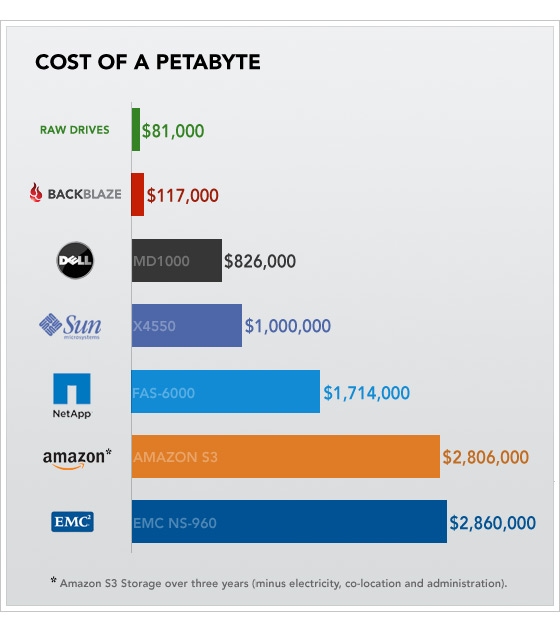
https://www.backblaze.com/blog/wp-content/uploads/2009/08/co... (Cost of a Petabyte by service vs DIY)
Re: Ask HN: Why aren't you using a public cloud?
#29I suspect there's still a lot of FUD regarding public cloud as well as on-prem admins and engineers actively pushing back for fear of losing their jobs. (I've seen this in action) There certainly are legitimate reasons not to move to public cloud, but it shouldn't be an emotional one. Measure cost (including manpower), SLA's, performance, governance, and compliance. After that it should be simple to stay on-prem, go…
The funny thing is: those jobs already went years ago outsourced to “smart hands” in the DC. You still need people to plan and operate all this stuff. SAs who make the jump willingly have nothing to fear from cloud.
Re: Ask HN: Why aren't you using a public cloud?
#30I’ve worked in a few different settings on large-scale scientific computing. For those applications: - Not cost-efficient at large scale. When you expect and plan to run thousands of nodes at near 100% CPU and memory usage for years at a time, running a machine room can still be less expensive. - Specialized hardware not available in public clouds, e.g., very low latency networks configured in an optimal topology. -…
By the way, at one point, in science, there is already such a kind of computing cloud: We call it https://en.wikipedia.org/wiki/Grid_computing