One idea I've had (heavily influenced by The Diamond Age, I must admit) - a premium video game experience where NPCs you meet are sometimes voiced/acted by actors hired real-time on-demand with face or even body mocap. The NPCs revert back to regular AI versions if an actor is unable to be hired at that time. The player could interact by speaking with their own voice, naturally role-playing the scene. This would of c…
Ask HN: What non-obvious tech/market may take off in the next few years?
141–150 of 176 posts
Re: Ask HN: What non-obvious tech/market may take off in the next few years?
#142One idea I've had (heavily influenced by The Diamond Age, I must admit) - a premium video game experience where NPCs you meet are sometimes voiced/acted by actors hired real-time on-demand with face or even body mocap. The NPCs revert back to regular AI versions if an actor is unable to be hired at that time. The player could interact by speaking with their own voice, naturally role-playing the scene. This would of c…
I don't think this makes sense for a number of reasons. 1. As you said, the costs involved. You'd probably need to charge people something like $10 per interaction with a voice actor, plus $2 per minute. This makes for a very limited market. 2. Actors need to be waiting for a request on a wide range of characters since there would not be enough demand for them to consistently play the same character all the time. So,…
Re: Ask HN: What non-obvious tech/market may take off in the next few years?
#143No code/low code. People here underestimate the work it requires to craft a production CRUD app and keep it working. The problem these tools solve are more related to infrastructure rather than one's ability to code. Learning to code might be the easiest part but deploying it, maintaining it, scaling it, securing it and integrating it with thousands of other services remains a huge task even for experienced folks. It…
I think one of the issues of nolocode is it doesn't actually help people think like programmers, but the tools are often created with the implicit need to do that, a need which the creators don't see because they are coders. People get spreadsheets and word documents. I don't really know why. But they get them. But while it might seem like the step from doc/xls to nolocode is small or even non-existent, I think it ac…
The nice thing about this model is that it implies there's a bar to be a Maker and other users can't break your work. You need to be able to reason about concepts like DRY, star schema, cardinality, etc. As a Maker in my org (15-30K people depending on where we are with the pandemic) I can support many no-code apps painlessly in addition to my primary responsibilities, whereas one CRUD app on Heroku had me feeling spread pretty thin.
Re: Ask HN: What non-obvious tech/market may take off in the next few years?
#144Earlier quoted context omitted.
HN crowd has a lot of crypto deniers. The funny thing is that HN leaders like literally PG, Googl Bosses, Zuck and Marc Andreasen are very bullish on it. So it doesn't take much to realize who is right
Like the rest of SV, they are blinded by hubris and their own blindness to the downsides of tech. Crypto currency is a disaster.
Re: Ask HN: What non-obvious tech/market may take off in the next few years?
#145No code/low code. People here underestimate the work it requires to craft a production CRUD app and keep it working. The problem these tools solve are more related to infrastructure rather than one's ability to code. Learning to code might be the easiest part but deploying it, maintaining it, scaling it, securing it and integrating it with thousands of other services remains a huge task even for experienced folks. It…
It was such a spectacular failure it's funny to see it recycled.
And for you to claim you wouldn't have to worry about maintenance is especially comical. It was extremely high maintenance and expensive, and it often broke.
Programmers don't just code a problem, they solve the problem. Teasing out the actual business logic is as much a part of the job as anything else, and one that most employees and managers are so clueless and utterly useless at that any no code solution will require a programmer to actually use it any way.
But without any of the flexibility code gives, you end up with tons of dumb, manual, expensive, hacks and a sub-standard product. Eventually the 'no-code' platform adds the ability to use some code and you end up with a really shitty software platform that delivers 80%, but the effort required to get that last 20% is far in excess of just starting again and writing it from scratch in code.
Ask any programmer who remembers workflow software their experience and you will learn from the mistakes of two decades ago.
Re: Ask HN: What non-obvious tech/market may take off in the next few years?
#146No code/low code. People here underestimate the work it requires to craft a production CRUD app and keep it working. The problem these tools solve are more related to infrastructure rather than one's ability to code. Learning to code might be the easiest part but deploying it, maintaining it, scaling it, securing it and integrating it with thousands of other services remains a huge task even for experienced folks. It…
So you really haven't made the code go away; you've disguised it as something that isn't code. This actually works well for tricking people into programming when they otherwise wouldn't. And this itself is a viable strategy: consider the secretaries in the 1970s who used Lisp to "customize" Multics Emacs and were never told they were programming it. But it doesn't eliminate the complexity of coding. And most "no-code/low-code" platforms have disadvantages (vendor lock, extremely limited applicability, zero portability) that are almost guaranteed to bite you in the ass later.
Re: Ask HN: What non-obvious tech/market may take off in the next few years?
#147No code/low code. People here underestimate the work it requires to craft a production CRUD app and keep it working. The problem these tools solve are more related to infrastructure rather than one's ability to code. Learning to code might be the easiest part but deploying it, maintaining it, scaling it, securing it and integrating it with thousands of other services remains a huge task even for experienced folks. It…
No code = someone else's code, it's been around forever, used to be called cots
Re: Ask HN: What non-obvious tech/market may take off in the next few years?
#148No code/low code. People here underestimate the work it requires to craft a production CRUD app and keep it working. The problem these tools solve are more related to infrastructure rather than one's ability to code. Learning to code might be the easiest part but deploying it, maintaining it, scaling it, securing it and integrating it with thousands of other services remains a huge task even for experienced folks. It…
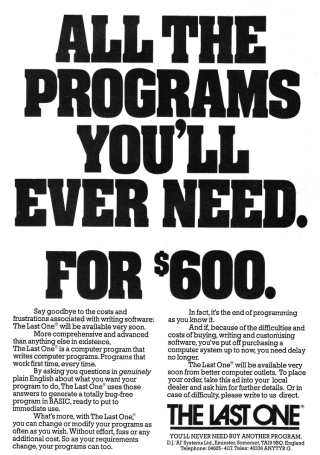
They tried this in the 90s and 00s. It was such a spectacular failure it's funny to see it recycled. And for you to claim you wouldn't have to worry about maintenance is especially comical. It was extremely high maintenance and expensive, and it often broke. Programmers don't just code a problem, they solve the problem. Teasing out the actual business logic is as much a part of the job as anything else, and one that…
https://thedailywtf.com/images/ads/All-programs-you-need-sma...