Live data from Hacker News

Ask HN: Why does nobody support h.265/HEVC anymore?

news.ycombinator.com

131–140 of 170 posts

Re: Ask HN: Why does nobody support h.265/HEVC anymore?

#131
post #119
post #63

Earlier quoted context omitted.

Every country in the world "endorses" the concept of "essential" patents. It's called a patent.

No. A patent covers a way of doing things. An essential patent covers the way of doing things. Essential patents in general fail the obviousness test; they cover the solution that most experts in the field would reach in solving the given problem.

Aren't essential patents essential because they are a standard (or part of one) that makes them essential? Not that they must be obvious?

For example, what good is the perfect communication codec if every operator must each pay top dollar?

Re: Ask HN: Why does nobody support h.265/HEVC anymore?

#132
post #119

Earlier quoted context omitted.

No. A patent covers a way of doing things. An essential patent covers the way of doing things. Essential patents in general fail the obviousness test; they cover the solution that most experts in the field would reach in solving the given problem.

Aren't essential patents essential because they are a standard (or part of one) that makes them essential? Not that they must be obvious? For example, what good is the perfect communication codec if every operator must each pay top dollar?

I'm not saying that 'essential' means 'obvious' in any official sense, rather that they generally cover solutions that experts in the field would come to if attempting to solve the problem.

I struggle to see how the patent office could ever uphold the requirement of inobviousness, how could they possibly have expert level domain knowledge across all domains?

So the patents get granted, contextually obvious or not.

I should stop typing while I'm still vaguely on topic, before I start ranting about patent thickets and wilful infringement.

Re: Ask HN: Why does nobody support h.265/HEVC anymore?

#133
post #107

The frustrating thing IMHO is that IP security cameras support H.264 and H.265, while browsers support H.264 and VP9/AV1. It's good that they have one codec in common, but I'd prefer they share a modern one. I think much of it is geopolitical. Browser vendors are mostly in the West, can't just ignore the patents, and don't want to pay for the patents. Camera and chipset makers are mostly in China and simply ignore pa…

Give it time. HEVC hardware support was available before AV1 hardware support. I think thats the only reason - realtime encoding of these modern codecs necessitates hardware support on a device like a security camera.

How much time? The codec licensing shitshow was already going strong before web browsers were a thing.

Re: Ask HN: Why does nobody support h.265/HEVC anymore?

#134

Because people prefer to destroy ecology and user experience than pay one symbolic dollar for a lifetime license

That symbolic dollar causes so much overhead though. Who tracks who has bought or not bought it? Should users/software devs/hardware makers pay? For potentially billions of users/software copies/devices across many national jurisdictions. I click the x265 video link. And now the browser/OS/hardware have to do a dance to determine if I am allowed to watch the video or not. Or because that is a big hassle, don't bother…

Are windows codec packs still a thing? That worked fine back in the day. They're welcome to talk to me about licensing their $1 patent for personal use after they track me down (though, chances are, I already accidentally own a license to it anyway.)

Re: Ask HN: Why does nobody support h.265/HEVC anymore?

#135

Earlier quoted context omitted.

I mean, is a video codec really just "math"? There's a binary payload description and algorithms involved for applying said math as well. I'm no expert in the field, so I'm actually asking in good faith here...

Everything you can instruct a computer to do is just math, yes. "Instructions on how to use the math" is, unsurprisingly, also more math. https://en.m.wikipedia.org/wiki/Lambda_calculus

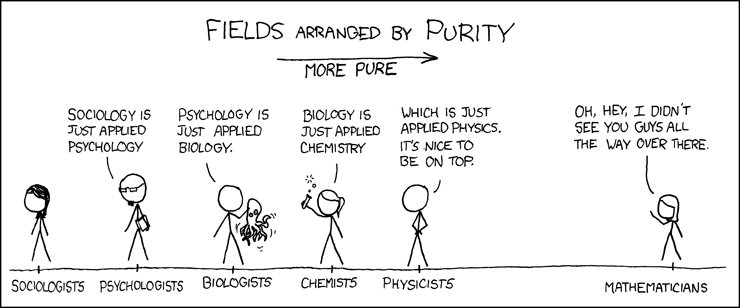
https://imgs.xkcd.com/comics/purity.png

Re: Ask HN: Why does nobody support h.265/HEVC anymore?

#136

Earlier quoted context omitted.

Everything you can instruct a computer to do is just math, yes. "Instructions on how to use the math" is, unsurprisingly, also more math. https://en.m.wikipedia.org/wiki/Lambda_calculus

I am well aware of the foundations of CS and the lambda calculus, but this is more than a bit reductionist, like saying "everything is made of subatomic particles." Patents on processes and methods are pretty common. Dismissing it as "they just patented some math" and then falling back to saying "oh, lambda calculus" -- I think you can do better :-) But, yes, I'm sure the patents suck.

I don't feel like you were asking on good faith after this response.

Re: Ask HN: Why does nobody support h.265/HEVC anymore?

#138

Earlier quoted context omitted.

If you’re against patents, yes. If you’re gainfully employed doing math things that turn into codecs, no. Patents suck, but they also serve a purpose.

I’m not sure why is this being downvoted… A patent for a drug is just chemistry, which is also just math with a specific ruleset… Patents are designed to protect work, especially work where most of the effort is in the research / discovery rather than the implementation. Implementing a video decoder is relatively easy coming up with the algorithms to encode/decode the video efficiently and effectively however is a lo…

The majority of the posters here are IT practitioners. Stupid patent rules get in the way, and there is a visceral reaction to them.

It’s a tough, nuanced issue. I don’t think anyone is happy with the system, but many stakeholders have a vested interest.

Re: Ask HN: Why does nobody support h.265/HEVC anymore?

#139

Earlier quoted context omitted.

If you’re against patents, yes. If you’re gainfully employed doing math things that turn into codecs, no. Patents suck, but they also serve a purpose.

I’m not sure why is this being downvoted… A patent for a drug is just chemistry, which is also just math with a specific ruleset… Patents are designed to protect work, especially work where most of the effort is in the research / discovery rather than the implementation. Implementing a video decoder is relatively easy coming up with the algorithms to encode/decode the video efficiently and effectively however is a lo…

There are essential differences between chemistry and mathematics.

To discover anything in mathematics, including a new video compression algorithm, you do not need anything else, except a computer. In theory, not even the computer is needed, as you could do everything with pen and paper, but it might require years or centuries.

Chemistry is an experimental science for now, until someone would find a method to solve the equations of quantum mechanics for non-trivial systems.

A lot of mathematics is used in chemistry but at its base chemistry remains experimental, because all the mathematical models used in chemistry to predict some facts use a large number of model parameters that have been determined experimentally. There are no truly "ab initio" mathematical predictions in chemistry.

Using mathematics in chemistry allows a significant reduction in the number of chemical experiments that must be done to discover anything new, but they cannot be eliminated yet.

Any discovery in mathematics can be easily redone again, by someone else, completely independently, and this actually happens extremely frequently.

There do not seem to exist many reasons that can justify why the later discoverers must be punished to pay money to others in order to use the mathematical relations that they have discovered themselves, even if by some chance someone else happened to discover the same relations earlier.

For mathematical discoveries, there are little grounds to claim that the first discoverer should be able to recover any expenses, as most of the strictly necessary expenses are just in the salaries of people and it is very difficult to estimate what percentage of those expenses had actually contributed to the discovery.

On the other hand, for inventions referring to chemical substances, or to mechanical, thermal or electrical devices and so on, a lot of experiments with physical devices must be made and the experimentation costs can indeed be very high, so it can be argued that it might be good for a society to encourage such experiments by promising a temporary monopoly for the exploitation of the results, as long as the duration of the monopoly is not excessive.

For the kind of minor innovations that are the object of most recent patents, a reduced patent duration seems more appropriate, e.g. 10 years.

A patent duration of 20 years or more seems acceptable only for a few patents for which the acceptance criteria should be much more strict than they have become recently, i.e. such patents should really be "non-obvious for those skilled in the field", and not just trivial combinations of formerly known devices or methods.
Re: Ask HN: Why does nobody support h.265/HEVC anymore?

#140

Because the US endorses the concept of "essential patents," meaning you need to pay a licensing fee to be lawfully allowed to perform the math that transforms data into A/V content. Never to mention the two blatant issues with this, being: 1) video codecs are the exemplary "we'll patent math and there's nothing you can do about it" scam, since that's literally all a video codec is 2) a process being "essential" to a…

> video codecs are the exemplary "we'll patent math and there's nothing you can do about it" scam, since that's literally all a video codec is Most software is literally all math.

That is why previously software could not be patented and it still cannot be patented in many countries.
Post reply on HN