Live data from Hacker News

Ask HN: Do OLED displays only save energy with absolute black?

news.ycombinator.com

11–20 of 29 posts

Re: Ask HN: Do OLED displays only save energy with absolute black?

#11
post #6
post #3

Earlier quoted context omitted.

Thanks, that's exactly what I am wondering Is #010101 effectively #FFFFFF or does it actually use less energy the darker it is? With LCDs we know it is the former, but what about OLED displays?

The brighter the pixels are, the more power they are using. A pixel uses 0 power at 0 brightness, and it goes up from there.

Well, with LCD it does not matter. It always uses the same power. Hence the question.

So you are confirming that the statement is actually wrong. The darker a pixel on OLED, the less power it uses. Right?

Re: Ask HN: Do OLED displays only save energy with absolute black?

#12
post #5
post #3

Earlier quoted context omitted.

Thanks, that's exactly what I am wondering Is #010101 effectively #FFFFFF or does it actually use less energy the darker it is? With LCDs we know it is the former, but what about OLED displays?

I'm not sure. Considering what I know about OLED, I'd assume that #010101 consumes considerably more energy than #000000 since it needs to emit light for that individual diode. The energy efficiency from there will mostly depend on the brightness/size of the display.

But does it use less power than #FFFFFF?

Re: Ask HN: Do OLED displays only save energy with absolute black?

#13
post #2

(Warning: I am not a display technology expert) I'm guessing it's a combination of yes and no. OLED screens save power on black colors because it can completely shut off the pixels responsible for illuminating that portion of the screen. If you have a slightly brighter color than pure black, the diode will turn on but not at full-brightness. Technically speaking, you probably stand to save the most power on a purely…

I found the following research paper that does seem to support your educated guess: Energy Aware Color Sets https://eprints.cs.univie.ac.at/4187/1/eg09_color.pdf

Could you point me in the right direction please? It does talk about OLED, but I couldn't find where it specifically referred to the question here.

Re: Ask HN: Do OLED displays only save energy with absolute black?

#14
post #2

(Warning: I am not a display technology expert) I'm guessing it's a combination of yes and no. OLED screens save power on black colors because it can completely shut off the pixels responsible for illuminating that portion of the screen. If you have a slightly brighter color than pure black, the diode will turn on but not at full-brightness. Technically speaking, you probably stand to save the most power on a purely…

The problem is that I find it really hard to read. The contrast is too large for the eyes. Some background color and lighting makes reading more comfortable. Perfect black is good for video though

Re: Ask HN: Do OLED displays only save energy with absolute black?

#15
post #12
post #5

Earlier quoted context omitted.

I'm not sure. Considering what I know about OLED, I'd assume that #010101 consumes considerably more energy than #000000 since it needs to emit light for that individual diode. The energy efficiency from there will mostly depend on the brightness/size of the display.

But does it use less power than #FFFFFF?

Yes, but it's efficiency scales with the overall brightness of the display. True OLED black will always consume the same amount of power, regardless of brightness.

Re: Ask HN: Do OLED displays only save energy with absolute black?

#16
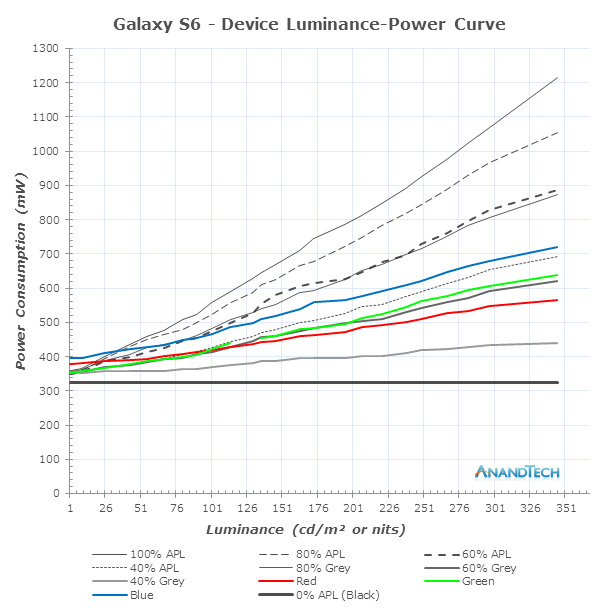
That’s not true—just a very persistent myth. Your intuition is correct. Anandtech display reviews have actual measurements if you’re interested.

See this chart: https://images.anandtech.com/doci/9394/luminance-curve.png

From this article: https://www.anandtech.com/show/9394/analysing-amoled-power-e...

What’s actually true that most people don’t expect is that OLED displays often use more power than LCD displays even with very dark content.

Re: Ask HN: Do OLED displays only save energy with absolute black?

#17
post #2

(Warning: I am not a display technology expert) I'm guessing it's a combination of yes and no. OLED screens save power on black colors because it can completely shut off the pixels responsible for illuminating that portion of the screen. If you have a slightly brighter color than pure black, the diode will turn on but not at full-brightness. Technically speaking, you probably stand to save the most power on a purely…

The active matrix still has to be powered up with 100% black content.

Re: Ask HN: Do OLED displays only save energy with absolute black?

#18
In broad strokes, an OLED turns current into visible light. More current = more light, and more current = more power. So the brighter an individual pixel needs to be, the more current is consumed by the OLED cell. There is a generally linear relationship between the brightness of a display and its power consumption.

In discrete LEDs the datasheets will typically have a table or plot of luminosity (candelas) vs current through the device, and you can figure how much current is needed (and therefore how much power is drawn) to reach a target luminosity. Brightness (nits) is a measure of the luminosity over an area. The tables in the datasheet of an OLED display unit are a bit different but the principle holds.

Now going from RGB color space in the digital world to the actual current draws of individual LED cells is not a 1:1 or even linear relationship, so while you can say in broad strokes that #ffffff will draw more power than #000000 it's not as straightforward for the rest of the color gamut. The reason to keep that in mind is that the "brightness" (or saturation, if you're in HSV instead of HSL) is not equivalent to the physical brightness of the display.
Re: Ask HN: Do OLED displays only save energy with absolute black?

#19
post #16

That’s not true—just a very persistent myth. Your intuition is correct. Anandtech display reviews have actual measurements if you’re interested. See this chart: https://images.anandtech.com/doci/9394/luminance-curve.png From this article: https://www.anandtech.com/show/9394/analysing-amoled-power-e... What’s actually true that most people don’t expect is that OLED displays often use more power than LCD displays even…

Thanks, from that I understand the brighter the color the more power it will use. So #010101 will use more than proper black but far less than proper white.

That was my question, thanks a lot

Re: Ask HN: Do OLED displays only save energy with absolute black?

#20
post #16

That’s not true—just a very persistent myth. Your intuition is correct. Anandtech display reviews have actual measurements if you’re interested. See this chart: https://images.anandtech.com/doci/9394/luminance-curve.png From this article: https://www.anandtech.com/show/9394/analysing-amoled-power-e... What’s actually true that most people don’t expect is that OLED displays often use more power than LCD displays even…

> That’s not true;

Which question are you referring to?

Post reply on HN