There exists a formulation of the Japanese Constitution in Prolog, which can then be called with a proposition to determine its constitutionality.
Ask HN: What are some interesting examples of Prolog?
11–20 of 64 posts
Re: Ask HN: What are some interesting examples of Prolog?
#12You could look at "PRESS: PRolog Equation Solving System", "a system for solving
symbolic, transcendental, non-differential equations."
    Journal of Symbolic Computation
    Volume 7, Issue 1, January 1989, Pages 71-84
    "Solving symbolic equations with PRESS"
Source: https://github.com/maths/PRESS
- - - -
BTW, Does anyone know where I can find the source for MIXTUS partial evaluation system?
Re: Ask HN: What are some interesting examples of Prolog?
#13There exists a formulation of the Japanese Constitution in Prolog, which can then be called with a proposition to determine its constitutionality.
Link for those interested: https://github.com/bitlaw-jp/the-constitution-of-japan
Re: Ask HN: What are some interesting examples of Prolog?
#14One of the most interesting applications of Prolog I have seen in the recent past is the formalization of dose-escalation trial designs that occur in clinical oncology. In particular, David C. Norris has implemented a Prolog formulation of the cumulative cohort design (CCD) as part of his precautionary package: https://github.com/dcnorris/precautionary/blob/main/exec/pro... This Prolog program can be used to exhausti…
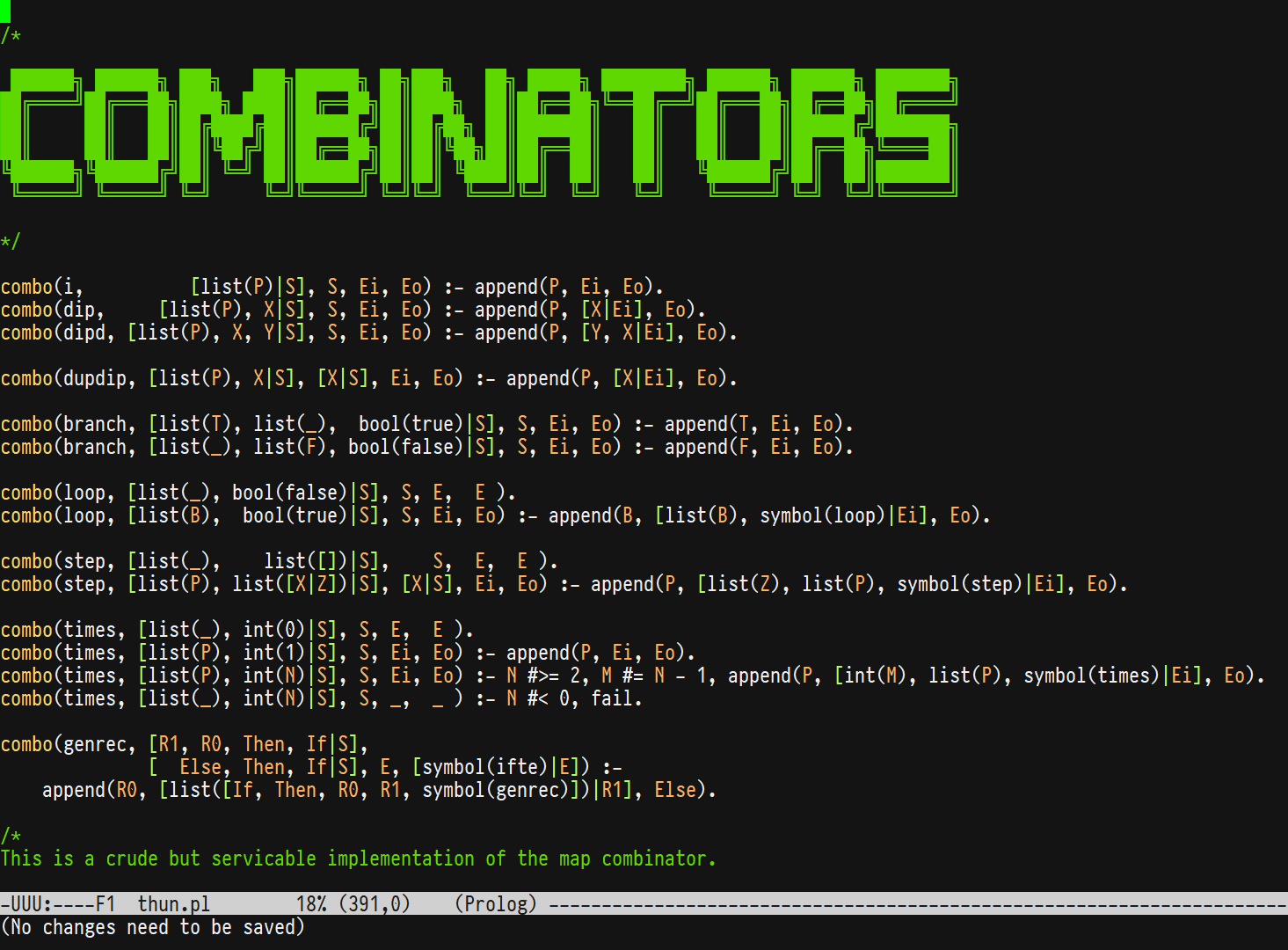
Wow this is the best thing since the Actually Portable Executable source code. https://justine.lol/thun.png How did the author generate those letters?
Re: Ask HN: What are some interesting examples of Prolog?
#15Not exactly a big codebase, but it was a revelation for me how natural typecheckers can feel in Prolog: I basically rewrote typing rules with some tweaks: [1] Also, tests were surprisingly enjoyable in Prolog: [2]. [1] https://github.com/EarlGray/language-incubator/blob/29755c32... [2] https://github.com/EarlGray/language-incubator/blob/29755c32...
Worth checking out if you're interested in using constraint/logic programming languages for type checking is the Statix (https://www.spoofax.dev/references/statix/) language, which is used in the Spoofax language workbench. It works similarly to Prolog in solving constraints, but adds support for scope graphs, which are a generic approach to specifying the name binding behavior of programming languages through logic constraints.
Re: Ask HN: What are some interesting examples of Prolog?
#16One of the most interesting applications of Prolog I have seen in the recent past is the formalization of dose-escalation trial designs that occur in clinical oncology. In particular, David C. Norris has implemented a Prolog formulation of the cumulative cohort design (CCD) as part of his precautionary package: https://github.com/dcnorris/precautionary/blob/main/exec/pro... This Prolog program can be used to exhausti…
Wow this is the best thing since the Actually Portable Executable source code. https://justine.lol/thun.png How did the author generate those letters?
Re: Ask HN: What are some interesting examples of Prolog?
#17Not exactly a big codebase, but it was a revelation for me how natural typecheckers can feel in Prolog: I basically rewrote typing rules with some tweaks: [1] Also, tests were surprisingly enjoyable in Prolog: [2]. [1] https://github.com/EarlGray/language-incubator/blob/29755c32... [2] https://github.com/EarlGray/language-incubator/blob/29755c32...
Not a criticism of the code here by any stretch, I always find it impressive when people manage to understand languages that are totally foreign to me, that being said however Prolog has always struck me as uniquely unreadable. Even back in university when we looked briefly at different styles of programming, the code always ended up looking something like lines 107-132 in your example, which to someone jumping in is…
Regarding the code in question, it is possible to write it a bit more elegantly and more compactly, with a combination of techniques. For example, let's consider this snippet from lines 110 to 119:
    type(Ctx, case(T0, {z, Tz}, {s(V), Ts}), Ty) :- !,
      isvar(V),
      type(Ctx, T0, nat),
      type(Ctx, Tz, Ty),
      CtxS = [{V, nat} | Ctx], type(CtxS, Ts, Ty).
    type(Ctx, case(T0, {inl(Vl), Tl}, {inr(Vr), Tr}), Ty) :- !,
      isvar(Vl), isvar(Vr),
      type(Ctx, T0, uni(Ty1, Ty2)),
      Ctx1 = [{Vl, Ty1} | Ctx], type(Ctx1, Tl, Ty),
      Ctx2 = [{Vr, Ty2} | Ctx], type(Ctx2, Tr, Ty).
    type(Ctx, case(T0, {z, Tz}, {s(V), Ts}), Ty) :-
      isvar(V),
      type(Ctx, T0, nat),
      type(Ctx, Tz, Ty),
      CtxS = [{V, nat} | Ctx], type(CtxS, Ts, Ty).
    type(Ctx, case(T0, {inl(Vl), Tl}, {inr(Vr), Tr}), Ty) :-
      isvar(Vl), isvar(Vr),
      type(Ctx, T0, uni(Ty1, Ty2)),
      Ctx1 = [{Vl, Ty1} | Ctx], type(Ctx1, Tl, Ty),
      Ctx2 = [{Vr, Ty2} | Ctx], type(Ctx2, Tr, Ty).
    type(Ctx, case(T0, {z, Tz}, {s(v(V)), Ts}), Ty) :-
      type(Ctx, T0, nat),
      type(Ctx, Tz, Ty),
      CtxS = [{V, nat} | Ctx], type(CtxS, Ts, Ty).
    type(Ctx, case(T0, {inl(v(Vl)), Tl}, {inr(v(Vr)), Tr}), Ty) :-
      type(Ctx, T0, uni(Ty1, Ty2)),
      Ctx1 = [{Vl, Ty1} | Ctx], type(Ctx1, Tl, Ty),
      Ctx2 = [{Vr, Ty2} | Ctx], type(Ctx2, Tr, Ty).
    type(Ctx, case(T0, {z, Tz}, {s(v(V)), Ts}), Ty) :-
      type(Ctx, T0, nat),
      type(Ctx, Tz, Ty),
      type([{V, nat} | Ctx], Ts, Ty).
    type(Ctx, case(T0, {inl(v(Vl)), Tl}, {inr(v(Vr)), Tr}), Ty) :-
      type(Ctx, T0, uni(Ty1, Ty2)),
      type([{Vl, Ty1} | Ctx], Tl, Ty),
      type([{Vr, Ty2} | Ctx], Tr, Ty).
Re: Ask HN: What are some interesting examples of Prolog?
#18One of the most interesting applications of Prolog I have seen in the recent past is the formalization of dose-escalation trial designs that occur in clinical oncology. In particular, David C. Norris has implemented a Prolog formulation of the cumulative cohort design (CCD) as part of his precautionary package: https://github.com/dcnorris/precautionary/blob/main/exec/pro... This Prolog program can be used to exhausti…
Wow this is the best thing since the Actually Portable Executable source code. https://justine.lol/thun.png How did the author generate those letters?
figlet is the classic tool to generate these:
http://www.figlet.org/
toilet is a slightly more modern reimplementation with some added features (like color): http://caca.zoy.org/wiki/toilet
Re: Ask HN: What are some interesting examples of Prolog?
#19Make files are prolog programs in drag.
Re: Ask HN: What are some interesting examples of Prolog?
#20Not a lot of code but a somewhat different use of Prolog than you're likely to see elsewhere. I used my fork of a MQTT library for Prolog (https://github.com/sprior/swi-mqtt-pack) to implement the central controller for my home automation system. The system responds to MQTT events and then coordinates the appropriate action by sending MQTT messages to other home services. Recent versions of SWI-Prolog also support redis and I've started using that to store device configuration and state between services. The MQTT version is actually a reimplementation of my previous version which used CORBA for inter-service communication.
I don't distribute the home automation code however it's pretty specific to my house. The MQTT library provides some building block examples.
You can also see some other comments I've made on HN which describe some other details.