Ask HN: What's the Future of Red Hat Developer Post IBM Acquisition?
developers.redhat.com
Ask HN: What's the Future of Red Hat Developer Post IBM Acquisition?
1–10 of 15 posts
Re: Ask HN: What's the Future of Red Hat Developer Post IBM Acquisition?
#2I’m Brad Micklea and I lead Red Hat’s Developer Business Unit, which covers developer evangelism, our developer program at developers.redhat.com, and our developer tools. All these facets of our business, as with Red Hat more generally, will remain independent from IBM. This means that…
- You’ll still bump into our fantastic Red Hat developer relations team at events, meetups and keynotes.
- The Red Hat developer program—including the site, blog, and our social media channels—will remain independent and continue to focus on great open source software and culture.
- If you’re a member of the developer program, you’ll continue to enjoy free access to Red Hat software downloads, eBooks, events and great content.
I’m sure there is some nervousness in the developer community with this announcement. I welcome your questions and will be monitoring this thread and replying to as many as I can over the coming day or so.
Re: Ask HN: What's the Future of Red Hat Developer Post IBM Acquisition?
#3[deleted]
Re: Ask HN: What's the Future of Red Hat Developer Post IBM Acquisition?
#4RIP RedHat, and probably CentOS and Fedora too... eventually.
Re: Ask HN: What's the Future of Red Hat Developer Post IBM Acquisition?
#5RIP RedHat, and probably CentOS and Fedora too... eventually.
This isn't a question, but this may stil help with your doubts: https://developers.redhat.com/blog/2019/07/09/preserving-the...
TL;DR: Nothing changes!
Re: Ask HN: What's the Future of Red Hat Developer Post IBM Acquisition?
#6I've been through an acquisition in the past where the purchasing company told us that we'd remain independent and that "we like what you're doing, that's why we purchased the company, we don't want to change anything". This was true for roughly 6 months, then sweeping business and cultural changes happened.
Do you have any assurances that what you've been told, regarding independence will remain true? If so, are those assurances any more concrete than the initial promise of independence?
Not trying to be negative, but telling a company that's been acquired that things will stay the same, seems to be one of the oldest corporate lies in the book.
Thoughts? Thanks for your post.
Re: Ask HN: What's the Future of Red Hat Developer Post IBM Acquisition?
#7I've been through an acquisition in the past where the purchasing company told us that we'd remain independent and that "we like what you're doing, that's why we purchased the company, we don't want to change anything". This was true for roughly 6 months, then sweeping business and cultural changes happened. Do you have any assurances that what you've been told, regarding independence will remain true? If so, are tho…
There are no guarantees in life and I'm in technology because I like change...but when the announcement came across my email in October I was nervous for some of the same reasons.
The assurances I have come from several angles. The public statements from both Jim (our CEO), Ginny (IBM CEO) and Arvind (SVP Cloud Products @IBM). You can see those here: CEO: https://www.redhat.com/en/blog/jim-whitehurst-email-red-hatt... Arvind: https://www.redhat.com/en/blog/qa-ibms-landmark-acquisition-...
But I always put more trust in my own interactions and I've had an opportunity now to work with quite a few of my new colleagues in IBM on both the engineering and business side. What I have seen from them is humility and curiosity about our business - there has been no arrogance. This has been true of their words and their actions so far. To me this is important because I think it's as a result of arrogance on the part of the acquirer that many deals go bad post-close.
Re: Ask HN: What's the Future of Red Hat Developer Post IBM Acquisition?
#8I've been through an acquisition in the past where the purchasing company told us that we'd remain independent and that "we like what you're doing, that's why we purchased the company, we don't want to change anything". This was true for roughly 6 months, then sweeping business and cultural changes happened. Do you have any assurances that what you've been told, regarding independence will remain true? If so, are tho…
There are no guarantees in life and I'm in technology because I like change...but when the announcement came across my email in October I was nervous for some of the same reasons. The assurances I have come from several angles. The public statements from both Jim (our CEO), Ginny (IBM CEO) and Arvind (SVP Cloud Products @IBM). You can see those here: CEO: https://www.redhat.com/en/blog/jim-whitehurst-email-red-hatt..…
Public statements are garbage and just sales pitches to reassure investors.
Unless Red Hat's deal legally mandated things stay a certain way in actual words written in a contract, then it's literally nothing and IBM can gut the place tomorrow if they wanted to.
This happens all the time with acquisitions. Most notable is TravisCI firing what, most of their senior staff 6 months after acquisition?
Re: Ask HN: What's the Future of Red Hat Developer Post IBM Acquisition?
#9Earlier quoted context omitted.
There are no guarantees in life and I'm in technology because I like change...but when the announcement came across my email in October I was nervous for some of the same reasons. The assurances I have come from several angles. The public statements from both Jim (our CEO), Ginny (IBM CEO) and Arvind (SVP Cloud Products @IBM). You can see those here: CEO: https://www.redhat.com/en/blog/jim-whitehurst-email-red-hatt..…
Public statements are garbage and just sales pitches to reassure investors. Unless Red Hat's deal legally mandated things stay a certain way in actual words written in a contract, then it's literally nothing and IBM can gut the place tomorrow if they wanted to. This happens all the time with acquisitions. Most notable is TravisCI firing what, most of their senior staff 6 months after acquisition?
Proof will come in the actions that follow. If you see changes in how Red Hat behaves in the community feel free to let me know - @bradmicklea on Twitter.
Re: Ask HN: What's the Future of Red Hat Developer Post IBM Acquisition?
#10I've been through an acquisition in the past where the purchasing company told us that we'd remain independent and that "we like what you're doing, that's why we purchased the company, we don't want to change anything". This was true for roughly 6 months, then sweeping business and cultural changes happened. Do you have any assurances that what you've been told, regarding independence will remain true? If so, are tho…
There are no guarantees in life and I'm in technology because I like change...but when the announcement came across my email in October I was nervous for some of the same reasons. The assurances I have come from several angles. The public statements from both Jim (our CEO), Ginny (IBM CEO) and Arvind (SVP Cloud Products @IBM). You can see those here: CEO: https://www.redhat.com/en/blog/jim-whitehurst-email-red-hatt..…
Hope springs eternal in the hearts of men. Here's the thing: We have a LOT of evidence that those corporate promises mean nothing. There is a vast history inside and out of IBM of exactly this pattern of everyone saying nothing will change and then everything changes.
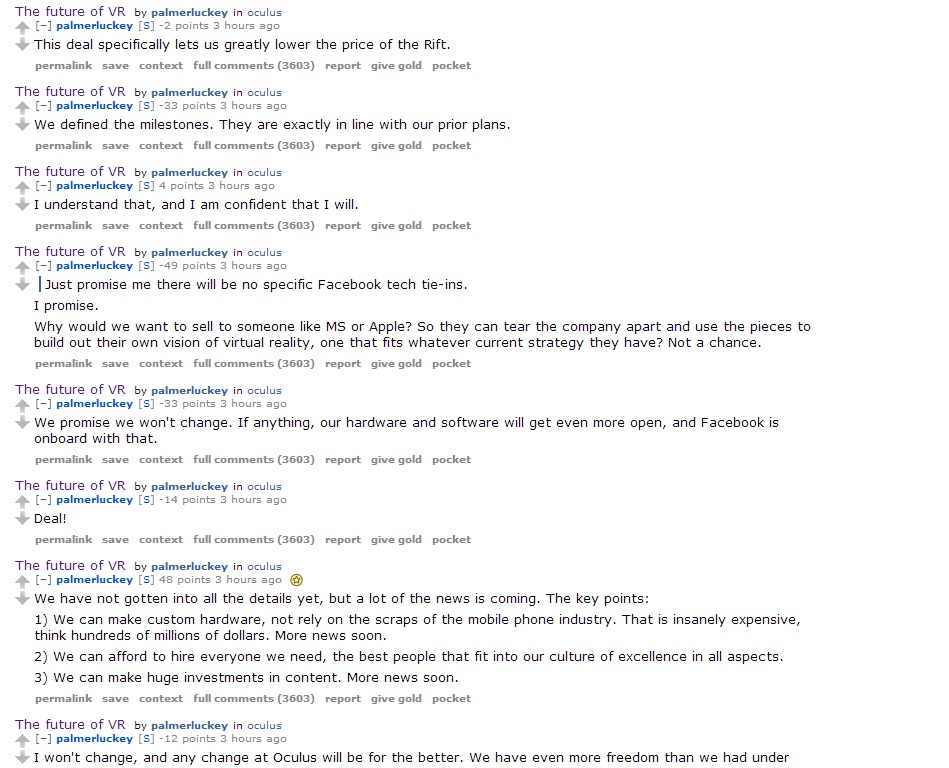
What you are saying to us is that the only reason you think nothing will change is that you really, really believe the IBM people. (Just like Palmer Luckey:https://thenextweb.com/wp-content/blogs.dir/1/files/2014/03/...) But that's even less than what other companies have been able to offer skeptics. But we know
"Seventy percent of U.S. acquisitions in the United States negatively impact the acquiring company’s results, sometimes immediately, and often continuing many years after purchase. Approximately 40 percent of the acquisitions of the last 10 years brought devastating business results. In about 80 percent of such cases, product or service, market share, and cultural impact are far below the goals anticipated in the beginning." https://media.terry.uga.edu/socrates/publications/2011/07/bi...
YOU might be convinced, but you haven't given anyone a reason to believe it.